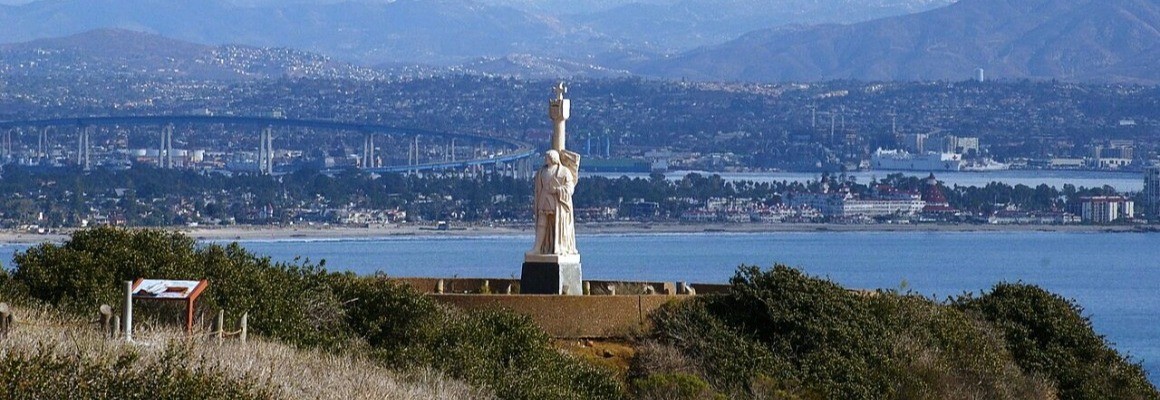

The Coronado Bridge crosses San Diego Bay, it was built to connect the mainland with Coronado Island. On the map of California, it is designated as Highway 75, and it is distinguished from other bridges by its characteristic curved shape and girder supports.
Background
Businessman John D. Spreckels recommended building a bridge between San Diego and Coronado in 1926, but the proposal was rejected. The answer was based on the fact that it was too risky to build a complex and at the same time expensive structure: the bridge could collapse as a result of an earthquake, and then all the efforts invested in the construction would be in vain.
This issue was raised again, as the construction of the bridge became necessary. But in 1935, an officer at the Naval Air Station on North Island said that if the bridge appeared, the Navy would have to leave San Diego. Construction has been postponed. In the 1950s, the City Council of Coronado took the initiative to develop a feasibility study necessary to start construction work on the structure. This led to the fact that by 1964, the Navy supported the idea of launching the Coronado Bridge, but on the condition that there would be a free space of at least 61 meters under it, necessary for the movement of ships.
History of creation
To fulfill the fleet's condition, it was decided to increase the length of the Coronado Bridge by laying a curved trajectory instead of a direct path to the island. Robert Mosher, a student of Frank Lloyd Wright, the creator of organic architecture, was appointed chief architect. He did a lot of work to take into account all the nuances and ensure the safety of the facility. On his initiative, a box bridge with a girder made of concrete and steel, supported by beams and supported by towers, was taken as a basis.
Later it turned out that not only the navy was against the opening of the bridge, the townspeople did not like it either. As a result, the decision on construction was made by the state of California, and work began in 1967. The project required more than 10,000 tons of structural steel and another 7,000 tons of reinforcing steel, as well as more than 90,000 cubic yards of concrete. The Coronado Bridge's opening ceremony for automobile traffic took place in 1969.
Short description
Despite all the difficulties associated with the launch of the facility, it is still functioning. In addition, it was recognized as a monument of engineering art, which attracts the attention of travelers from different countries. The Coronado Bridge looks spectacular, and it is clearly visible from afar. The length exceeds 3 kilometers, and the height in the central part is 61 meters. There are 5 lanes on it: 2 heading east, 2 heading west, and 1 reversing median lane.
The externally functional landmark is an arch with a curved profile. The design was approved not because of aesthetic appeal, but primarily for the sake of allowing large ships to pass under the space beneath it. The columns supporting the bridge on the east side are decorated with frescoes. In 2002, tolls on it were officially discontinued. There are signs with the phone numbers of the support service hotline for those who are thinking about committing suicide by jumping into the water.
How to get
The Coronado Bridge belongs to the CA-75 freeway, and it can be accessed from both Coronado and San Diego. It offers views of downtown San Diego and naval installations, and on a clear day you can see the hills of Mexico. Every year, the bridge hosts a non-competitive Bike the Bay event, in which athletes travel around the bay.
Gallery