Rio turned out to be completely different from how I imagined it from the photos.
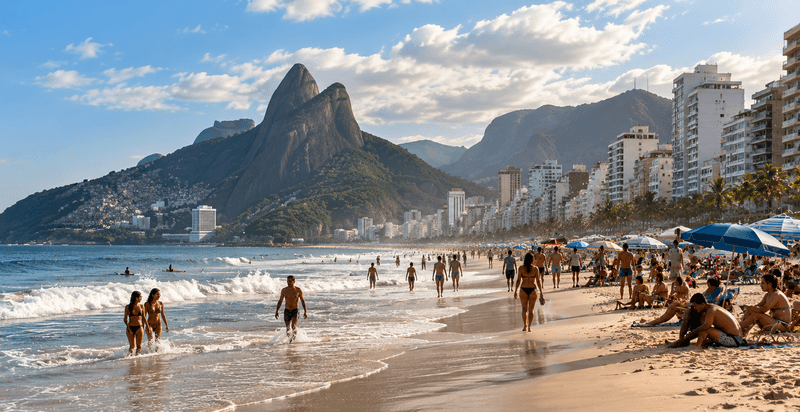
Before my trip to Rio de Janeiro, I thought I already knew this city. I've seen pictures of Christ the Redeemer, Sugar Loaf, Copacabana, and Ipanema so many times that I've had a ready-made picture in my head for a long time. Mountains, ocean, beach, palm trees and eternal sunshine. But when I first went outside in Rio, I realized that the photos only show a very small part of this city. Rio turned out to be much more lively than I expected. The first thing that surprised me was how close the completely different worlds are here. You can walk along an ordinary city street, cars are rustling around, people are rushing about their business, and after a few minutes the ocean and huge green mountains suddenly open in front of you. I started just walking around without a specific route. First I went to the Copacabana. In the photos, the beach looks almost like a decoration, but in reality it lives its own life. Someone is playing volleyball, someone is running along the water, someone is sitting at a kiosk, and someone is just looking at the ocean. It doesn't feel like you're at one of Brazil's most famous tourist attractions. Later, I ended up in Ipanema. The atmosphere seemed even calmer there. People were sitting on the sand, talking, playing sports and waiting for the sunset. At some point, I stopped taking pictures and just sat down to watch what was happening. I thought Rio was just beaches and postcards. Of course, I couldn't leave without going up to Christ the Redeemer. I've seen him in photographs hundreds of times. But it wasn't even the monument itself that made the strongest impression, but the road up and the moment when the whole city opens up before your eyes. From the height, Rio looks completely different. Green mountains rise between the districts, the ocean is visible behind them, and dense urban buildings literally encircle the natural landscape. It becomes clear why the city cannot be perceived only as an ordinary metropolis. Then there was the Sugar Loaf. I was expecting a beautiful panorama, but I didn't expect how strange it would feel to be surrounded by mountains, water, beaches, islands, and a huge city at the same time. It seems as if several different places have somehow been brought together at one point. The most interesting thing started when I stopped looking for sights. On the third day, I decided not to plan anything at all. I just left the hotel and went where I wanted to go. That's when I liked Rio the most. I saw small cafes, old houses, street musicians, people who met after work, and ordinary city streets that you would never see on a tourist postcard. Music was playing somewhere, vendors were arguing somewhere, someone was sitting on the steps with coffee. The city seemed not to be a decoration for travelers, but a place where people really live. It was then that I realized why Rio is so difficult to convey with photographs. It cannot be reduced to Christ, the Copacabana, or the beautiful view from the mountain. The main thing here is the combination of nature, the city and a special rhythm of life. Now I understand why Rio is memorable. Before the trip, I imagined Rio as the perfect tropical city from a postcard. In reality, it turned out to be noisier, more complex, sometimes more chaotic and much more interesting. Here you can look at the ocean in the morning, find yourself in the middle of a huge city in the afternoon, listen to music on the street in the evening, and in a few minutes you can see the green mountains right between the houses again. It is this combination that remains in my memory. That's probably why I didn't want to make a list of the best places after Rio. I just wanted to go back and walk around the city for several hours without a route. Because the real Rio turned out to be completely different from how I imagined it from the photographs.