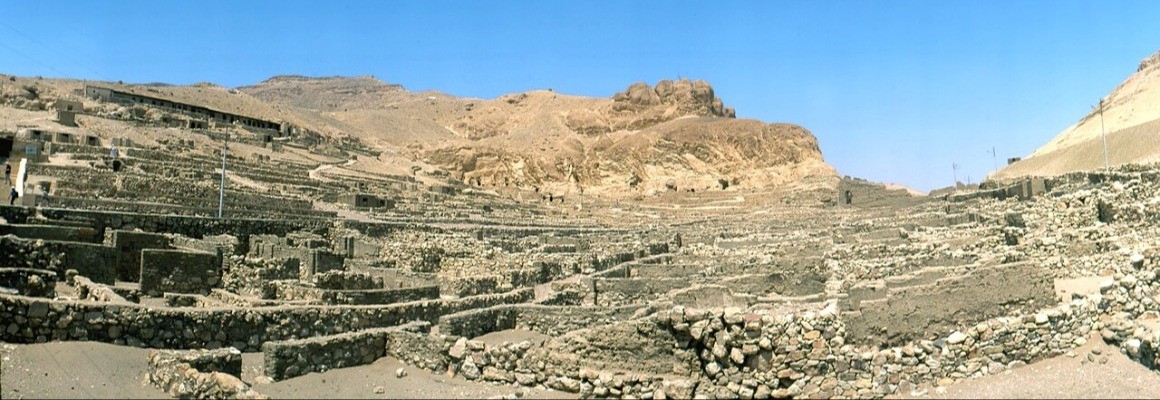
The Valley of the Queens is an ancient necropolis on the west bank of the Nile near Luxor, where the wives of pharaohs, princes, princesses and other members of the royal family were buried. The site contains dozens of rock-cut tombs decorated with religious scenes and wall paintings. Its most famous monument is the tomb of Queen Nefertari, the wife of Ramesses II, regarded as one of the finest examples of ancient Egyptian funerary art.
History of the necropolis
In antiquity, the area was known as Ta-Set-Neferu. Scholars interpret the name in different ways, including “Place of Beauty” and “Place of the Royal Children.” Burials began here during the Eighteenth Dynasty, around the sixteenth or fifteenth century BCE, but the necropolis was used most intensively during the Nineteenth and Twentieth Dynasties of the New Kingdom.
While pharaohs were generally buried in the Valley of the Kings, separate tombs were prepared for royal wives and children. The chambers were cut into limestone hillsides and decorated with mythological scenes, images of deities and texts intended to guide the dead through the afterlife. The desert setting on the west bank reflected Egyptian beliefs associating the western horizon with death and rebirth.
The tomb of Queen Nefertari
The valley’s best-known monument is tomb QV66, belonging to Nefertari, the Great Royal Wife of Ramesses II. It was discovered in 1904 by an archaeological expedition led by Italian Egyptologist Ernesto Schiaparelli. The tomb has a complex layout of stairways, corridors and a burial chamber whose walls are covered with colourful paintings.
The scenes show Nefertari before the gods and performing rituals associated with her journey into the afterlife. Their imagery draws on ancient Egyptian religious texts, including themes from the Book of the Dead. Isis, Osiris, Anubis and other deities appear in the queen’s symbolic passage toward eternal life. The paintings are admired for their fine lines, balanced colours and remarkably preserved details.
Nefertari was one of the most prominent wives of Ramesses II. Her name and images appear on monuments from his reign, including the temples at Abu Simbel. The exceptional decoration of her tomb reflects her high status and the importance attached to preparation for the afterlife.
Other tombs
Beyond Nefertari’s burial place, the valley contains tombs of royal children and other members of the Ramesside dynasty. One notable monument is QV55, the tomb of Prince Amun-her-khepeshef, a son of Ramesses III. Its paintings and funerary imagery reveal religious ideas of the New Kingdom. Other tombs preserve representations of gods, ritual processions and scenes connected with the deceased’s passage into eternity.
The tombs vary in their state of preservation. Some were damaged by ancient robbers, moisture and salts, while others are known through fragments of wall paintings and architectural remains. Archaeological research helps identify the tomb owners, reconstruct the history of the necropolis and trace changes in burial customs.
The religious meaning of the paintings
Ancient Egyptians viewed a tomb as more than a burial place: it was a setting for the transition into another world. Images and sacred texts were intended to help the deceased overcome dangers, receive divine protection and attain eternal life. The paintings of the Valley of the Queens therefore have both artistic and religious significance.
Scenes associated with the judgment of Osiris, the solar cycle and the soul’s journey are especially important. Colours, gestures, symbols and the arrangement of figures followed established conventions. These details provide valuable insight into the beliefs, rituals and artistic traditions of the New Kingdom.
UNESCO World Heritage
The Valley of the Queens forms part of the wider archaeological landscape of ancient Thebes, which also includes the Valley of the Kings, the Temple of Hatshepsut, the Ramesseum and other monuments on the west bank of the Nile. In 1979, the area was inscribed on the UNESCO World Heritage List as part of “Ancient Thebes with its Necropolis.”
Preserving the tombs requires careful management. Temperature changes, humidity, salts and carbon dioxide from visitors’ breathing can gradually damage ancient paintings. Access to certain chambers may therefore be restricted or controlled, while conservation specialists monitor the condition of the walls.
Visiting the Valley of the Queens
The necropolis lies on the west bank of the Nile near Luxor. It is often included in trips to the Valley of the Kings, the Temple of Hatshepsut and other archaeological sites on the west bank. Before visiting, check which tombs are open, as access can change because of conservation work.
Nefertari’s tomb is especially famous for its vivid paintings, but its visiting arrangements and admission cost may differ from the standard necropolis ticket. Visitors should follow conservation rules, avoid touching the walls and refrain from using flash photography where prohibited. The Valley of the Queens offers an important perspective on royal burial customs, the role of royal women and the religious culture of pharaonic Egypt.
Gallery