Peterhof is a palace and park ensemble on the southern shore of the Gulf of Finland, about 30 kilometres west of central Saint Petersburg. Often called the Russian Versailles, it is famous for its imperial palaces, formal gardens, cascades and elaborate fountains. Peterhof also has a distinctive hydraulic system that allows many historic fountains to operate through gravity rather than individual modern pumps.
History of Peterhof
The first documented reference to Peterhof dates to 1705. Its name derives from a Dutch expression meaning “Peter's court.” Peter the Great conceived the residence as a ceremonial imperial retreat on the Baltic coast after Russia gained access to the sea during the Great Northern War. Construction began in 1714, and the emperor personally contributed drawings and planning ideas. Architects involved in the early development included Johann Friedrich Braunstein, Jean-Baptiste Le Blond and Niccolò Michetti. Francesco Bartolomeo Rastrelli later transformed the palace into a major example of Russian Baroque architecture.
The ceremonial opening took place on 15 August 1723. By then, the Lower Park had been laid out, the Sea Canal had been excavated, and parts of the fountain system and the Monplaisir and Marly palaces were in place. Later rulers continued to expand and remodel the ensemble.
The Grand Peterhof Palace
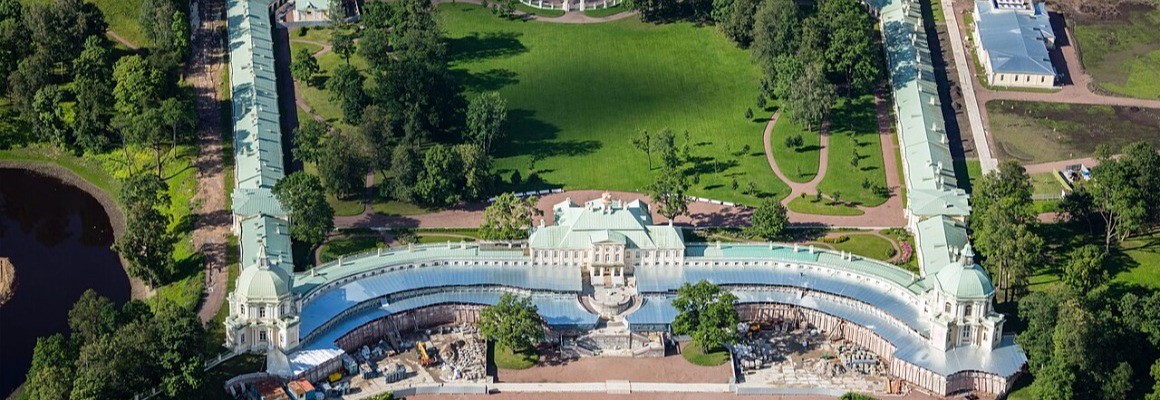
The Grand Palace is the architectural centrepiece of Peterhof. Its façade stretches for almost 300 metres above the Lower Park, linking the Upper Garden with the cascades, avenues and fountains. The original building was a modest two-storey residence known as the Upper Chambers. In the mid-18th century, Empress Elizabeth commissioned a major reconstruction by Rastrelli, who gave the palace its monumental Baroque appearance.
The palace contains ceremonial halls, galleries and reception rooms decorated with gilded carving, mirrors, stucco, painted ceilings and patterned parquet floors. The Dance Hall, Chesme Hall and Throne Hall are among its best-known interiors. Their changing decorative styles reflect the tastes of successive rulers, from the exuberance of Baroque design to more restrained classical forms.
The Grand Cascade and Samson Fountain
The Grand Cascade descends from the southern façade of the palace towards the Sea Canal. Its composition combines stepped waterways, gilded sculptures, marble figures and ornamental basins. At its centre stands the Samson Fountain, depicting the biblical hero forcing open a lion's jaws. The scene is traditionally interpreted as a symbol of Russia's victory in the Great Northern War.
The original sculpture was lost during the Second World War. A replacement was recreated using historical photographs and archival evidence and unveiled in 1947. The Sea Canal extends from the cascade towards the Gulf of Finland, creating a long visual axis that connects the palace, water and seascape.
Fountains and the Lower Park
The Lower Park covers approximately 102.5 hectares and follows the principles of a formal French garden, with straight avenues, symmetry and carefully designed perspectives. Its historic hydraulic network uses differences in elevation and water channels to supply many fountains by gravity. Visitors can see the Roman Fountains, Pyramid Fountain, Golden Hill Cascade, Adam and Eve fountains, bowl fountains and playful trick fountains designed to surprise unsuspecting courtiers with jets of water.
The park is divided into central, Marly and Monplaisir sections, each containing its own avenues, sculptures and architectural features. The Hermitage Pavilion was designed for intimate court gatherings and private meals, reflecting a European tradition of small secluded garden buildings.
The Upper Garden, Monplaisir and Marly
The Upper Garden covers about 15 hectares in front of the Grand Palace. In Peter the Great's time it served both decorative and practical purposes: vegetables, fruit, herbs and medicinal plants were grown there, while its ponds supplied water for the fountains below.
Monplaisir, meaning “my pleasure” in French, was closely associated with Peter the Great. Situated near the Gulf of Finland, it is smaller and more intimate than the Grand Palace. Marly Palace, in the western part of the Lower Park, was inspired by small country residences of European monarchs. Both buildings help explain the personal and ceremonial dimensions of imperial life.
Destruction and restoration
After the 1917 Revolution, Peterhof became a state museum complex. The first public excursion through the Grand Palace took place in 1918. During the Second World War, occupation and fighting devastated the palaces, sculptures and gardens. Restoration began after the area was liberated in 1944. The reconstructed Samson Fountain was unveiled in 1947, and the Grand Palace building had been restored by 1958. The work relied on archival documents, photographs and surviving decorative fragments.
UNESCO World Heritage
In 1990, Peterhof was included in the UNESCO World Heritage property “Historic Centre of Saint Petersburg and Related Groups of Monuments.” Its significance lies in its imperial architecture, historic landscape planning, sculpture, gardens and the remarkable integration of water engineering with artistic design.
How to get there
Peterhof lies in the Petrodvorets district of Saint Petersburg. Visitors can take a suburban train from Baltiysky railway station to Novy Peterhof and continue by bus or on foot. Buses and minibuses also connect the area with metro stations. During the navigation season, high-speed hydrofoils known as Meteors travel from central Saint Petersburg to the Lower Park pier; services depend on weather and seasonal schedules.
Allow a full day to explore the main sights. The most popular period is the fountain season, generally from spring through early autumn. In winter, fountains are switched off and some parks or museum buildings may operate on different schedules. Check the official museum website for current opening hours, tickets and fountain dates before travelling.
Peterhof is more than a collection of palaces and fountains. It is a unified historical landscape shaped by imperial ambition, European artistic influences, ingenious engineering and the extensive restoration of cultural heritage after wartime destruction.
Gallery