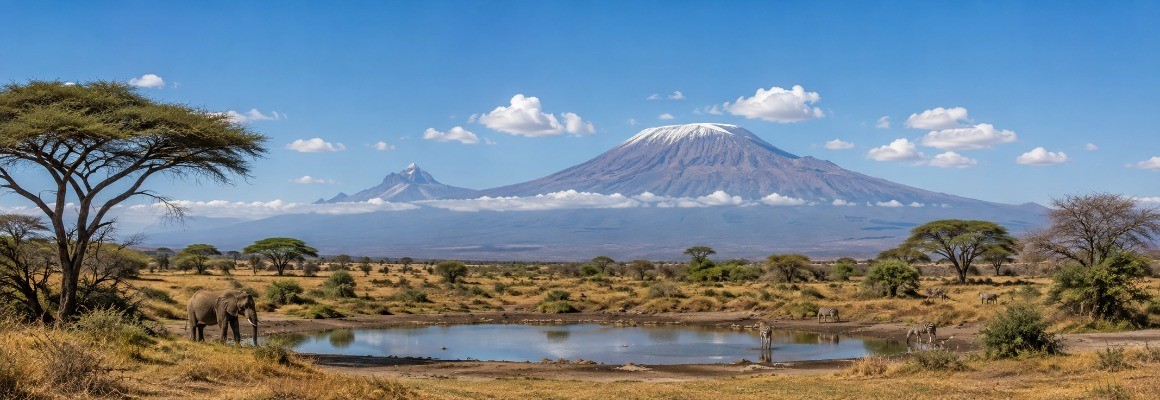
Kilimanjaro National Park lies in northeastern Tanzania, near the border with Kenya. Its main attraction is Mount Kilimanjaro, the highest peak in Africa, rising to 5,895 metres above sea level. The volcanic massif towers above the surrounding plains and savannas, while its snow-capped summit creates one of the continent’s most recognisable natural landscapes.
The national park was established in 1973, opened to tourists in 1977, and inscribed on the UNESCO World Heritage List in 1987. Following a boundary expansion in 2005, the park covered approximately 1,712 km². It protects mountain slopes, high-altitude ecosystems, and natural forests that provide habitats for many species of plants and animals.
Mount Kilimanjaro and its volcanic peaks
Kilimanjaro is a vast volcanic massif consisting of three principal peaks: Kibo, Mawenzi, and Shira. Kibo reaches 5,895 metres and includes Uhuru Peak, the highest point in Africa. Mawenzi rises to 5,149 metres and is characterised by sharp rocky ridges, while Shira, at about 3,962 metres, represents the remains of an ancient volcanic massif.
The mountain is considered the world’s highest free-standing volcanic massif. It rises dramatically above the surrounding plains and can be seen from far away. Snow and glaciers near the summit contrast strikingly with the warm African landscapes at the foothills. However, the glaciers are gradually shrinking, and climate change poses a serious threat to the high-altitude environment.
Five natural zones
One of Kilimanjaro’s defining features is the succession of natural zones encountered during the ascent. The lower slopes contain farmland and plantations where coffee and bananas are grown. Higher up, a belt of humid montane forest appears, with dense vegetation, ferns, mosses, and climbing plants.
Above the forest lie heathlands and high-altitude moorlands. Giant groundsels and lobelias give this landscape an unusual appearance. Higher still is an alpine desert of rocky slopes, sharp temperature changes, and sparse vegetation. Near the summit, glaciers and volcanic rock dominate an environment where living conditions are particularly harsh.
This succession of ecological zones allows climbers to pass through landscapes resembling several different climatic regions of Earth during a single ascent. Temperatures fall significantly with altitude, and oxygen becomes less available, so even physically fit travellers must consider elevation and acclimatisation.
Wildlife in the national park
Kilimanjaro’s montane forests provide refuge for a variety of mammals. Among the best-known residents are black-and-white colobus monkeys and blue monkeys. Bushbuck, duikers, and buffaloes may be encountered in forest clearings and along the edges of the woodland. More elusive predators, including leopards and spotted hyenas, also occur in the park, although sightings are uncommon.
The park is home to many bird species as well. The forest belt supports montane birds, sunbirds, and other species associated with humid woodland. Above the treeline, the animal community changes as wildlife must cope with cold, strong winds, intense sunlight, and limited food. Observing nature requires patience and a respectful distance because the park’s primary purpose is ecosystem protection.
Climbing to Uhuru Peak
One of the park’s most memorable experiences is climbing Mount Kilimanjaro. Most trekkers aim for Uhuru Peak on Kibo, the mountain’s highest point. The ascent usually takes five to eight days, depending on the route and itinerary. Longer itineraries allow more time to adapt to the altitude and may improve the likelihood of reaching the summit successfully.
Several principal routes are available, including Marangu, Machame, Lemosho, Shira, Rongai, and Umbwe. They differ in length, difficulty, scenery, and accommodation. Some routes use mountain huts, while others involve overnight stays in tents. The choice should reflect physical fitness, experience, available time, and advice from the climb organiser.
Standard Kilimanjaro routes do not normally require technical mountaineering equipment, but the altitude makes the ascent a serious challenge. Altitude sickness can affect even well-trained people. Climbers should progress gradually, follow their guides’ advice, monitor their condition, and be prepared to stop ascending if dangerous symptoms appear.
The Shira Plateau and Mawenzi Peak
The Shira Plateau is a broad high-altitude area formed from an ancient volcanic massif. It offers panoramic views of Kibo, surrounding valleys, and unusual alpine landscapes. As the elevation increases, vegetation becomes lower and more scattered, while the rocky terrain emphasises the harsh character of the environment.
Mawenzi is distinguished by jagged rock formations and steep ridges. Unlike the more accessible route to Uhuru Peak, a technical climb of Mawenzi requires specialised experience and mountaineering skills. Even without climbing to its summit, the massif is striking and forms an important part of Kilimanjaro’s volcanic landscape.
Things to do in the park
The main activity for visitors is multi-day trekking on the slopes of Kilimanjaro. However, the park offers other ways to explore its natural environment. Visitors can take a day trip to the Shira Plateau, walk forest trails with a guide, watch birds, or visit designated viewpoints.
Mountain biking is permitted in selected areas, including routes on the Shira Plateau and the Kilema route. The available activities depend on current regulations and trail conditions. Visitors should check permits, guide requirements, and access restrictions for their chosen area in advance.
Best time to visit Kilimanjaro
Climbers often choose the relatively dry periods from January to March and from June to October. Extended rainfall is generally less likely during these months, although mountain weather can change quickly in any season. June, July, August, and September are popular with trekkers, so some routes may be busier.
The main rainy season usually runs from March to May, with a shorter rainy period around November and December. Trails may be wet and slippery, while cloud cover can limit visibility. Temperatures at high elevations can fall below freezing even during comparatively warm months, so suitable clothing for cold, wind, and precipitation is essential.
How to get to Kilimanjaro National Park
The nearest major air gateway is Kilimanjaro International Airport, about 40 kilometres from the park. Many travellers stay in Moshi or Arusha and arrange transfers to the entrance gate for their chosen route. Climbs are usually booked in advance through licensed operators because access to mountain routes is regulated by the park administration.
Before travelling, check current entry rules, fees, requirements for guides and porters, and accommodation arrangements. A climb requires suitable footwear, warm clothing, sun protection, enough drinking water, and a carefully planned acclimatisation schedule.
Kilimanjaro National Park is one of Africa’s most remarkable natural destinations. Its volcanic peaks, cloud forests, alpine deserts, and glaciated areas create an extraordinary range of landscapes. For some visitors, it is an opportunity to explore unique ecosystems; for others, it is a personal challenge to trek to the highest point of the continent.
Gallery