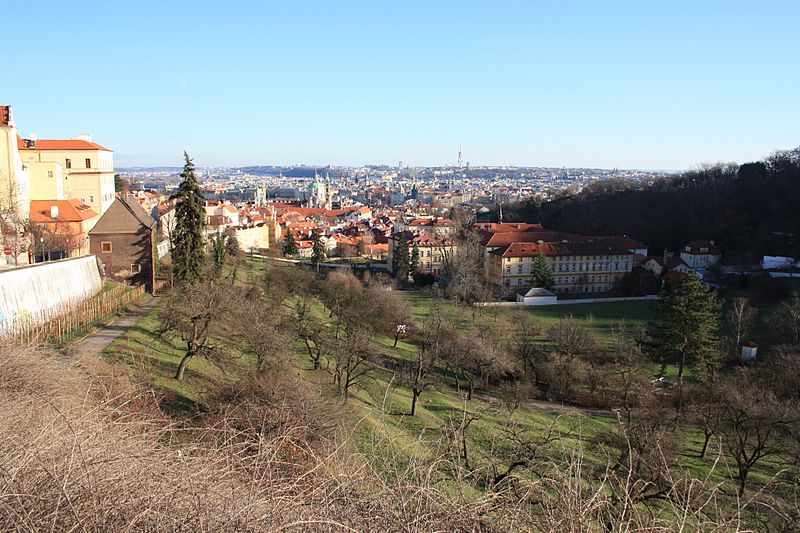
Strahov Monastery is one of the oldest and most important monastic complexes in the Czech Republic. It stands in Prague’s historic Hradčany district and was founded in 1143. For almost nine centuries, it has been an important centre of religious life, education, book culture, and art. Today, visitors come for its historic architecture, art collections, remarkable library, and panoramic views of the Czech capital.
Foundation and early history
The monastery’s story began with Jindřich Zdík, Bishop of Olomouc, who conceived the idea of establishing a community of regular canons in Prague after a pilgrimage to the Holy Land. The project received support from the bishops of Prague and the Bohemian ruler Vladislav II. In 1143, Premonstratensian canons from Steinfeld in the Rhineland settled on Strahov Hill. Their order, founded by Norbert of Xanten, combined monastic spirituality with pastoral work and education.
The earliest monastic buildings were made of wood, but construction of a stone complex and a Romanesque basilica soon followed. By the end of the 12th century, Strahov had become a significant religious centre. A fire damaged the buildings in 1258, after which the monastery was rebuilt. In 1420, during the Hussite Wars, the complex was plundered, and the monastic community entered a prolonged period of decline.
The monastery’s revival
A new chapter began in the late 16th century, when Abbot Jan Lohelius undertook the restoration of the monastery. He arranged repairs to the church and residential buildings, revived the monastery’s economic life, and strengthened its spiritual and educational activities. His successors continued to develop the complex and expand its collections.
In 1627, the remains of Saint Norbert, founder of the Premonstratensian order, were transferred to Strahov. This event reinforced the monastery’s religious importance and its standing among communities of the order. However, in 1648, near the end of the Thirty Years’ War, Swedish troops seized a substantial part of the library’s holdings. The monks subsequently worked to rebuild the collection and restore the monastery’s rooms.
Strahov Library
The monastery’s principal attraction is the renowned Strahov Library, celebrated for its historic halls, old books, and elaborate decoration. Its collections developed over many centuries. Today, they include printed books, manuscripts, incunabula–books produced during the earliest period of printing–as well as maps, globes, and other historical objects.
The Theological Hall was established in the 1670s under Abbot Jerome Hirnhaim. Its Baroque interior features wooden bookcases, decorative stucco, and ceiling paintings that create a richly ceremonial atmosphere. The hall was primarily used to house theological works, Bibles, and books essential to the monastery’s religious and scholarly activities.
The Philosophical Hall was created at the end of the 18th century, when the existing rooms could no longer accommodate the growing collection. Its construction was commissioned under Abbot Václav Mayer, and the work was completed in the 1790s. The lofty hall is crowned by a monumental ceiling painting by Austrian artist Franz Anton Maulbertsch, depicting the intellectual development of humanity. Its imposing bookcases, high vaults, and painted ceiling make it one of Prague’s most impressive historic interiors.
Rare books and the Cabinet of Curiosities
The library preserves not only theological and philosophical literature but also works on history, geography, medicine, natural sciences, and art. Medieval manuscripts and early printed books are especially valuable. One of the collection’s best-known treasures is the Strahov Gospel Book, an ancient manuscript containing the texts of all four Gospels.
Another fascinating part of the exhibition is the Cabinet of Curiosities, a predecessor of the modern natural history museum. It contains unusual natural specimens, scientific instruments, and objects that reflect the curiosity of European scholars and collectors in past centuries. Historical globes and other exhibits illustrate how geographical and scientific knowledge gradually expanded.
Architecture and monastic churches
Strahov Monastery’s architectural character developed over several historical periods. Romanesque, Gothic, Renaissance, and Baroque elements can all be found in its history, although the present ensemble largely reflects rebuilding campaigns of the 17th and 18th centuries. Architects associated with the Baroque complex include Giovanni Domenico Orsi, Jean Baptiste Mathey, Kilián Ignác Dientzenhofer, and Anselmo Lurago.
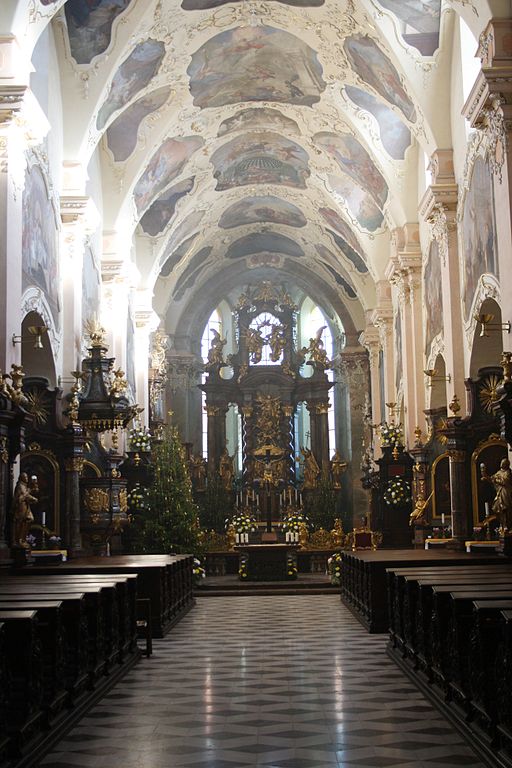
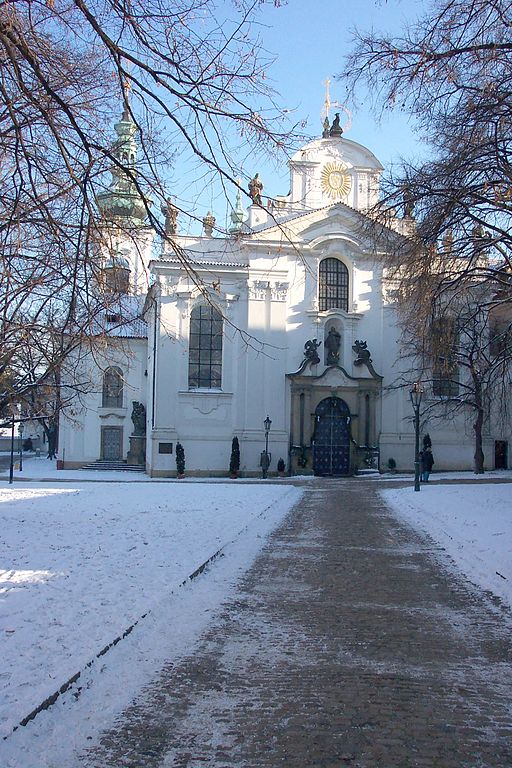
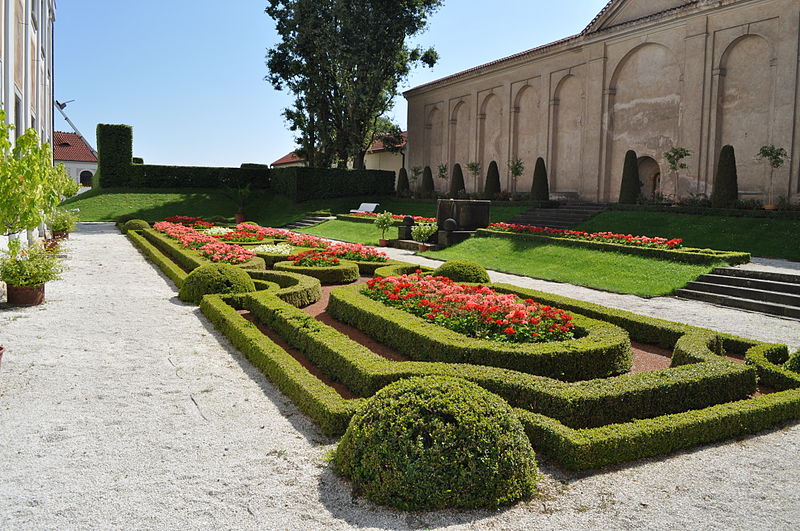
The Basilica of the Assumption of the Virgin Mary occupies a central place in the complex. Its interior contains religious artworks, and its history is closely connected with the life of the monastic community. The grounds also include the Church of Saint Roch, founded in the early 17th century. The courtyards, corridors, and historic buildings reveal how the religious complex developed and adapted to changing circumstances.
The monastery in the 20th century and today
In 1950, after the establishment of the communist regime in Czechoslovakia, the monastic community was forcibly dissolved and its property confiscated. The library and other collections came under state administration. Following the political changes of 1989, the monastery buildings and property began to be returned to the Premonstratensians, and extensive restoration work followed.
Today, Strahov Monastery remains an active religious community as well as an important cultural landmark. Visitors can explore historic interiors, library collections, and exhibitions. Access to the library halls themselves may be restricted to protect the ancient books, furniture, and frescoes, so it is advisable to check the current visiting arrangements in advance.
Why visit Strahov Monastery?
Strahov Monastery brings together the history of medieval Bohemia, architecture from several periods, and one of Europe’s best-known historic libraries. Visitors can admire magnificent ceiling paintings, old bookcases, rare manuscripts, and collections of scientific curiosities. Its elevated position near Prague Castle also makes it an excellent starting point for exploring Hradčany and discovering historic Prague.
Gallery