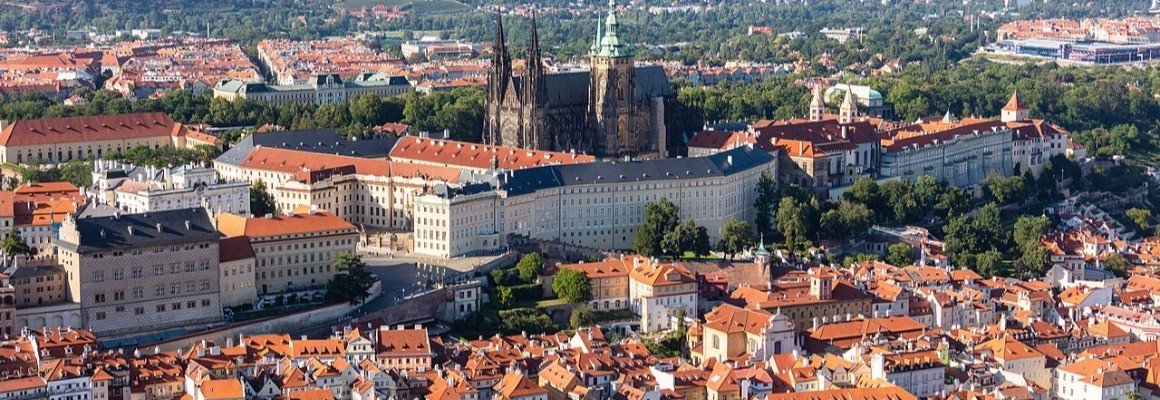
Charles Bridge is one of Prague’s best-known landmarks and a symbol of the Czech capital. It connects the historic districts of Old Town and Lesser Town across the Vltava River. Framed by medieval towers and decorated with dozens of sculptures, it offers beautiful views of Prague Castle, old church domes, and the city’s red-tiled rooftops. More than a river crossing, it is an essential part of Prague’s history and architectural identity.
The History of Its Construction
Construction of Charles Bridge began in 1357 on the orders of Charles IV, Holy Roman Emperor and King of Bohemia. It was intended to replace the older Judith Bridge, which had been badly damaged by a flood in 1342. The new crossing was built of stone to create a durable structure capable of carrying pedestrians, carts, and merchants.
The work continued for several decades. According to a popular tradition, the foundation stone was laid on 9 July 1357 at 5:31 a.m. The sequence 1, 3, 5, 7, 9, 7, 5, 3, 1 forms a symmetrical pattern and is associated with Charles IV’s interest in astrology and symbolic dates. Historians, however, treat the details of this tradition with caution.
At first, the structure was known as the Stone Bridge or Prague Bridge. The name Charles Bridge became established much later, in the nineteenth century, in honor of Charles IV, under whose rule construction began.
The Architecture of a Medieval Bridge
Charles Bridge is about 516 meters long and approximately 10 meters wide. It rests on 16 arched spans and is built from stone masonry. Over the centuries, floods, ice flows, and military events repeatedly damaged the bridge, leading to repairs and reinforcement. Despite many alterations and restorations, it has retained its medieval character.
Historic towers stand at both ends of the bridge. On the Old Town side rises the Old Town Bridge Tower, regarded as an outstanding example of Gothic architecture. Its façade features sculptures and symbolic images associated with Charles IV and the Bohemian crown. On the Lesser Town side stand two Lesser Town Bridge Towers, which differ in age and architectural style.
Sculptures and Legends
The bridge’s most distinctive feature is the gallery of sculptures lining its parapets. Today, visitors can see around 30 sculptural groups, most of them religious in subject. Many originals have been replaced by copies over time, while the authentic works are preserved in museums and other protected locations.
Most statues were added in the seventeenth and eighteenth centuries, when Baroque sculpture became an important part of Prague’s appearance. Well-known figures include Saint John of Nepomuk, Saint Ludmila with Saint Wenceslas, and a crucifix decorated with inscriptions. Each sculpture reflects religious beliefs, historical events, or local traditions.
One of the bridge’s best-known legends is connected with John of Nepomuk. According to the story, the priest was executed on the orders of King Wenceslas IV and thrown from the bridge into the Vltava. The historical circumstances of his death are more complex than the legend suggests, but over time he became a symbol of fidelity and a protector against dangers associated with water. Visitors often touch a relief on the base of his statue, following a local tradition while making a wish.
Charles Bridge and the History of Prague
In the Middle Ages, the bridge had enormous economic and strategic importance. It connected the royal center at Prague Castle with the trading districts of the Old Town. Merchants, craftspeople, travelers, and officials crossed it regularly. The bridge became a vital part of the urban route linking different parts of Prague and connecting routes across Central Europe.
Over the centuries, the bridge witnessed coronation processions, city celebrations, armed clashes, and natural disasters. In 1648, during the final phase of the Thirty Years’ War, fighting took place around the bridge and the Old Town between Swedish troops and Prague’s defenders. The bridge continued to play an important role in city life, although the development of transport gradually changed its function as the main river crossing.
Charles Bridge Today
Today, Charles Bridge is pedestrian-only and ranks among Prague’s most visited places. Street artists, musicians, photographers, and souvenir sellers can be found along it. The bridge offers panoramic views of the Vltava, Prague Castle, and the historic districts. It is especially atmospheric early in the morning, when there are fewer people and soft light emphasizes the texture of the stone and the outlines of the towers.
The bridge can become crowded during the day, especially in the tourist season. To appreciate the sculptures and architectural details in relative peace, visit at sunrise or later in the evening. A walk across the bridge can easily be combined with a visit to Old Town Square, Lesser Town, and Prague Castle. Walking across the bridge is free, although admission to some nearby towers and museums may require a ticket.
Why Charles Bridge Is Worth Visiting
Charles Bridge combines medieval engineering, Gothic architecture, Baroque art, and living urban traditions. Its stone arches and towers tell the story of Prague, while its sculptures preserve traces of earlier religious beliefs and legends. It is a place where a historic monument remains part of everyday city life.
For travelers, Charles Bridge offers a chance to see Prague from one of its most recognizable viewpoints and experience the atmosphere of an old European city. Beyond taking photographs, visitors can look closely at the sculptures, coats of arms, masonry, and views from both banks of the Vltava. Even a short walk across the bridge offers a connection with centuries of Czech history.
Gallery