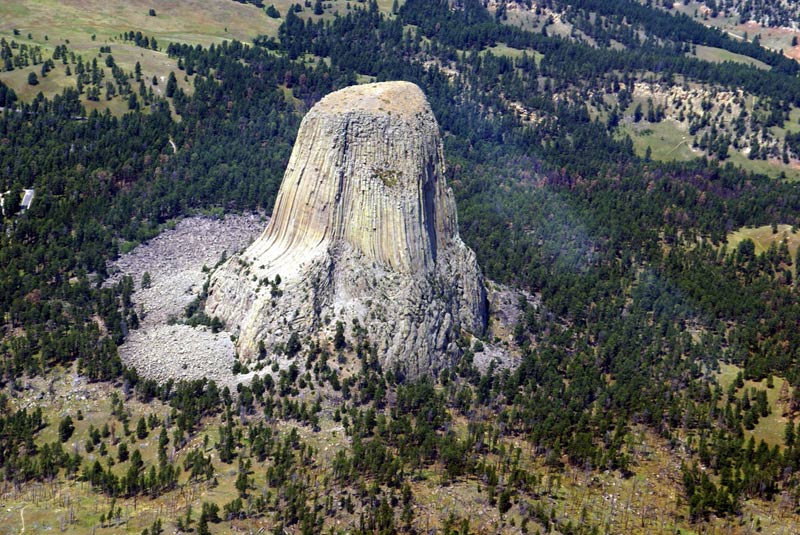
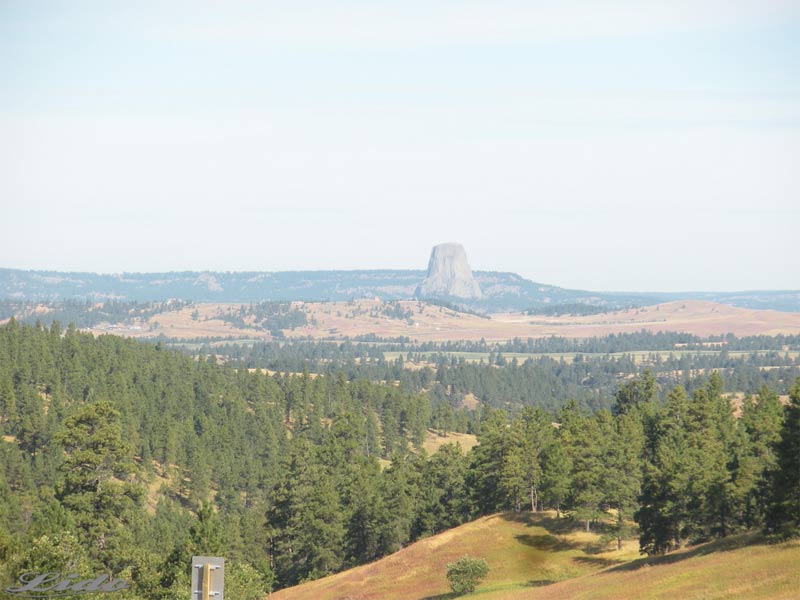
Devils Tower is a massive rock monolith in northeastern Wyoming, USA. Rising above the Belle Fourche River valley and surrounding forests, it stands out dramatically against the rolling plains. Its nearly vertical walls are covered with long, parallel grooves, making the formation look like an enormous stone tower. It is one of North America’s most unusual geological landmarks and attracts travellers, climbers, researchers and people fascinated by mysteries.
The formation rises about 264 metres above the surrounding terrain and reaches roughly 1,558 metres above sea level. In 1906, President Theodore Roosevelt proclaimed it the first United States national monument. For many Indigenous peoples of the Great Plains, it is also a sacred place associated with bears, spiritual traditions and stories about the origin of the landscape.
How the tower formed
Geologists agree that Devils Tower consists of igneous rock formed from molten material beneath Earth’s surface about 50 million years ago. Magma intruded into older sedimentary layers, cooled and hardened. Over time, softer surrounding rocks were worn away by weathering and erosion, exposing the more resistant mass.
The precise formation process remains debated. Hypotheses include an intrusive igneous body, a remnant of an ancient volcanic neck, a laccolith or sill, and a structure associated with maar-diatreme volcanism. The Tower is not an active volcano. Its rock is phonolite porphyry, which differs from the basalt found in many other columnar formations.
The mystery of the stone columns
Hundreds of nearly vertical columns divide the Tower’s surface, many with roughly hexagonal cross-sections. They formed as the igneous rock cooled and contracted, producing stress and cracks. A similar pattern can be seen in drying mud, although the Tower’s columns developed within a mass of cooling magma. Erosion later exposed the columns, while broken fragments accumulated around the base.
Where the name came from
The English name Devils Tower became associated with the formation after an 1875 expedition led by Colonel Richard Irving Dodge. He recorded a translation resembling “Bad God’s Tower” or “Devil’s Tower,” but the translation may have been inaccurate. Indigenous names include Bear Lodge, associated with the Lakota name Mato Tipila. In 1906, Devils Tower became the official name of the national monument.
Indigenous oral histories
Many oral histories are associated with the Tower. In one well-known story, children escape a giant bear when the ground rises miraculously beneath them. The bear claws at the rock while trying to climb it, leaving the long grooves visible today. In some versions, the children become stars or are associated with the Pleiades. These accounts are living spiritual traditions for many Indigenous communities, not merely folklore for entertainment.
Conspiracy theories: UFOs and aliens
The Tower’s unusual shape has inspired modern speculation that it is an alien structure, a beacon for spacecraft or a portal between dimensions. Supporters of such theories point to the regular columns and apparent symmetry. However, geology explains the columns through the natural cooling of igneous rock, and there is no reliable evidence that the Tower was built artificially. Claims about portals or a special energy field are also unverified.
Steven Spielberg’s 1977 science-fiction film Close Encounters of the Third Kind made the Tower famous worldwide by depicting it as a meeting place between humans and an extraterrestrial civilisation. Reports of UFOs near the formation should be considered critically: unusual lighting and atmospheric effects do not, by themselves, demonstrate extraterrestrial activity.
What remains genuinely uncertain
The real scientific puzzle is that geologists have not settled on one definitive model explaining the exact type of intrusive body and every stage of erosion that exposed it. The history of the Tower’s name and its cultural meaning are also complex. Scientific hypotheses, sacred oral histories and modern conspiracy claims should be distinguished rather than treated as equally supported explanations.
Wildlife and trails
The monument lies in a transition zone where prairie meets pine forest and rocky slopes. Ponderosa pines, junipers, grasses and shrubs grow around the Tower. Wildlife includes deer, prairie dogs, squirrels, rabbits and many bird species. The popular Tower Trail is a loop of about two kilometres around the base. The Tower is also famous among climbers for its cracks between the columns.
Getting there and when to visit
Devils Tower is in northeastern Wyoming and is most conveniently reached by car, including from Gillette or as part of a road trip through the Black Hills region. Public transport is limited, so check road conditions, opening hours and visitor rules on the official park website before travelling.
Late spring, summer and early autumn are good for walking. Summer can be hot, and thunderstorms may change conditions quickly. Snow and ice make winter travel more difficult. Early morning and late afternoon provide attractive light for photography, emphasising the Tower’s vertical grooves.
Visitor tips
One to two hours is usually enough for the main trail. Bring water, comfortable shoes and sun protection. Avoid areas where rocks may fall and follow warning signs. Devils Tower combines striking geology, cultural memory and modern mysteries; visitors should respect its sacred status and avoid presenting speculation as proven fact.
Gallery