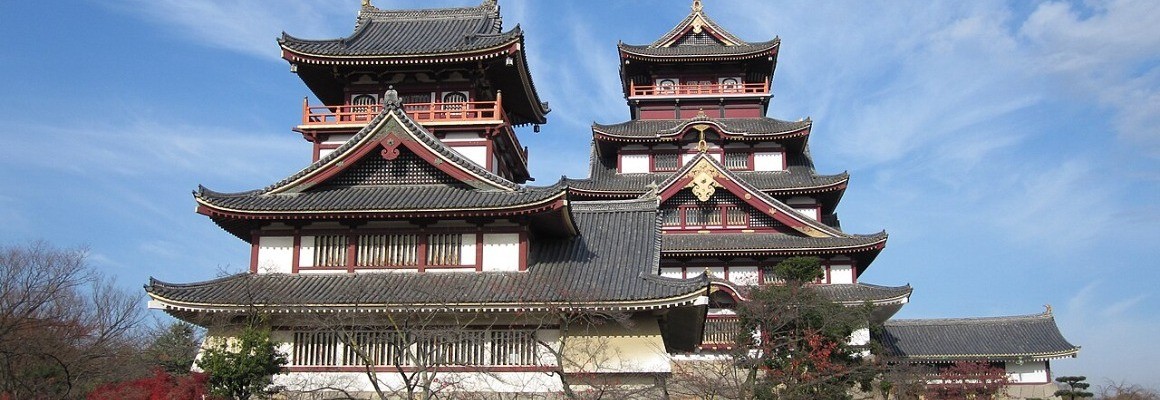
Osaka Castle is one of Japan’s most recognizable historical landmarks. Located in the heart of Osaka, it stands within a spacious park of mature trees, moats and massive stone walls. Gold-coloured ornaments, green roof tiles and the white walls of the main tower create the familiar image of a Japanese fortress. Behind this striking appearance lies a history of political rivalry, destruction and reconstruction.
The history of Osaka Castle
Construction began in 1583 under the orders of Toyotomi Hideyoshi, a military leader who played a major role in unifying Japan after a long period of civil conflict. He intended the castle to be both a grand residence and a powerful military centre. It was built on the site of the former Ishiyama Hongan-ji temple complex. After Hideyoshi’s death in 1598, his successors came into conflict with Tokugawa Ieyasu. During the winter and summer sieges of Osaka in 1614 and 1615, the fortress fell and the Toyotomi family’s rule came to an end.
In the 1620s, the Tokugawa government rebuilt the castle with enormous stone walls and an elaborate system of moats. The main tower was later destroyed again when lightning struck it in 1665. In 1868, a fire during the upheaval of the Meiji Restoration damaged and destroyed other parts of the complex.
The present main tower
The current tower was reconstructed in 1931 with donations from Osaka residents. Built from reinforced concrete, it was designed using historical images and traditional Japanese castle forms. It is therefore not an original surviving structure from the sixteenth century, but a modern reconstruction that preserves the castle’s historic appearance.
The interior houses a museum about the castle, Toyotomi Hideyoshi and the unification of Japan. Exhibits include historical documents, models, weapons, armour and displays about major conflicts. An observation deck on the upper floor offers panoramic views of modern Osaka.
In October 2026, Japan’s Council for Cultural Affairs recommended that the main tower be designated an Important Cultural Property. At the time of publication, this was a recommendation for official designation rather than a completed formal procedure.
Stone walls and fortifications
Some of the castle’s most impressive features are outside the tower. Huge granite blocks form tall walls above deep moats. Stones were brought from different parts of Japan, and their size and precise placement demonstrate the skill of seventeenth-century builders.
Historic gates, turrets and other defensive structures remain within the grounds. Notable examples include Otemon Gate and Sengan-yagura Turret. A gigantic stone near Sakuramon Gate is another highlight. The moats and fortifications were designed to slow approaching enemies and protect the castle’s inner precincts.
Osaka Castle Park
The castle is surrounded by a large urban park covering about 106 hectares. Walking paths, lawns, cherry trees and plum trees make it a popular place for residents to relax, exercise and picnic. In spring, the park becomes a major destination for cherry blossom viewing. Nishinomaru Garden is especially well known for its views of the main tower. Plum blossoms usually appear earlier than cherry blossoms, although flowering dates vary with the weather.
The park also contains Hokoku Shrine, cultural venues and event spaces. Visitors can spend several hours walking along the moats and viewing the fortress walls from different angles.
What to see inside and nearby
The main tower’s museum explains the castle’s history, while the upper observation deck provides a broad view of Osaka. Around the tower, visitors can explore gates, bridges, stone walls and other defensive features. Nearby, the Osaka Museum of History presents the city’s development from ancient times to the modern era, helping explain Osaka’s long-standing importance as a commercial and cultural centre.
How to get there
The park can be reached from JR Osakajokoen and Morinomiya stations, as well as Tanimachi 4-chome and Temmabashi subway stations. The grounds are extensive, so walking from a station to the main tower may take 15–20 minutes or longer, depending on the route.
Before visiting, check the official website for current museum opening hours, ticket prices and possible restrictions. Allow several hours to explore the tower, fortifications and park. The grounds can be particularly busy during cherry blossom season and public holidays. Osaka Castle is more than an architectural symbol: it reflects Japan’s transition from civil war to centralized rule and shows how historic heritage remains part of modern city life.
Gallery