Versailles is one of France’s most celebrated palace and garden ensembles. Located in the town of Versailles, about 20 kilometres southwest of central Paris, it is widely regarded as a masterpiece of European architecture and a powerful symbol of absolute monarchy. Its lavish rooms, gilded decoration, formal gardens, fountains and royal residences make it one of the best-known palace complexes in the world.
The history of Versailles began in the 17th century, when Louis XIII ordered a modest hunting lodge to be built in the area. The site was transformed on a grand scale under Louis XIV, the Sun King. Beginning in 1661, architects, painters, sculptors and landscape designers worked to create a residence that would express the authority and prestige of the French crown.
In 1682, Louis XIV moved the royal court and government to Versailles. The palace became the political centre of France, and court life was governed by elaborate ceremonies and strict etiquette. Louis XV and Louis XVI also lived here. Versailles hosted diplomatic receptions, official celebrations and elaborate court festivities, while its architecture and gardens influenced royal residences throughout Europe.
The French Revolution
Versailles played a major role in the French Revolution. In October 1789, a crowd from Paris marched to the palace amid food shortages and political unrest. The royal family was compelled to move to Paris, and Versailles lost its role as the principal royal residence. During the following years, some furnishings were dispersed and the purpose of many rooms changed.
In the 19th century, King Louis-Philippe transformed the palace into a museum dedicated to the history of France. It opened in 1837 and helped preserve Versailles as a major historical monument. In 1919, the Treaty of Versailles was signed in the Hall of Mirrors, making the palace a setting for another event of international importance.
The Palace and the Hall of Mirrors
The palace developed through several phases of construction and combines classical proportions, columns, sculpture and richly decorated interiors. Its design was not merely intended to provide a royal home. The scale of the buildings, the ceremonial courtyards and the carefully planned views were part of a political statement about the power of the monarch.
The Hall of Mirrors is the most famous room in Versailles. Designed by Jules Hardouin-Mansart and decorated under the direction of Charles Le Brun in the late 17th century, it connects the King’s and Queen’s State Apartments and overlooks the gardens. Mirrors stand opposite tall windows, while gilded details, marble, chandeliers and painted ceilings create an atmosphere of extraordinary splendour. The ceiling paintings celebrate the reign and achievements of Louis XIV.
The gallery was used for court ceremonies and receptions for foreign ambassadors. The signing of the Treaty of Versailles in 1919 gave the room a lasting place in modern history. Today, it remains one of the palace’s most visited spaces.
Royal Apartments and the Royal Chapel
The palace contains the State Apartments of the King and Queen, reception rooms, studies and rooms associated with the everyday life of the monarchy. Paintings, tapestries, carved ornament, gilding and decorative furniture illustrate the tastes and symbolism of the French court. Many rooms draw on classical mythology and allegorical representations of royal power.
The Royal Chapel is another architectural highlight. Completed in the early 18th century, it features a soaring interior, columns, sculpture and a richly painted ceiling. Religious services for the royal family and the court were held here, reflecting the close relationship between monarchy, religion and ceremony in Versailles.
The Gardens of Versailles
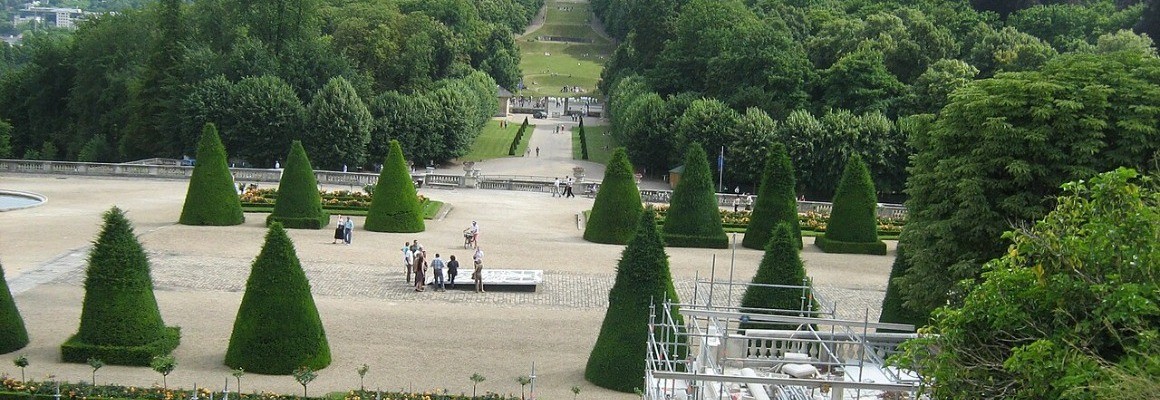
The gardens are as famous as the palace itself. Their transformation began under Louis XIV, with landscape architect André Le Nôtre directing the design. Symmetrical flower beds, clipped hedges, long avenues, sculptures, pools and fountains form a carefully ordered composition. The French formal garden expresses the idea that nature can be shaped according to human design.
The Fountain of Apollo depicts the sun god riding his chariot and reflects the solar symbolism associated with Louis XIV. Beyond it lies the Grand Canal, a long waterway once used for boating and court entertainment. The Orangerie was designed to protect citrus trees and other delicate plants during colder months. Seasonal musical garden events and fountain shows bring parts of the landscape to life, although schedules and access conditions vary.
The Grand Trianon
The Grand Trianon is a separate royal residence built in the late 17th century for Louis XIV. Its pink-marble facades, open galleries and relationship with the surrounding gardens create a more intimate atmosphere than the main palace. The residence offered the king and his close circle a retreat from the formal rituals of the court. It was also used by later French rulers and hosted important guests.
The Petit Trianon and Marie-Antoinette’s Estate
The Petit Trianon was built in the 18th century for Louis XV to a design by Ange-Jacques Gabriel. Its restrained architecture reflects the style of the period. Louis XVI later gave the residence to his wife, Marie-Antoinette, who developed the surrounding grounds as a more private place for leisure.
Her estate includes gardens, ornamental structures, paths, ponds and the Queen’s Hamlet, a group of rustic-looking buildings inspired by an idealised countryside. The setting contrasted with the rigid etiquette of the main court. Although it resembles a village, the hamlet was a deliberately designed royal retreat rather than an ordinary farming community. Today, it offers a quieter and more pastoral side of Versailles.
UNESCO World Heritage
The Palace and Park of Versailles were added to the UNESCO World Heritage List in 1979. The protected property includes the palace, the Trianon residences, their gardens and associated areas. UNESCO recognises the ensemble for its artistic achievement and its influence on royal architecture and landscape design across Europe.
Versailles is important not only for its beauty but also for the history it preserves: the development of the French state, the culture of the royal court, the French Revolution and international diplomacy. Its gardens and palace became a model for many European residences of the 17th and 18th centuries.
What to See
Visitors should make time for the Hall of Mirrors, the State Apartments, the Royal Chapel and the historic reception rooms. Outside, the gardens, Fountain of Apollo, Grand Canal and Orangerie are major highlights. If time allows, continue to the Grand Trianon, Petit Trianon and Queen’s Hamlet.
The estate is extensive, and exploring the palace, gardens and outlying residences in a few hours is difficult. A substantial part of a day is recommended for the main interiors and some of the gardens. Seeing the entire estate may require a full day or two separate visits.
How to Get There
Versailles lies in the Île-de-France region southwest of Paris and can be reached by suburban train. The town has several stations, including Versailles Château Rive Gauche, Versailles Rive Droite and Versailles Chantiers. Versailles Château Rive Gauche is generally convenient for visitors to the palace, which can be reached on foot from the station.
Allow extra time for the walk to the entrance and possible queues, especially during the busy tourist season. Booking palace admission in advance through the official website is recommended.
Visitor Information
The Palace and the Estate of Trianon are normally closed on Mondays, and opening hours vary by season. The gardens and park have separate access arrangements and may open earlier than the palace. Admission to the gardens may be charged on days when the Musical Gardens or Musical Fountains Shows take place. Check current opening times, ticket conditions and the availability of individual areas before travelling.
Comfortable shoes are essential because the distances between the palace, fountains, Grand Canal and Trianon are considerable. In warm weather, bring water and sun protection. Parts of the estate may be explored by tourist train, bicycle or electric vehicle, subject to current availability. Versailles offers an exceptional combination of architecture, art, landscape design and European history.
Gallery