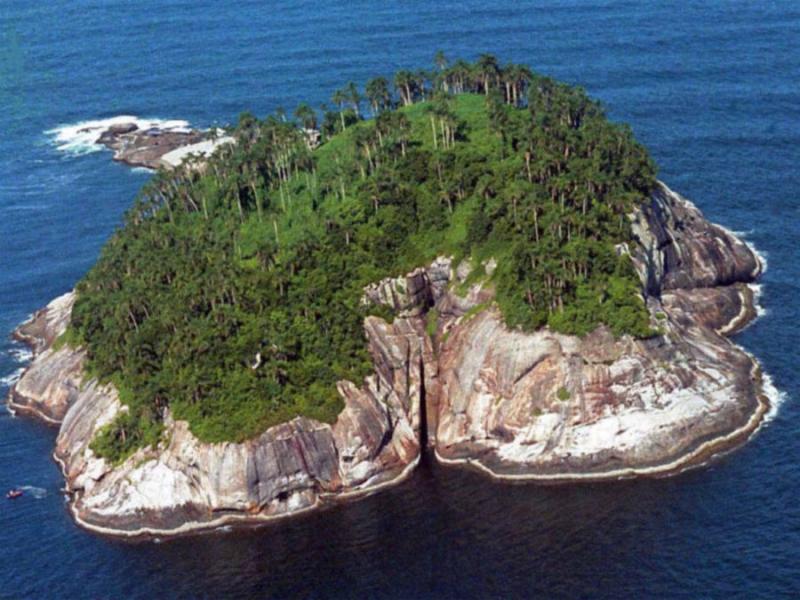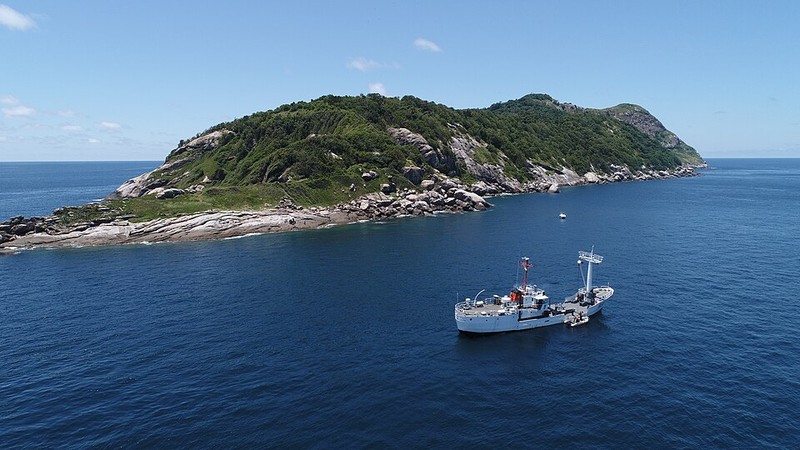

Queimada Grande Island (Ilha da Queimada Grande) is a small rocky island off the coast of the state of Sao Paulo in Brazil. It is known far beyond the borders of the country due to its unusual nature and endemic venomous snake - the island jararaka, or golden spear-headed snake (Bothrops insularis).
Due to the large number of snakes, Queimada Grande is often referred to as "Snake Island". Many stories have formed around the island about its dangers, disappeared people and attempts to survive in the dense forest. However, the real value of this place lies not only in the legends. Queimada Grande is an important conservation area, where a unique island ecosystem has been preserved.
Where is the island of Queimada Grande?
The island is located in the Atlantic Ocean about 35 kilometers from the coast of the city of Itanyaen, between the cities of Itanyaen and Peruibi in the state of Sao Paulo. The island has an area of about 43 hectares and is a rocky massif with steep slopes.
There are practically no flat areas and sandy beaches on the island. Its coastline consists mainly of rocks, so landing here is difficult in itself. The maximum height of the island reaches about 200 meters.
Keimada Grande is part of the specially protected natural area "Islands of Keimada Pequena and Keimada Grande", created to preserve the local ecosystem and rare animal species.
Why is the island called Snake Island?
The main feature of the Qeimada Grande is related to its inhabitants. The island zhararaka, a snake that is found in nature only on this island, lives here.
The scientific name of the species is Bothrops insularis. It is a close relative of the mainland zhararaks, however, due to prolonged isolation on the island, the snake has acquired its own characteristics. Its venom is considered very strong, and its diet and lifestyle differ from many related species.
The isolation of the island has played an important role in the formation of this unique population. When the sea level changed and the island was separated from the mainland, the animals that lived here continued to develop in a limited area.
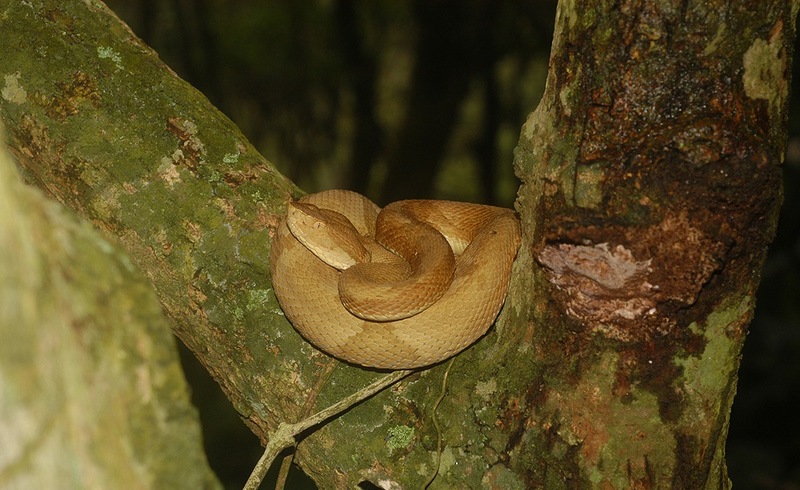
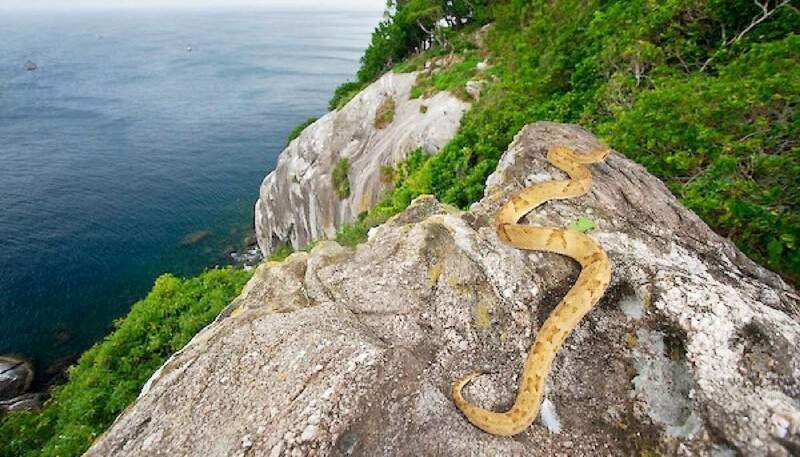
Golden Spearhead Snake of the Queimada Grande
The island jararaka is endemic to the Caymada Grande. This means that in the natural environment this species is found only here. The snake has a yellowish-brown color and belongs to the family of vipers. It is well adapted to life in the forest and can move through vegetation. Unlike many snakes that live mainly on land, the island snake often uses shrubs and trees.
The basis of her diet consists of birds and other small animals. The change in available prey on the island has also affected the behavior of this species.
Today, the island jararaka is considered a species in need of protection. It is included in the list of endangered protected species. Along with it, the nature protection area protects other rare species of animals, including the endemic non-venomous dormideira snake.
How many snakes live on the island
On the Internet, you can find a variety of estimates of the number of snakes on the Caymada Grande. Sometimes stories are published about tens of thousands of snakes and claims that there are several individuals on every square meter of the island.
Such figures should be treated with caution. Different studies and sources give significantly different estimates of the population. In older publications, estimates of several thousand individuals are found, while travel materials sometimes cite significantly higher figures.
The main fact is not the specific number of snakes, but the fact that a unique population of an endemic species has formed in a small area, the existence of which depends on the preservation of the island ecosystem.
Why is Queimada Grande considered a dangerous place?
The danger of the island is not only due to the presence of venomous snakes. Queimada Grande has a steep and uneven terrain, dense vegetation and rocky coastline. Disembarkation from a boat can be difficult even under suitable weather conditions.
There is no usual tourist infrastructure on the island, and medical assistance in case of an emergency is hampered by its distance from the mainland.
It is the combination of these factors that has caused the free tourist landing on the island to be limited. Visiting the territory requires a special permit, and an independent trip with disembarkation is not a common tourist route.
Why is the island called Queimada Grande?
The name Queimada Grande is usually associated with the history of local fishermen. According to a common version, when people needed to land on an island or approach its shore, they used fire to scare snakes away from vegetation.
It is from the Portuguese word associated with burning or burnt vegetation that the name Queimada originated. At the same time, the island should not be perceived as a place completely covered with a scorched forest.: Today, a significant part of the territory is occupied by natural vegetation.
Lighthouse on the island
There is a small lighthouse on the flatter part of the Queimada Grande. It is one of the most notable structures on the island and stands out well against the background of dense vegetation.
The lighthouse is associated with the maritime history of the area. Queimada Grande is located on the route of ships along the coast of Brazil, and the rocky coast and lack of convenient landing sites make navigation especially important.
Today, the lighthouse is maintained as part of the marine infrastructure, and the island itself remains primarily a natural area.
The sea around Queimada Grande
Of interest is not only the island itself, but also the surrounding waters. The area is known among divers due to the transparency of the water in suitable weather conditions, the diversity of marine life and several sunken ships.
There are dive sites and several famous wrecks in the vicinity of the island, including the cargo ship Tocantins, the merchant ship Rio Negro and Araponga. During sea trips in this area, you can also meet dolphins, and during certain periods, whales.
Thus, Queimada Grande is of interest not only to snake experts and lovers of unusual places, but also to divers and marine researchers.
Is it possible to visit the island of Queimada Grande
This is one of the most important questions for travelers. Queimada Grande is not an ordinary tourist island, where you can come on your own and freely walk around the territory.
Landing on the island is limited and is allowed only with a special permit. The restrictions are related to both the safety of people and the need to preserve the unique natural environment. Therefore, travelers who want to see Queimada Grande should check the current rules in advance with the environmental authorities and local official tourist services. Attempting to land on the island on your own is not a safe or recommended way to visit.
Is it worth going to the island of Queimada Grande
Queimada Grande is an unusual attraction, but it's not the place for an ordinary beach trip. There is no resort infrastructure, sandy beaches and free access to the territory.
The main interest of the island lies in its unique nature, history and the opportunity to see one of the most unusual examples of island evolution. For most travelers, the most realistic option is to explore Queimada Grande from the sea or within the framework of permitted organized events, without trying to land on the island on their own.
It is the combination of remoteness, rocky landscape, dense forest and endemic island jararaca that has made Queimada Grande one of the most famous and mysterious islands in Brazil.
Gallery