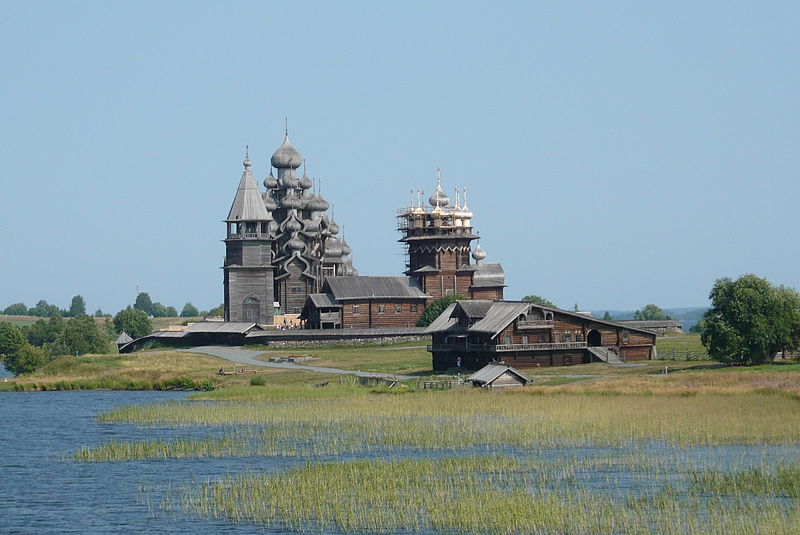
Kizhi is an island in Lake Onega in the Republic of Karelia, famous for one of Russia's most remarkable ensembles of wooden architecture. Its principal landmark is the Kizhi Pogost, comprising the Church of the Transfiguration, the Church of the Intercession, and a wooden bell tower. The buildings blend harmoniously with the northern landscape of lakes, forests, and traditional settlements.
The island is more than a collection of historic churches. The Kizhi open-air museum preserves wooden chapels, peasant houses, barns, mills, and other examples of the traditional culture of the Russian North.
The Kizhi Pogost and UNESCO
The Kizhi Pogost stands on a narrow strip of land in the southern part of the island. Historically, a pogost was a parish centre that brought together a church, a cemetery, and buildings serving the religious and communal life of nearby settlements. In 1990, the architectural ensemble was inscribed on the UNESCO World Heritage List for its exceptional carpentry, distinctive design, and harmony with the landscape.
Church of the Transfiguration
The best-known landmark is the Church of the Transfiguration, dated to 1714 by the museum. It rises about 37 metres and is crowned by 22 domes covered with small aspen shingles. Its complex composition combines octagonal log structures, extensions, and curved roof forms, demonstrating the remarkable skills of traditional northern carpenters.
A local legend tells of a master named Nestor who supposedly built the church with a single axe and without nails. The story is part of Kizhi's cultural tradition, but should not be treated as a fully verified account of the construction process. Inside, the church has an iconostasis with icons from the 17th and 18th centuries and a decorated wooden ceiling known as the “heaven.”
Church of the Intercession and the bell tower
The Church of the Intercession was built in 1764 for winter services. It is more compact than the Transfiguration Church and has nine domes. Together, the two churches form a balanced ensemble that reflects the practical needs of a northern parish throughout the year.
The wooden bell tower was built in 1862 and later reconstructed. Along with the churches and the enclosure, it completes the historic parish complex.
Kizhi Museum Reserve
The island is part of the Kizhi State Open-Air Museum of History, Architecture, and Ethnography. Its collection includes dozens of wooden structures brought from settlements across Karelia and neighbouring northern regions. Visitors can see chapels, traditional houses, barns, mills, and farm buildings.
Museum houses display household objects, craft tools, and features of traditional rural life. Guided tours and demonstrations of traditional crafts are offered, while access to particular interiors and activities varies by season.
History of the island
Kizhi lies in Zaonezhye, a historic region known for farming, fishing, crafts, and wooden construction. Churches on the island were mentioned in written records in the 16th century. In 1693, earlier churches were destroyed by fire after a lightning strike, and new buildings were later erected on the same site. The Transfiguration Church dates to 1714 and the Intercession Church to 1764.
During the 20th century, Kizhi became an important centre for the preservation of wooden architecture. Restoration work and the creation of the museum helped conserve historic buildings and document traditional construction techniques.
Landscape and visiting Kizhi
The island's appeal also comes from the open waters of Lake Onega, meadows, trees, and quiet northern scenery. Summer brings green vegetation, autumn muted colours, and winter snow that highlights the shapes of the wooden buildings. Weather can be windy, so visitors should bring comfortable shoes, an extra layer, and rain protection.
Kizhi is about 68 kilometres from Petrozavodsk by water route. During the navigation season, visitors usually arrive by high-speed boat across Lake Onega. Schedules, tickets, and transport options depend on the date and weather, so check the museum's official website before travelling.
Allow time to see both churches, the bell tower, the enclosure, and the traditional houses. Kizhi is valued not only for its famous domes but also for the complete picture it offers of traditional life in the Russian North.
Gallery