The Garden of Gethsemane is one of Jerusalem’s most revered Christian sites. It lies at the foot of the Mount of Olives, close to the Kidron Valley and the Old City. This small olive grove is best known through the Gospel accounts, which identify it as the place where Jesus Christ prayed on the night before his arrest. Today, pilgrims, history enthusiasts and travellers visit to experience a place closely associated with the final days of Jesus’ earthly life.
The name Gethsemane comes from an Aramaic expression commonly translated as “oil press,” referring to equipment used to extract olive oil. The name recalls the agricultural past of Jerusalem’s surroundings, where olive cultivation played an important role in daily life.
The biblical story
According to the Gospels of Matthew, Mark and Luke, after the Last Supper Jesus went with his disciples to the Mount of Olives and entered a place called Gethsemane. He withdrew to pray, experiencing profound distress before the suffering that lay ahead. Some of his disciples remained nearby but were unable to stay awake with him.
The Gospel narrative also connects the garden with Jesus’ arrest. Judas Iscariot arrived with an armed group and identified Jesus with a kiss. Jesus was then seized and taken away. Gethsemane consequently holds a special place in Christian tradition, symbolising prayer, inner struggle, faithfulness and acceptance of suffering.
For centuries, pilgrims have come to this part of Jerusalem to pray and remember the events described in the Gospels. The precise location of the historical garden cannot be established with complete certainty, however, and several nearby plots are associated with different Christian traditions.
The ancient olive trees
The garden’s main natural feature is its old olive trees, with massive, twisted and sometimes hollow trunks. Their unusual shapes contrast with the carefully maintained grounds and the stone buildings around them. Olive trees are widely regarded as symbols of peace, longevity and resilience, making them especially meaningful in this setting.
Some of Gethsemane’s trees are often described as centuries old, although their exact ages remain a subject of research. Studies have also indicated that eight of the old olive trees are genetically related and may have been grown from cuttings taken from a common source tree. This finding is intriguing, but it does not by itself prove that the existing trunks were alive during Jesus’ lifetime.
The garden is small rather than a sprawling park. Its significance lies primarily in its spiritual and historical associations and in the preservation of an old olive grove within the urban landscape of Jerusalem.
The Basilica of the Agony and the Church of All Nations
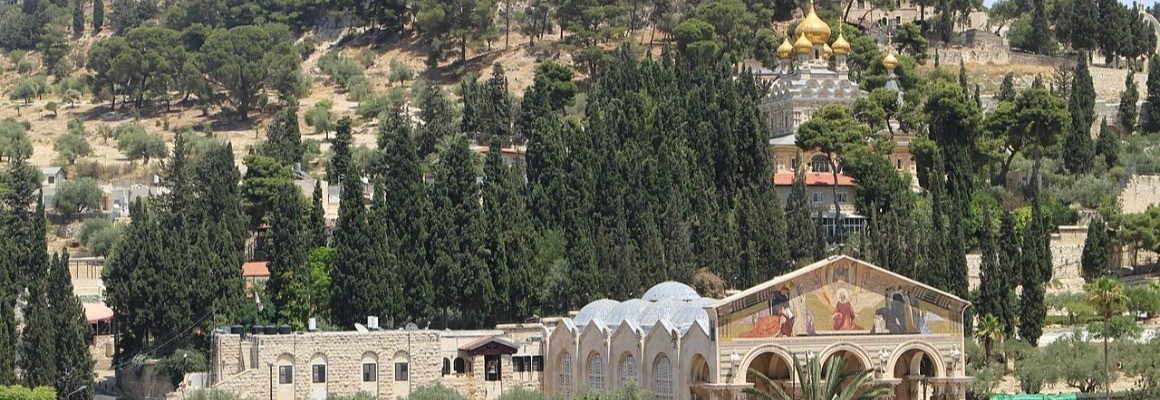
Beside the garden stands the Basilica of the Agony, also known as the Church of All Nations. The present building was constructed between 1919 and 1924 to a design by Italian architect Antonio Barluzzi. Its name reflects the international support behind the project, which received contributions from Catholic communities and countries around the world.
The basilica stands on the site of earlier Christian churches. Archaeological excavations uncovered remains of a Byzantine church and a later Crusader structure, showing that Christians revered this area long before the present building was erected.
Inside the church is an exposed section of bedrock traditionally associated with Jesus’ prayer before his arrest. The interior features subdued lighting, mosaics and a solemn atmosphere. Its decoration recalls the suffering of Christ and is particularly meaningful during Holy Week.
What to see during a visit
Visitors can view the old olive trees and enter the Basilica of the Agony when it is open. Inside, look for the mosaics, architectural details and the rock venerated as the place of Jesus’ prayer. The site does not require a long walk and fits easily into an itinerary through eastern Jerusalem.
Other important religious and historical landmarks on the Mount of Olives are nearby, including the Church of Dominus Flevit, the Church of Mary Magdalene and the Tomb of the Virgin Mary. The visit can be extended to nearby viewpoints overlooking the Old City and the Kidron Valley.
Practical advice
Check the visiting hours for both the garden and the basilica before travelling, as schedules may change because of services and religious holidays. Entry to the garden is generally free, but access arrangements may differ for individual parts of the complex.
Gethsemane remains an active place of prayer, so visitors should keep noise to a minimum and respect people attending services. Wear comfortable shoes and clothing appropriate for a religious site. During hot months, consider visiting in the morning or late afternoon and bring drinking water.
The Garden of Gethsemane is less a large landscaped park than a place where the natural environment meets centuries of religious memory. Its old olive trees, proximity to the Church of All Nations and connection to the Gospel story make it an important stop for anyone exploring Jerusalem’s history and spiritual heritage.
Gallery