Wat Rong Khun, widely known as the White Temple, is an unconventional Buddhist temple complex near Chiang Rai in northern Thailand. Its brilliant white buildings, delicate towers and mirrored decorations look like a palace from a fantasy world. Behind the striking appearance lies a symbolic story inspired by Buddhist ideas about desire, suffering, moral choices and spiritual liberation.
The complex was designed by Thai artist Chalermchai Kositpipat, who began transforming the older temple in 1997. Rather than simply restoring the original building, he envisioned a large artistic project combining architecture, sculpture and painting. Wat Rong Khun has since become one of the best-known landmarks in Chiang Rai Province.
History of the temple
An ordinary local temple once stood on this site, but it had fallen into poor condition. Chalermchai Kositpipat decided to rebuild it as an ambitious work of Buddhist art. The project was intended to express spiritual ideas through a distinctive contemporary artistic language. Construction began in 1997 and continues to develop as part of the artist's lifelong project.
A strong earthquake struck Chiang Rai Province on 5 May 2014 and damaged parts of the complex. After the structures were assessed, restoration work began. Wat Rong Khun is therefore not simply a monument frozen in the past, but an evolving artistic site that requires continuing maintenance.
Why the temple is white
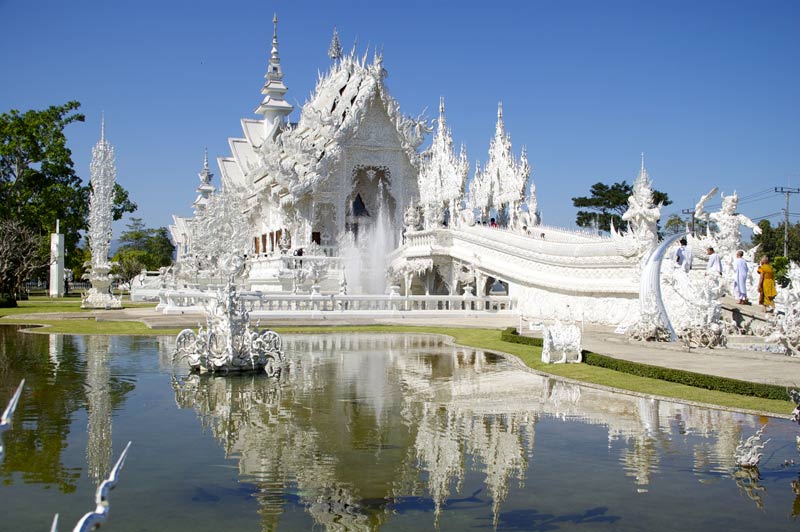
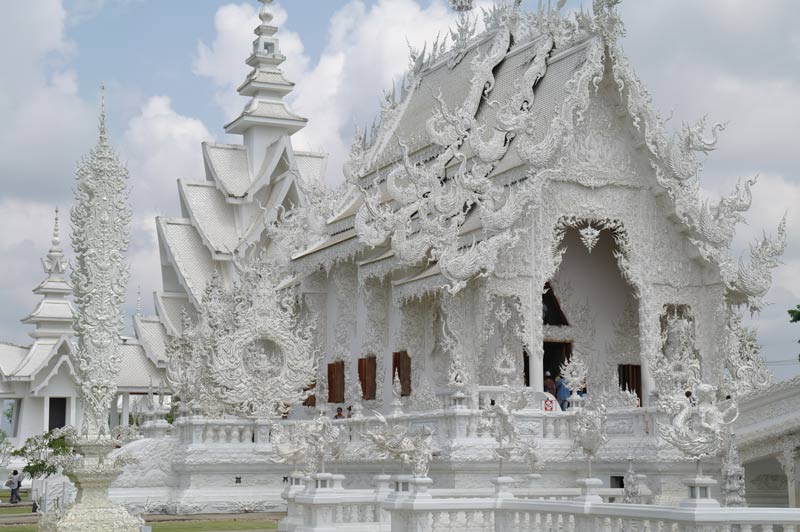
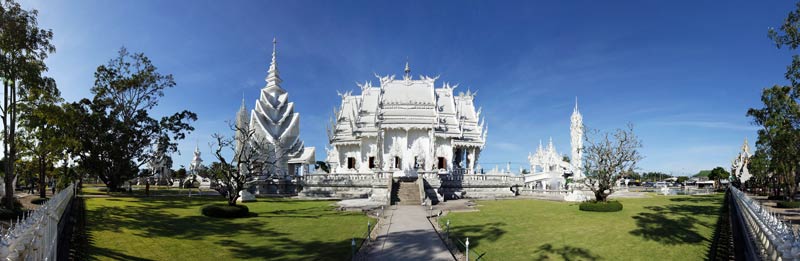
White represents the purity of the Buddha and spiritual perfection. The buildings are decorated with countless small mirror fragments that reflect sunlight and create a shimmering effect. These mirrors symbolise wisdom and the light of Buddhist teaching. The white colour scheme makes the complex stand apart from many Thai temples known for golden roofs and vivid colours.
The bridge of human desires
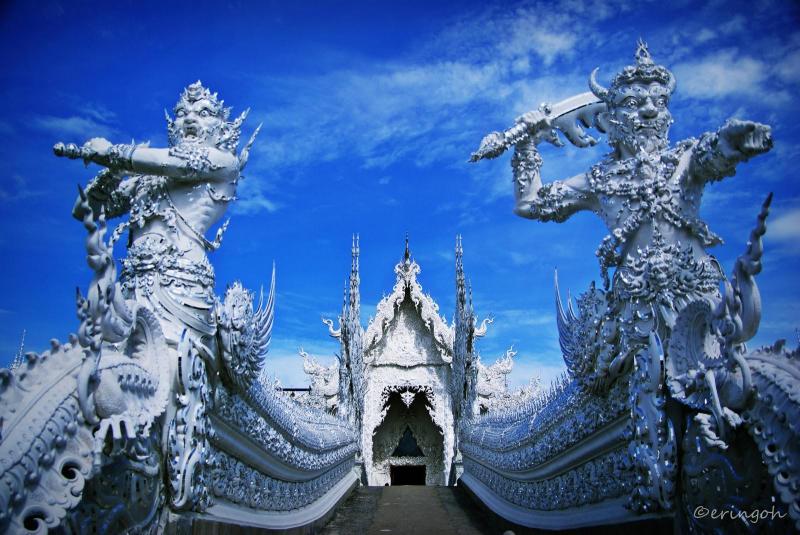
One of the most striking features is the bridge leading to the main temple building. Beneath it, sculpted hands reach upwards from the ground. They represent human desire, suffering, greed and attachment, which can prevent people from finding spiritual freedom.
Crossing the bridge can be interpreted as a symbolic journey away from worldly cravings and towards wisdom and enlightenment. It is not merely a physical passage but an important part of the artistic narrative created by the designer.
Architecture and sculptures
The temple is decorated with mythical creatures, nagas, demons, masks and intricate ornamental patterns. Some details draw on traditional Thai temple architecture, while others reflect the artist's own imaginative style. Tall gables and slender towers create a sense of upward movement, and the mirrored surfaces change appearance with the light.
The central building is the ubosot, an important type of hall in Thai Buddhist tradition. Its interior contains murals by Chalermchai Kositpipat that combine religious themes with images from the modern world. They invite reflection on human weaknesses, fears, desires and moral challenges. Photography inside the main hall may be prohibited, so visitors should follow the current rules.
The golden building
Another surprising feature is a richly decorated golden-coloured building used as a public restroom. Its colour contrasts sharply with the white temple. The contrast can be viewed as an artistic play on ideas of beauty, wealth and spirituality. The grounds also contain exhibition spaces, souvenir shops and other visitor facilities.
Contemporary art and Buddhist philosophy
Wat Rong Khun is not an ancient monument simply preserved in its original form. It is a contemporary reinterpretation of a Buddhist temple. The artist combines traditional architectural forms with unusual sculptures, mirrored surfaces and imagery that comments on modern society.
The central theme is spiritual development. The bridge, images of suffering and demons, white walls and interior paintings create a visual narrative about overcoming attachment and seeking wisdom. The complex is best understood as an individual artistic statement rather than a standard collection of ancient religious scenes.
How to get there
Chiang Rai is the most convenient starting point. Wat Rong Khun lies approximately 13–15 kilometres from the city centre. Visitors can reach it by taxi, rental car, motorbike, local bus or organised tour. A drive usually takes around 20–30 minutes, depending on traffic.
Travellers coming from Chiang Mai can include the White Temple in a Chiang Rai excursion, but the journey between the cities takes several hours, so the day should be planned carefully.
Best time to visit
On a clear day, the white plaster and mirrored details sparkle particularly brightly. Morning is often a good time to visit because tour groups tend to arrive later. The cooler season is usually more comfortable for walking, while rain can make outdoor paths slippery.
Visitor tips
Despite its popularity as a tourist attraction, Wat Rong Khun remains a religious site. Clothing should cover the shoulders and knees, and shoes must be removed before entering certain buildings. Follow staff instructions, avoid touching the decorative features and stay behind barriers. Photography is not permitted in every area.
Allow around one to two hours to explore the complex. Comfortable shoes, drinking water and sun protection are useful, especially during hot weather.
Places to visit nearby
The White Temple can be combined with Wat Rong Suea Ten, known as the Blue Temple, and Baan Dam Museum, often called the Black House. Chiang Rai itself has historic temples, markets and local food venues. The wider region is also known for mountain scenery and tea plantations.
Why visit Wat Rong Khun
The White Temple brings together contemporary architecture, Buddhist symbolism and personal artistic expression. Its bridge of reaching hands, sparkling white surfaces, mythical creatures and unusual murals reward close attention. Wat Rong Khun shows how ancient philosophical ideas can be expressed through modern art, making it one of the most memorable attractions in northern Thailand.
Gallery