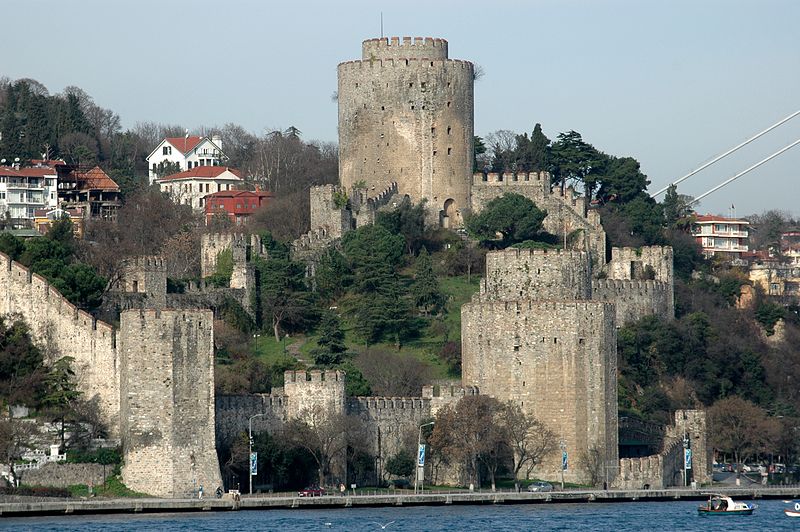
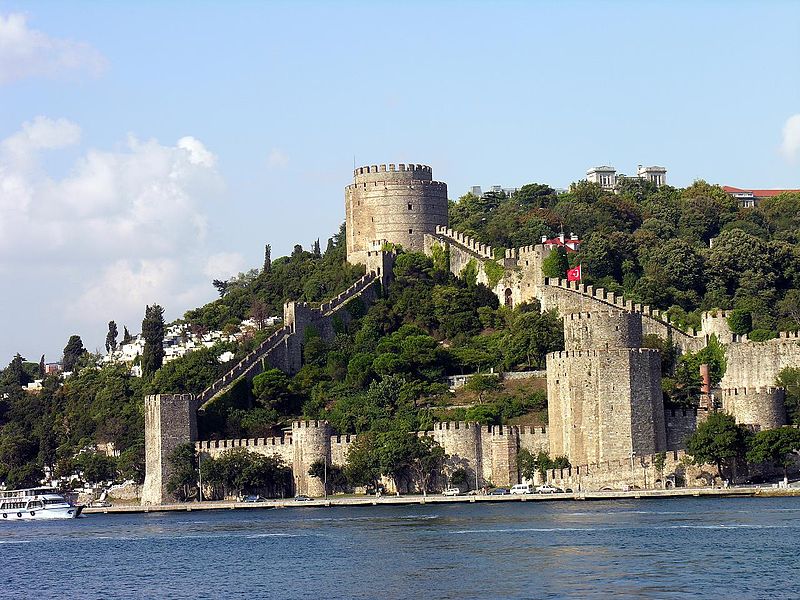
Rumeli Fortress, also known as Rumeli Hisarı, is a fifteenth-century Ottoman fortress on the European shore of the Bosphorus in Istanbul. Sultan Mehmed II ordered its construction in 1452 as part of the preparations for the conquest of Constantinople. Its strategic position allowed the Ottomans to monitor shipping through the strait and make it harder for supplies to reach the besieged Byzantine capital.
Construction and historical background
In the mid-fifteenth century, the Ottoman Empire sought to capture Constantinople, the capital of the Byzantine Empire. The Bosphorus connected the Black Sea with the Sea of Marmara, making control of the waterway essential. Anadolu Fortress already stood on the Asian shore, and the new stronghold on the European side strengthened Ottoman control over one of the narrowest sections of the strait.
Construction began in the spring of 1452 and was completed by the end of August. Historical accounts describe an exceptionally rapid building effort involving hundreds of craftsmen and workers. Three senior Ottoman officials supervised major sections of the project, and their names were later associated with the fortress's three principal towers.
Military importance
Rumeli Fortress was positioned opposite Anadolu Fortress, allowing the Ottomans to observe passing vessels and impede ships that might deliver food, weapons or reinforcements to the Byzantines. It formed part of a broader strategy to isolate Constantinople before the decisive campaign. The city fell to Ottoman forces in 1453, while the fortress continued to serve defensive purposes for many years.
Architecture and the three main towers
The fortress covers an area of approximately 30,000 square metres. Its walls follow the hillside and connect three large towers with smaller towers, bastions, passages and gates. The Saruca Pasha Tower is about 28 metres high, the Halil Pasha Tower around 22 metres, and the Zağanos Pasha Tower approximately 21 metres.
The massive masonry, rounded towers and narrow openings reflect the defensive purpose of the complex. An inscription on the Zağanos Pasha Tower is often highlighted among the early Turkish inscriptions associated with the Bosphorus. The fortress is an important example of fifteenth-century Ottoman military architecture.
The fortress after the conquest
After the conquest of Constantinople in 1453, the fortress gradually lost its original role in the preparations for the siege. From the sixteenth century, it was also used as a state prison. Inscriptions and graffiti left on the walls recall the period when prisoners were held here. The fortress was damaged by the major earthquake of 1509, and a fire in 1746 destroyed parts of its wooden structures. Repairs were carried out during the reign of Sultan Selim III.
Major restoration work began in 1953 to mark the 500th anniversary of the conquest of Constantinople. After the restoration was completed, the fortress opened as a museum in 1968.
What to see at the museum
The collection includes historical cannons, cannonballs and other objects from the Ottoman period, as well as stone artifacts from the Byzantine era. The fortress itself is also a major attraction, with its walls, inner courtyards, towers and traces of earlier structures. The garden contains pine trees, Judas trees and other plants typical of the Bosphorus region.
The grounds offer views of the strait, the Asian side of Istanbul and ships travelling between the Black Sea and the Sea of Marmara. A visit can be combined with a walk along the waterfront or a trip to nearby Bebek and Arnavutköy.
How to visit Rumeli Fortress
The fortress is located in the Sarıyer district on Istanbul's European side. It can be reached by public bus, taxi or car. Check the official museum website before visiting, as opening hours, ticket prices and access arrangements may change. The museum is generally closed on Mondays.
Comfortable shoes are recommended because the grounds include uneven surfaces, steps and stone paths. Access to the walls and towers may be restricted for restoration or safety reasons. Follow staff instructions and remain outside closed areas.
Why visit Rumeli Fortress
Rumeli Fortress illustrates a turning point in Istanbul's history, when control of the Bosphorus became an important element of Ottoman strategy. Its medieval architecture, historical collections, green garden and views over the strait make it one of the most interesting places to explore the story of Constantinople's conquest.
Gallery