Castel Sant'Angelo is one of Rome's most recognizable historic monuments, located on the right bank of the Tiber near the Vatican. Its massive cylindrical structure, powerful walls and statue of the Archangel Michael at the summit create a distinctive silhouette. Over nearly two thousand years, the building has served as an imperial mausoleum, military fortress, papal residence, prison and, finally, museum. Its architecture preserves traces of different periods in Rome's complex history.
The castle stands beside Sant'Angelo Bridge, which crosses the Tiber toward the historic centre. From here, visitors can easily reach St Peter's Square and other major sights. The fortress is especially striking in the evening, when its outline is reflected in the river and the bridge's angel sculptures stand out against the sky. Today, the site is both an architectural monument and a museum dedicated to ancient Roman heritage, Renaissance art and the history of the papacy.
The Mausoleum of Emperor Hadrian
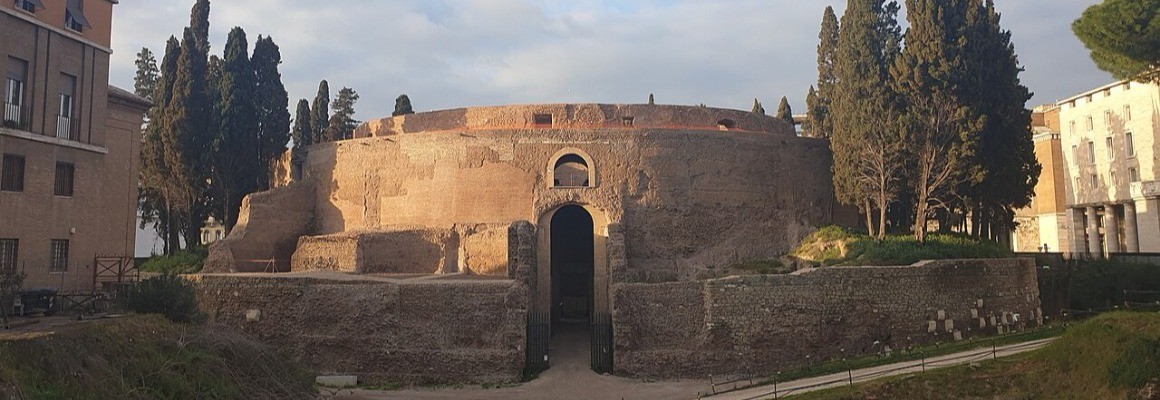
The castle's story began in the second century AD. Around 135, the Roman emperor Hadrian ordered the construction of a monumental mausoleum for himself and his family. The building was completed under his successor Antoninus Pius around 139. It was originally known as the Mausoleum of Hadrian, or the Mole Adriana. The imposing funerary monument had a massive cylindrical body above a square base and was decorated with sculptures and ornamental details.
The mausoleum was intended to house the remains of emperors and members of the imperial family. Its location beside the Tiber was connected to a road and bridge now known as Sant'Angelo Bridge. Over time, much of its original decoration disappeared, but the robust stone structure survived. This solid core allowed the monument to endure warfare and repeated rebuilding. The remains of the Roman mausoleum still form the architectural foundation of the castle.
From tomb to military fortress
As the Roman Empire weakened, the building gained strategic importance. In late antiquity and the early Middle Ages, it was adapted to defend the city and control the crossing over the Tiber. The mausoleum gradually became a fortified structure, and its walls and interior spaces were altered for military purposes. Some ancient decorative elements were lost when stone and statues were reused in fortifications or thrown down during sieges.
During the Middle Ages, the fortress was repeatedly strengthened and rebuilt. Its proximity to the Vatican made it a vital defensive position and a refuge during political instability. Popes expanded the fortifications, added bastions and created new internal spaces. Over time, the castle became one of the key elements of papal Rome's defensive system, capable of resisting attacks and protecting those inside.
The legend of the Archangel Michael
The castle's name comes from a sixth-century tradition. According to legend, Rome suffered a devastating plague in 590. Pope Gregory I organized a penitential procession to pray for the end of the disaster. During the procession, he saw the Archangel Michael above the ancient mausoleum, sheathing his sword. The vision was interpreted as a sign that the epidemic would end and the city was under heavenly protection.
In memory of this event, the building became known as Castel Sant'Angelo, or Castle of the Holy Angel. Images of the archangel were later placed on its summit. The present bronze statue of Michael was created by sculptor Peter Anton von Verschaffelt and installed in the eighteenth century. The figure sheathing his sword became the castle's emblem and a distinctive part of Rome's skyline. The legend lends the fortress an atmosphere where historical events and religious tradition intertwine.
Papal residence and the secret passage to the Vatican
From the Middle Ages onward, Castel Sant'Angelo became closely associated with the papacy. Its fortifications allowed popes to take refuge during rebellions, invasions and political crises. During the Renaissance, the fortress developed into both a defensive stronghold and a prestigious residence. Living quarters, ceremonial halls, frescoes and decorative interiors were added. Some popes used the castle as a temporary shelter, while others conducted important political affairs there.
One of its most remarkable features is the Passetto di Borgo, a fortified corridor connecting the Vatican area with the castle. It runs above the streets and allows passage from the papal precinct to the fortress without travelling through exposed public spaces. The passage was used during dangerous periods, including the invasion of Rome in 1527, when Pope Clement VII sought refuge in the castle. The Passetto remains a famous symbol of the close relationship between the fortress and the Vatican. Public access is available only during selected programmes and periods.
The prison and its historic prisoners
Behind the castle's massive walls were not only papal apartments and military quarters but also a prison. At different times, political opponents, suspected conspirators and people accused of offences against church or state authority were held here. Some rooms served as cells, while inner courtyards were associated with harsh punishments. The castle's history is therefore connected not only with art and defence, but also with repression and struggles for power.
Numerous stories of famous prisoners and escapes are associated with Castel Sant'Angelo. Some have become legendary, so visitors should distinguish documented events from later tales. By the seventeenth century, the castle was gradually losing its role as an elaborate papal residence and was increasingly used as a prison and military installation.
Architecture and museum rooms
The architecture of Castel Sant'Angelo is a visible chronicle of Rome. At its core lies the ancient Roman mausoleum, surrounded over the centuries by medieval fortifications, bastions, courtyards and Renaissance rooms. The visitor route passes through corridors, stairways, halls and defensive levels, revealing how a single structure was repeatedly adapted to different needs.
The museum displays works of art, sculptures, weapons, military-history objects and elements of historic interior decoration. The papal apartments, with their frescoes and ornamental details, are particularly interesting, as are the defensive spaces that reveal the castle's military role. By combining archaeology, architecture and art collections, the site functions both as a monument of ancient Rome and as a museum of later historical periods.
Terraces and panoramic views of Rome
One of the highlights of a visit is climbing to the upper terraces. From here, visitors can enjoy broad views of the Tiber, Sant'Angelo Bridge, the dome of St Peter's Basilica, the rooftops of the historic centre and the surrounding streets. The panorama is particularly beautiful at sunset, when warm light illuminates the domes and old buildings. The terraces also reveal the fortress's strategic position and help explain its importance in the city's defence.
Sant'Angelo Bridge is itself a major landmark. Its angel sculptures are associated with Christian symbolism and the story of Christ's Passion. A walk across the bridge pairs naturally with a visit to the castle and the Vatican district. Its riverside setting also makes the area a favourite place for photography and evening strolls.
Castel Sant'Angelo today
In 1870, the building passed into the ownership of the Italian state and was used for military purposes for a time. A national museum opened here in 1925. Today, Castel Sant'Angelo is one of Rome's important cultural and historic attractions. Visitors come for its unusual architecture, museum collections, panoramic views and the rich stories of emperors, popes, military leaders and prisoners.
Before visiting, check the museum's official website for current opening hours, entry conditions and special tours. Allow enough time to explore the various levels, historic interiors and open terraces. Castel Sant'Angelo is particularly rewarding for anyone wishing to discover several layers of Roman history in one place, from an imperial tomb to a papal fortress and a modern museum.
Gallery