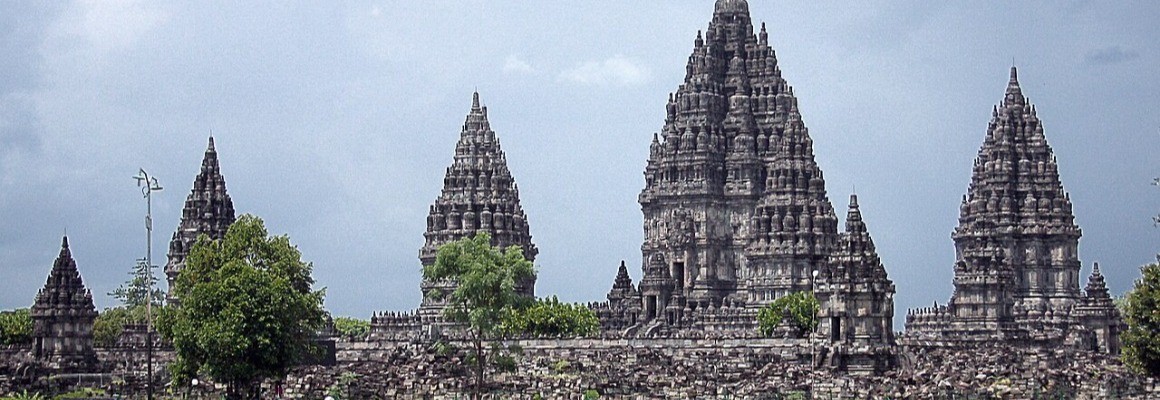
Borobudur is a monumental Buddhist temple complex on the Indonesian island of Java and one of the world's greatest achievements of Buddhist architecture. It stands in the Kedu Valley near Magelang, surrounded by green plains, volcanic mountains, and tropical hills. Its stepped stone structure, covered with thousands of reliefs and crowned with stupas, combines architecture, sculpture, and religious philosophy.
The temple was built during the 8th and 9th centuries under the Sailendra dynasty. In 1991, Borobudur was inscribed on the UNESCO World Heritage List together with the nearby Mendut and Pawon temples. Today, it is an important Buddhist pilgrimage destination and one of Indonesia's most significant historic landmarks.
History and construction
Borobudur is generally dated to the late 8th and 9th centuries, when Buddhist culture flourished in Central Java and local rulers commissioned major religious monuments. Its construction required extensive resources, engineering knowledge, and the work of many skilled craftsmen.
The temple was built mainly from andesite, a volcanic stone common on Java. Blocks were fitted together using stone joints rather than modern cement. After its period of prominence, Borobudur gradually lost its role as a major religious centre. It was no longer used as an active Buddhist sanctuary sometime between the 10th and 15th centuries, although the exact reasons remain uncertain.
Abandonment and rediscovery
For centuries, Borobudur stood outside the region's main religious and political life. Vegetation, soil, and natural processes gradually concealed parts of the structure. In 1814, during British administration of Java, Thomas Stamford Raffles arranged an investigation after hearing reports of an ancient monument. Clearing work revealed stone galleries, stupas, and carved reliefs.
Large conservation projects followed. In the 1970s, an international restoration programme supported by UNESCO dismantled sections of the monument, cleaned and strengthened the stones, stabilised the foundations, and reassembled the structure. These efforts helped protect Borobudur from tropical weather and structural deterioration.
Architecture and layout
Borobudur rises like a stepped stone mountain. Its design combines the forms of a stupa, a temple, and a symbolic sacred mountain. Five square terraces form the lower levels, followed by three circular platforms and a monumental central stupa at the summit. The lower galleries are richly decorated, while the upper levels are more open and restrained.
The arrangement is often interpreted as a representation of the Buddhist spiritual journey towards enlightenment. Moving upward through the terraces symbolises progress towards a higher level of understanding and release from worldly attachments. Interpretations of particular architectural details may vary among scholars and religious traditions.
The three realms of Buddhist cosmology
The lower part is associated with Kamadhatu, the realm of desire. The square terraces represent Rupadhatu, the realm of forms, and contain long galleries filled with reliefs and Buddha images. The upper circular platforms are associated with Arupadhatu, the formless realm. The transition from detailed carvings to open space expresses the monument's spiritual symbolism.
The 72 stupas and Buddha statues
One of Borobudur's most distinctive features is its group of 72 perforated stone stupas arranged around the three circular platforms. Each bell-shaped stupa has openings shaped like diamonds or squares, revealing a seated Buddha statue inside. A larger central stupa crowns the monument and forms its main vertical axis.
Buddha statues also occupy niches along the square terraces. Their hand gestures, known as mudras, carry religious meaning and are associated with different aspects of Buddhist teaching, including protection, instruction, meditation, and enlightenment.
Stone reliefs and Buddhist stories
The walls and balustrades are decorated with bas-reliefs covering approximately 2,500 square metres. They form an extraordinary visual record of Buddhist teachings, legends, moral lessons, and everyday life in ancient Java. Scenes depict palaces, markets, ships, houses, plants, animals, clothing, and musical instruments.
Some panels tell stories of the Buddha's previous lives, known as Jatakas, while others illustrate Buddhist texts and the path of the bodhisattva. Their sequence follows the temple's walking route, so moving through the galleries resembles reading a vast book carved in stone.
Ships and maritime history
Reliefs showing ships have attracted particular interest. They depict vessels with sails and distinctive construction features, providing evidence of the importance of maritime connections in ancient Southeast Asia. These carvings have inspired modern reconstructions of traditional ships and research into historic sea routes linking the Indonesian islands with other parts of Asia.
Pilgrimage and Vesak
Borobudur remains an important destination for Buddhists from Indonesia and abroad. The ascent through its terraces can be understood as a symbolic journey of spiritual development. The monument is especially significant during Vesak, a festival commemorating the Buddha's birth, enlightenment, and passing into parinirvana. The dates vary each year according to the Buddhist calendar.
Visitors should respect the site's religious significance and follow local rules. Access to certain areas may be restricted, and touching stonework or entering specific sections may be prohibited.
The temples of Mendut and Pawon
The Borobudur World Heritage property also includes Mendut and Pawon temples, located to the east. Mendut is known for its large Buddha statue flanked by bodhisattvas. Pawon is a smaller temple with elegant stone decoration and a simpler architectural form. Visiting all three monuments provides a broader understanding of Buddhist culture in Central Java.
Landscape and views
Borobudur stands in the Kedu Valley, surrounded by hills and volcanic mountains. On clear days, visitors may see Mount Merapi, Mount Merbabu, green fields, and nearby villages. Morning mist sometimes settles over the valley, creating a particularly atmospheric view. Visibility depends on the weather, season, and volcanic conditions.
How to get there
Borobudur is located in Central Java, approximately 40 kilometres northwest of Yogyakarta and near the town of Magelang. Many travellers use Yogyakarta as their base and reach the temple by car, organised tour, or public transport with transfers.
Before travelling, check current visiting rules, opening times, ticket prices, and access to the upper levels. To protect the monument, the number of visitors allowed onto the structure may be limited, and access may require a separate ticket or time slot. Allow several hours for the visit, wear comfortable shoes, and bring water and sun protection. If time permits, combine Borobudur with Mendut, Pawon, Yogyakarta, and the Hindu temple complex of Prambanan.
Borobudur is remarkable not only for its scale and craftsmanship but also for the way architecture, sculpture, Buddhist philosophy, and the surrounding landscape form a unified whole. Its terraces and stupas remain among the most recognisable symbols of Indonesia's cultural heritage.
Gallery