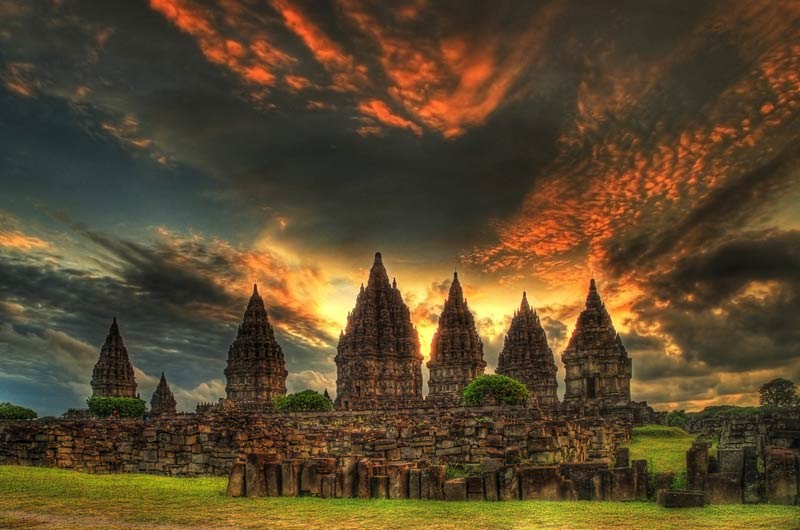
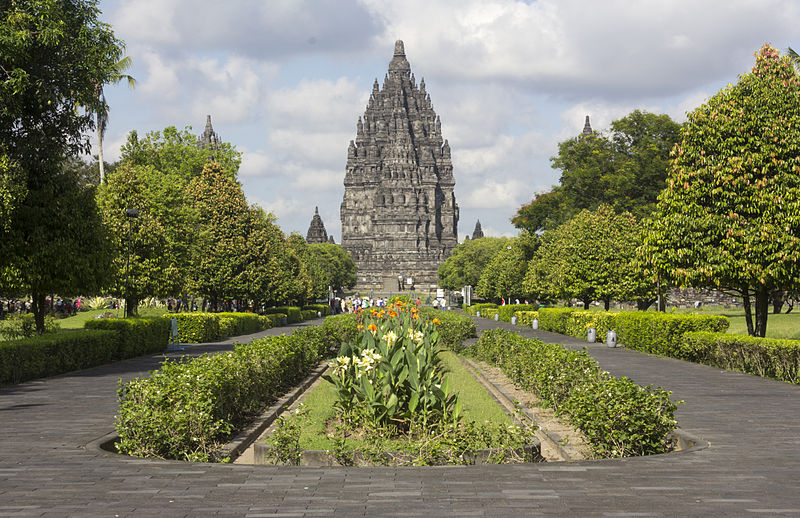
Prambanan is a magnificent Hindu temple complex on the Indonesian island of Java, famous for its tall stone towers, intricate carvings, and scenes from the ancient Indian epic Ramayana. It is one of the most important monuments of ancient Javanese civilization and the largest Hindu temple complex in Indonesia. Prambanan lies near Yogyakarta, on the boundary between the Special Region of Yogyakarta and Central Java Province. In 1991, the complex was inscribed on the UNESCO World Heritage List.
History of the Temple Complex
Prambanan emerged during the flourishing period of the ancient Mataram kingdom, which existed on Java between the eighth and tenth centuries. The principal structures date mainly from the ninth century, although construction and expansion continued later. The temples reflect the importance of Hinduism at the Javanese royal court and the high level of local architecture, engineering, and stone sculpture.
The complex was dedicated to major Hindu deities. Its central and largest sanctuary honors Shiva, while nearby temples are dedicated to Vishnu and Brahma. This arrangement reflects the concept of Trimurti, the three divine aspects associated with creation, preservation, and transformation.
Over time, Prambanan lost its former prominence. Shifts in Java’s political centers, earthquakes, and volcanic activity contributed to the damage and gradual abandonment of the buildings. Vegetation covered the stone structures, while local traditions preserved stories about them. The ruins attracted the attention of European travelers and researchers in the eighteenth century. Systematic study and restoration began much later, during the twentieth century.
Restoration has been a demanding task because many temples collapsed and thousands of stone blocks had to be studied and repositioned. Conservation continues in stages, as earthquakes and other natural forces remain threats to the site. Today, Prambanan is both a major visitor attraction and an important center for archaeological research and heritage preservation.
Architecture of Prambanan
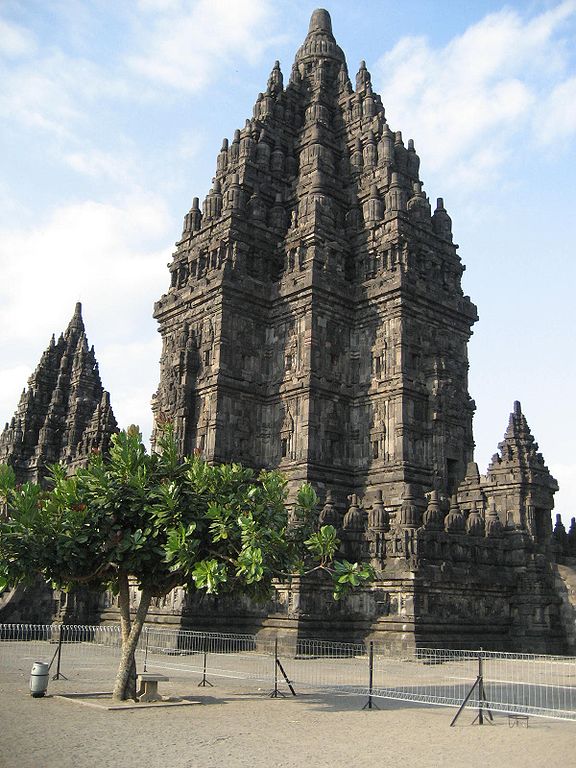
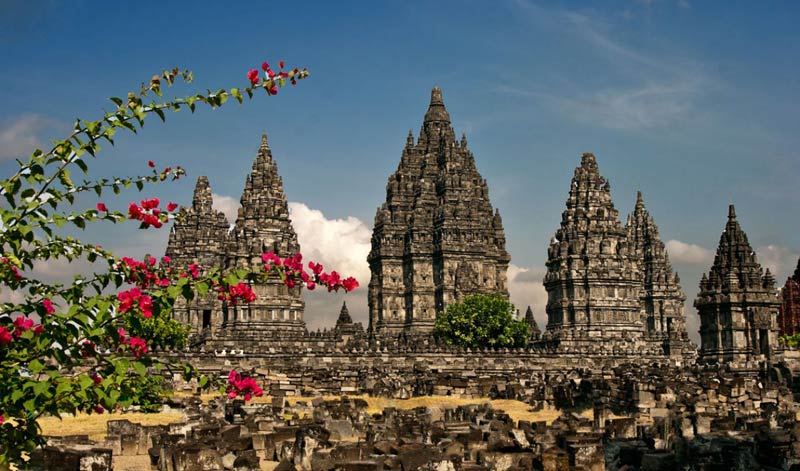
The complex is distinguished by its vertical silhouettes, tiered bases, and tall pointed towers. Its architecture combines Indian religious ideas with local Javanese artistic traditions. The buildings are made primarily of stone, and their surfaces feature niches, reliefs, divine figures, and ornamental patterns.
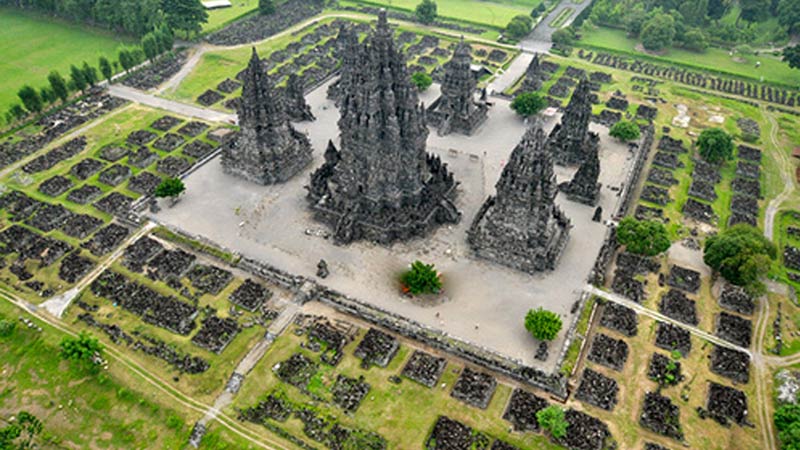
The layout is organized around a series of nested courtyards. The innermost area contained the most important sanctuaries, while surrounding structures formed an elaborate system of smaller temples. The original Prambanan complex included about 240 temple structures, although many survive only as ruins. The wider archaeological compound includes other monuments, bringing the total number of temples in the protected area to more than 500.
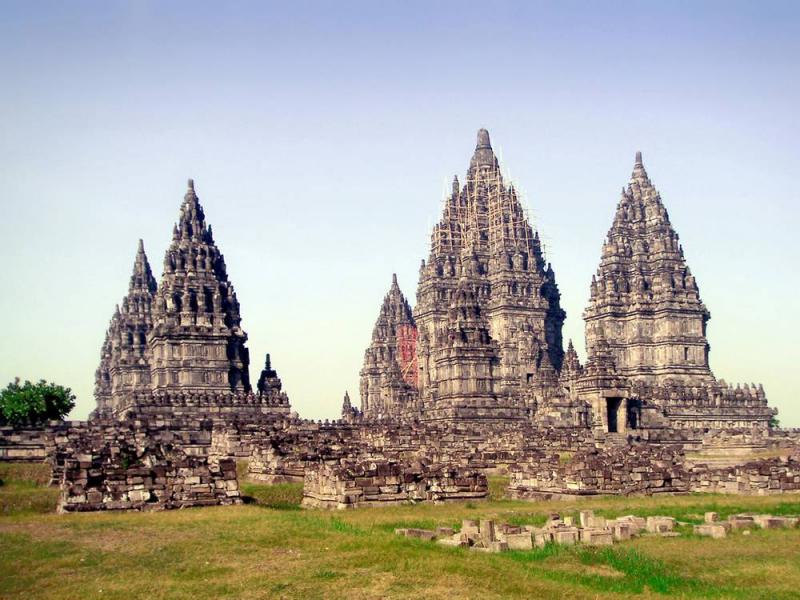
The tallest building in the central group is the Shiva Temple, which rises approximately 47 meters. Its striking silhouette stands above the surrounding structures. High towers, projecting tiers, and symmetrical sanctuaries create a sense of upward movement. The architecture demonstrates the skill of ancient builders and reflects the sacred-mountain concept linking the earthly and divine realms.
The Temples of Shiva, Vishnu, and Brahma
The principal group consists of three sanctuaries dedicated to the gods of the Hindu Trimurti. The central and largest temple honors Shiva, who is associated with transformation and renewal. Inside are sacred images, including a statue of Shiva, alongside other sculptures connected with Hindu mythology.
North of the Shiva Temple stands the Vishnu Temple, dedicated to the deity associated with preserving cosmic order. To the south is the Brahma Temple, honoring the traditional creator of the universe. These buildings are shorter than the central sanctuary but share a similar architectural composition and richly decorated stone walls.
In front of the three main temples stand shrines dedicated to the deities’ animal mounts: Nandi the bull, Garuda the bird, and Hamsa, a swan or goose associated with Brahma. In Hindu tradition, these mounts are called vahanas and symbolically carry the gods. Their shrines complete the layout and help explain the religious meaning of the complex.
Reliefs and the Ramayana
One of Prambanan’s greatest artistic treasures is its stone reliefs illustrating episodes from the Ramayana. This ancient Indian epic tells the story of Prince Rama, his wife Sita, and his loyal ally Hanuman. It recounts Sita’s abduction by the demon king Ravana and Rama’s struggle to rescue her.
The reliefs run along temple walls, creating a sequence of scenes that visitors can follow as they walk around the buildings. The carvings portray movement, clothing, plant motifs, and battle scenes. They are valuable not only as examples of religious art but also as evidence of ancient Javanese culture, showing how local artists adapted and reinterpreted Indian stories.
The epic also inspires the Ramayana ballet, a cultural performance staged in the Prambanan area on selected dates. Dance, music, costumes, and theatrical storytelling introduce audiences to the narrative and Javanese performing traditions. Schedules vary by season and organizer.
The Legend of Roro Jonggrang
Prambanan is associated with the famous Javanese legend of Princess Roro Jonggrang. According to the tale, Prince Bandung Bondowoso wished to marry her. To avoid the marriage, she set an almost impossible challenge: he had to build a thousand temples in a single night.
In the legend, Bandung Bondowoso possessed supernatural powers and summoned spirits to help with the construction. When the work was nearly finished, the princess ordered fires to be lit and noise to be made so that the scene resembled dawn. Believing the night had ended, the spirits stopped working. Unable to complete the thousand temples, the prince cursed Roro Jonggrang and turned her into stone.
Local tradition sometimes identifies the princess with a statue of the goddess Durga in the northern chamber of the Shiva Temple. The story is folklore, not an archaeologically verified account of the complex’s construction. Nevertheless, it has become an important part of Prambanan’s cultural identity.
Prambanan and Nearby Monuments
Prambanan forms part of a wider archaeological area containing monuments from different religious traditions. One of the best known is the Buddhist Sewu Temple complex, whose name is traditionally translated as “a thousand temples.” Its central sanctuary is surrounded by numerous smaller structures, and large stone guardians known as Dvarapalas stand at the entrances.
The Lumbung and Bubrah temples are also nearby. Together, these monuments show that Hindu and Buddhist communities in ancient Java shared the same cultural landscape. Their proximity is historically significant and offers insight into the region’s religious diversity.
The surrounding area contains other archaeological sites, while nearby Yogyakarta is known for traditional crafts, batik, gamelan music, and Javanese court culture. A visit to Prambanan is therefore often part of a longer journey through the historical landmarks of central Java.
What to See During a Visit
Begin with the central group of temples, allowing time for the Shiva Temple and the two neighboring sanctuaries. Their tower height, relief decoration, and carefully balanced composition are especially striking. The vahana shrines and surviving fragments of smaller buildings also help visitors imagine the original scale of the complex.
Next, examine the Ramayana reliefs and follow the sequence of scenes carved into the stone. If time allows, visit Sewu and other monuments in the archaeological park. Walking through the grounds reveals not only the best-known temples but also ruins that demonstrate the scale of this ancient religious center.
Photographers can explore several perspectives, from frontal views of the main temples to close-ups of the reliefs and panoramas of the towers against the sky. Morning and late afternoon usually offer softer light and more comfortable conditions than the midday heat.
How to Get to Prambanan
The complex lies about 17 kilometers east of central Yogyakarta. Visitors can reach it by car, taxi, ride-hailing service, or public transport serving the Prambanan area. Travel time depends on traffic and the route chosen.
Prambanan is often visited on a day trip from Yogyakarta. Before traveling, check current routes, opening hours, entry rules, and ticket prices through official visitor information channels. If you plan to attend the Ramayana ballet, confirm the schedule and arrangements in advance because performances do not necessarily take place every day and may be seasonal.
Practical Tips for Visitors
Comfortable shoes, a hat, and drinking water are useful for exploring the grounds. Much of the visit takes place outdoors, so be prepared for Java’s hot and humid weather. Morning is often a good time for a relaxed visit, while the later afternoon can be suitable for photography and exploring the archaeological park.
Prambanan is a protected cultural heritage site. Do not climb restricted structures, touch fragile carvings, leave litter, or cross barriers. Follow staff instructions and current visitor regulations. Access to particular temple areas may be limited to protect the monument.
Prambanan brings together outstanding architecture, Hindu mythology, and the history of ancient Java. Its soaring temples, Ramayana scenes, the legend of Roro Jonggrang, and nearby Buddhist monuments make it one of Indonesia’s most significant historic destinations.
Gallery