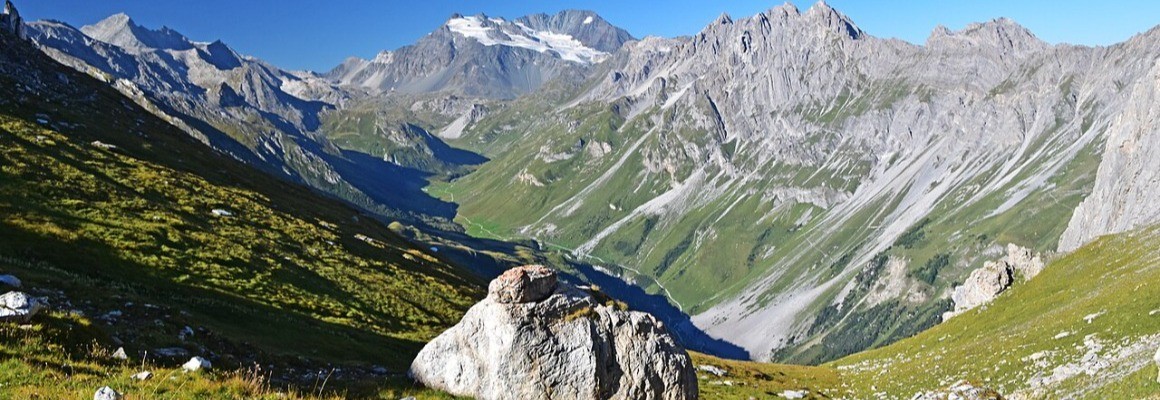
Écrins National Park is located in the French Alps, across the departments of Isère and Hautes-Alpes. Established on March 27, 1973, it protects one of France’s most impressive mountain regions. The park’s core area covers approximately 91,800 hectares, while the surrounding partnership area with local communities is much larger. Elevations range from around 700 metres to 4,102 metres above sea level.
Mountain ranges and high peaks
The park’s defining feature is the Écrins massif, with its sharp rocky summits, steep slopes, and deep glacial valleys. Its highest point is Barre des Écrins, which reaches 4,102 metres. Other notable peaks include Dôme de Neige des Écrins, Pic Lory, and the summits of the La Meije massif. More than 150 peaks in the park rise above 3,000 metres.
The landscape was shaped by tectonic forces, glaciers, and erosion. Sheer rock walls, snowfields, glaciers, and alpine pastures exist side by side. Deep valleys descend into inhabited mountain areas dotted with traditional villages and visitor facilities.
Glaciers, lakes, and valleys
Glaciers are among the park’s most distinctive features. They shape the high mountain scenery and feed numerous rivers and streams. Glacial activity has carved deep valleys, cirques, and other characteristic landforms. Glacier coverage changes with climatic conditions, making these ice masses important subjects for scientific research.
The park contains mountain lakes surrounded by cliffs, alpine meadows, and coniferous forests. One well-known destination is Lake Lauvitel, situated in the mountainous area. The valleys of Vallouise, Champsaur, and Valgaudemar attract visitors with their combination of dramatic scenery, traditional villages, and varied hiking routes.
Plant life
Because of the considerable elevation range and the influence of both Alpine and Mediterranean climates, the park supports an exceptionally varied flora. Pine and oak forests grow in lower valleys, while higher slopes support conifers including European larch. Subalpine and alpine meadows appear farther up, giving way at the highest elevations to bare rock, scree, and areas with very short growing seasons.
Approximately 2,500 plant species have been recorded in Écrins. They include rare and endemic plants adapted to harsh mountain conditions. In spring and summer, alpine meadows bloom with wildflowers, while larch forests turn golden in autumn. Protecting these habitats is essential to the conservation of Alpine biodiversity.
Wildlife
The national park provides a refuge for many animals typical of mountain ecosystems. Alpine chamois and ibex can be seen on rocky slopes, while marmots inhabit open areas and give loud warning whistles when danger approaches. Birds of prey include golden eagles and other species that use rising air currents to soar above the valleys.
Depending on altitude and season, the park is home to numerous mammals, birds, reptiles, and insects. Its varied environments allow species adapted to warmer valleys to coexist with those that thrive in cold, high-altitude habitats. Visitors should keep their distance from wildlife, avoid feeding animals, and refrain from disturbing breeding areas.
Hiking trails and mountain tourism
Écrins is one of France’s leading destinations for hiking, mountaineering, and discovering high-altitude nature. Hundreds of kilometres of marked trails cross the park, leading to mountain lakes, viewpoints, glacial valleys, and traditional Alpine settlements. Some routes are suitable for day trips, while others require several days and overnight stays in mountain refuges.
The GR 54 trail, which circles the Écrins massif, is particularly well known. It offers views of different parts of the mountain region but requires good fitness and careful planning. Mountain refuges and visitor information centres provide guidance on routes and local conditions.
Before setting out, check the weather forecast, trail conditions, and refuge availability. Conditions can change rapidly at high elevations, and snow, fog, and rockfalls can create hazards. Difficult routes require appropriate equipment, and hiring a qualified mountain guide may be advisable.
Nature protection rules
The core of the national park is strictly protected. Visitors must follow marked trails wherever required, avoid collecting plants or minerals, take all rubbish away, and refrain from lighting fires. Restrictions also apply to motor vehicles, cycling, and dogs in the protected core, with limited exceptions defined by park regulations.
Écrins National Park combines dramatic mountains, glaciers, lakes, diverse plant life, and rich wildlife. It is an excellent destination for travellers who want to experience the wild landscapes of the French Alps, go hiking, or discover high mountain scenery far from major cities.
Gallery