Tiwanaku is an ancient archaeological complex in western Bolivia, situated on the high-altitude Altiplano plateau near the southern shore of Lake Titicaca. It was the political, religious, and cultural centre of one of the most influential civilizations of pre-Columbian South America. Monumental stone platforms, temples, carved stelae, and the famous Gateway of the Sun demonstrate the engineering skill and artistic achievements of the ancient Andean peoples.
The site lies at an elevation of approximately 3,850 metres above sea level. Unlike many ancient cities that developed in river valleys or along coastlines, Tiwanaku flourished in the demanding environment of the high Andes. Its inhabitants adapted to a cold climate, seasonal rainfall, and the challenges of high-altitude farming. Today, the ruins reveal the scale of a civilization that influenced large areas of the Andes for centuries.
History of the Ancient Civilization
The history of Tiwanaku spans many centuries. The settlement existed long before its greatest period of prosperity, and from approximately AD 500 to 1000 it became an important centre of political authority, religious life, and trade. Its influence extended across much of the south-central Andes, including parts of present-day Bolivia, Peru, and Chile.
Researchers associate Tiwanaku's development with religious authority, agricultural technologies, craft production, and long-distance exchange networks. Monumental stone structures, pottery, textiles, and metal objects were produced in the city and surrounding region. Archaeological discoveries show that local traditions interacted with neighbouring cultures and that Tiwanaku's religious imagery spread far beyond the urban centre.
After approximately the eleventh century, the influence of this centre gradually declined. The reasons remain debated. Possible factors include climatic changes, prolonged droughts, agricultural difficulties, and political transformations. Several causes may have acted together. Tiwanaku did not disappear without a legacy: its artistic traditions and religious symbols continued to influence Andean cultures.
Architecture and Stoneworking
One of Tiwanaku's most impressive features is its monumental stone architecture. Ancient builders used massive blocks of sandstone and andesite, shaping them with considerable precision. Some blocks have flat faces, carefully fitted joints, and holes for fastenings. Such work required technical knowledge, extensive labour, and sophisticated organisation.
Some stone was quarried locally, while other materials had to be transported from distant areas. Moving heavy blocks across the highlands posed a considerable engineering challenge. Archaeologists continue to investigate the exact transport methods and construction sequences used by the builders.
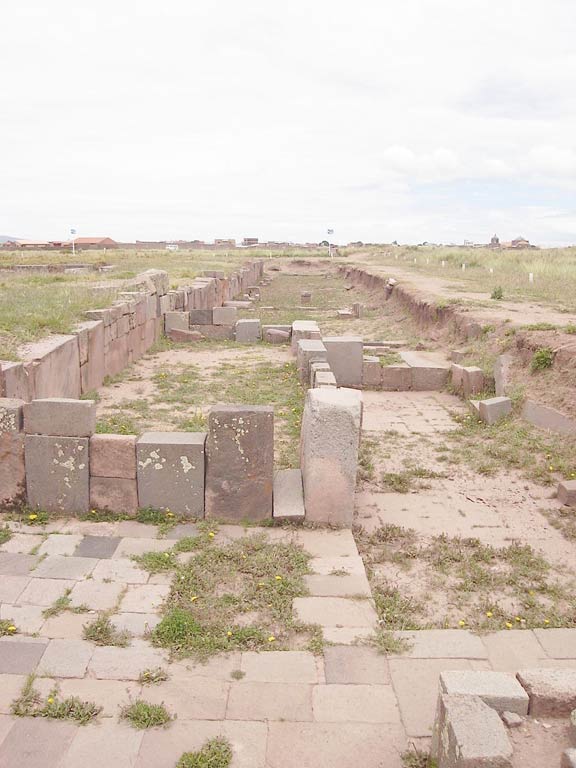
The complex included ceremonial courtyards, platforms, walls, stairways, and monumental structures. Their arrangement suggests careful planning. Architecture served both practical and symbolic purposes, connecting political authority, religious beliefs, and ancient ideas about the order of the world.
Kalasasaya and the Gateway of the Sun
Kalasasaya is one of the best-known parts of the archaeological complex. It is a large ceremonial enclosure surrounded by stone walls and upright stone elements. The space was probably used for rituals and public ceremonies, although the precise function of individual features remains under study.
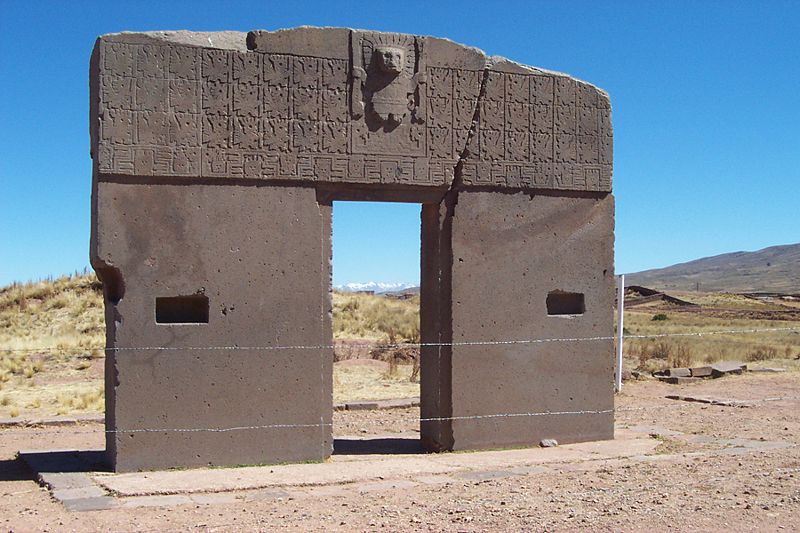
Kalasasaya is associated with the famous Gateway of the Sun, a monolithic monument carved from a single block of andesite. Its upper section features a central figure often interpreted as a deity or an important mythological being. Rows of winged figures appear on either side, accompanied by intricate geometric details. These images are among the most recognisable works of ancient Andean art.
The Gateway of the Sun is remarkable for both its craftsmanship and its possible religious significance. Researchers suggest that its imagery may relate to celestial powers, calendar cycles, and social order. The exact meaning of the symbols remains uncertain, so popular explanations should be treated as hypotheses rather than established facts.
Kalasasaya and the Semi-Subterranean Temple
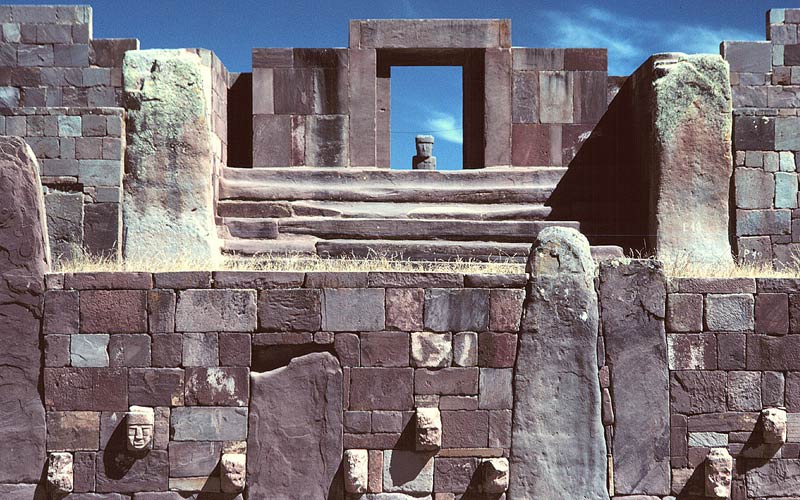
Another major feature of the complex is the semi-subterranean temple. Its walls are decorated with numerous stone heads projecting from the masonry. Each has distinctive facial features and stylistic details. Researchers have proposed various interpretations: the heads may represent mythical beings, ancestors, sacrificial figures, or symbolic images connected with religious ceremonies.
The temple's interior differs from the open ceremonial courtyards elsewhere in the complex. Its architecture and decoration demonstrate the diversity of Tiwanaku's religious structures. Fragments of platforms and walls throughout the site also help archaeologists reconstruct the original appearance of the ancient city.
Akapana: The Monumental Platform
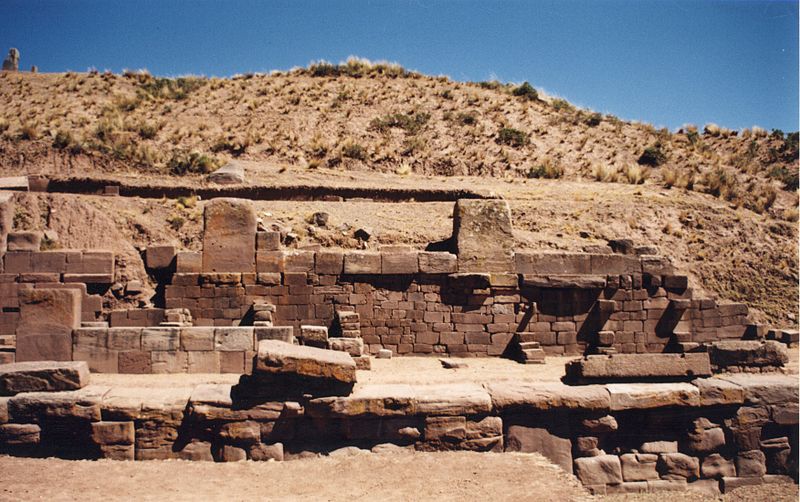
Akapana is one of Tiwanaku's largest structures, a massive stepped platform resembling a terraced pyramid. Its original form and individual architectural features are reconstructed through archaeological research. Building such a monument required organised labour and substantial resources.
The purpose of Akapana remains debated. It may have served ceremonial and religious functions, and its location may have carried symbolic meaning. Archaeologists also study its drainage system and other engineering features. These details suggest that the builders paid attention not only to appearance but also to water management on the high plateau.
The platform has suffered considerable damage over time, and some stones have been lost or displaced. Researchers distinguish surviving ancient elements from later restoration work to avoid giving the impression that the original structure remains fully intact.
Agriculture and Life on the Altiplano
Tiwanaku's development depended heavily on the ability to produce food in high-altitude conditions. The region used raised agricultural fields known as suka kollus. Water channels between the raised beds could help regulate moisture and reduce the effects of night frosts. This system allowed productive farming despite a challenging climate.
Residents cultivated potatoes and other crops adapted to the highlands and raised llamas and alpacas. These animals provided wool, meat, and transport for goods. Farming, herding, and trade supported the population and strengthened connections with distant regions.
Control of agricultural resources probably played an important role in Tiwanaku's political organisation. Food production and distribution helped support artisans, builders, and participants in religious ceremonies. The exact structure of government and the relationship between the centre and surrounding settlements remain subjects of research.
Religion, Art, and Symbols
Religious beliefs occupied an important place in Tiwanaku society. Monumental temples, carved images, stone stelae, and ritual objects provide evidence of this importance. Art repeatedly features human figures, winged beings, animals, and intricate geometric patterns. Some images may have expressed ideas about fertility, authority, ancestors, and the relationship between people and natural forces.
A particularly important image appears on the Gateway of the Sun. It is often called the Staff-Bearing Deity. Related imagery appears in other Andean cultures, although its interpretation and historical connections remain complex. Researchers compare these images with pottery, textiles, and other discoveries to understand how religious ideas and artistic styles spread.
Tiwanaku art was notable not only for its monumental scale but also for its elaborate symbolic language. Repeated figures and patterns may have communicated religious ideas in a society that did not use writing in the modern sense. Sculpture and architecture therefore remain essential sources for understanding its worldview.
Tiwanaku and the Inca Legacy
Tiwanaku emerged and reached its height long before the Inca Empire formed. Nevertheless, its monuments and cultural traditions became part of the wider history of the Andes. Later, the Incas attached great importance to ancient sacred places and incorporated them into their own ideas about origins and the sacred geography of the region.
Tiwanaku and the Incas were different societies separated by time and political circumstances. Tiwanaku should therefore not be described as an Inca city. Its significance lies in the independent development of a complex civilization that made major contributions to architecture, religious art, and high-altitude agriculture.
Tiwanaku Today
Today, the archaeological complex is one of Bolivia's most important historical sites. In 2000, Tiwanaku was added to the UNESCO World Heritage List as an outstanding testament to the cultural and political development of ancient Andean societies. The protected area includes the principal monumental structures and related archaeological zones.
Museums near the ruins display pottery, stone sculptures, and other finds that help explain the everyday life and artistic traditions of the ancient population. Archaeological research continues, while specialists work to conserve the stone structures, study the original layout, and protect the site from deterioration.
Visiting the Archaeological Complex
Tiwanaku is located about 70 kilometres west of La Paz. Visitors usually reach it by road on a day trip or an independent excursion. The site includes Kalasasaya, the Gateway of the Sun, the semi-subterranean temple, and the Akapana platform, as well as archaeological collections in nearby museums.
At an elevation of about 3,850 metres, some travellers may need time to acclimatise. The climate is cool, sunlight can be intense, and weather conditions may change quickly. Warm clothing, a hat, sun protection, and drinking water are useful. Visitors should follow site rules, avoid climbing fragile structures, and refrain from touching ancient stones.
The Mystery of the Ancient Andes
Tiwanaku brings together remarkable architecture, sophisticated agricultural technology, and a rich symbolic culture. Its stone monuments recall a civilization that established an influential centre in a demanding high-altitude environment and left a lasting mark on South American history. Despite extensive research, many details of Tiwanaku life and beliefs remain unknown. This combination of historical importance and unanswered questions makes the complex especially fascinating to visitors.
Gallery