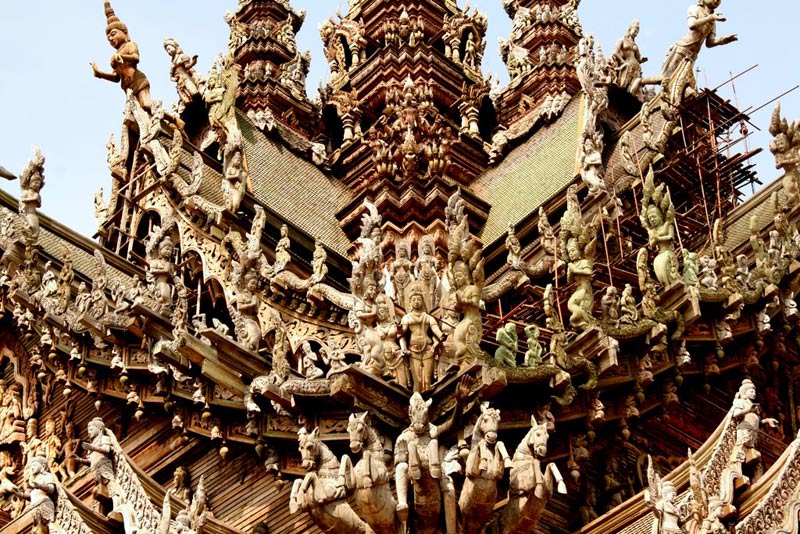
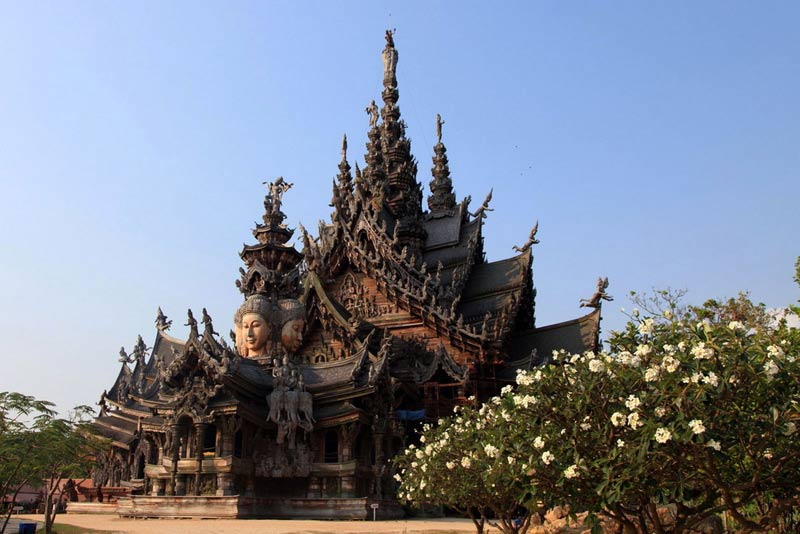
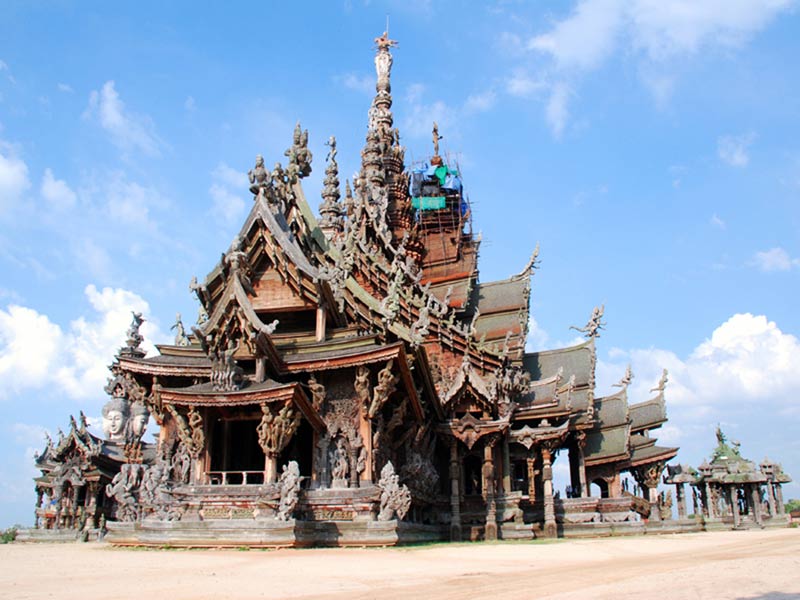
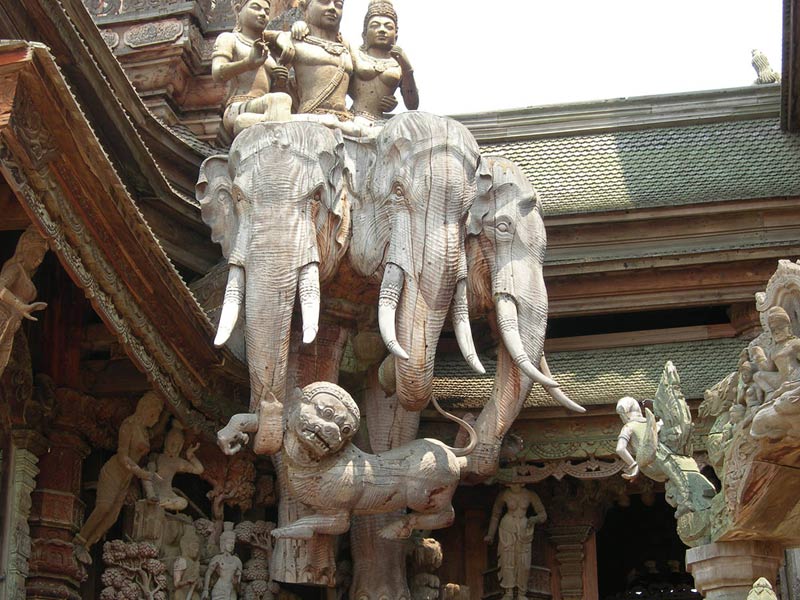
The Sanctuary of Truth is an extraordinary architectural complex on the Gulf of Thailand in northern Pattaya. This immense wooden structure is covered with intricate carvings depicting deities, mythical beings, people and symbols from Eastern religious and philosophical traditions. Often called a wooden castle, it is more than an impressive landmark: its architecture explores questions about life, morality, human nature and the universe.
The complex stands on Laem Ratchawet in the Na Kluea area. Its multi-tiered roofs, tall spires and sculptural decorations create a striking silhouette against the sea. It appeals to travellers interested in Asian art, traditional woodcarving and Eastern philosophy.
History of the Sanctuary of Truth
Construction began in 1981 at the initiative of Thai businessman and patron Lek Viriyaphan. His vision was to create a structure combining traditional craftsmanship with reflections on spiritual values and humanity’s place in the universe.
Unlike many historic temples in Thailand, the Sanctuary of Truth is a modern artistic project inspired by traditional building techniques and Asian cultural imagery. Work has continued for decades because the wooden structure requires constant care in the tropical coastal climate. Craftspeople keep creating new carvings and maintaining existing elements.
Architecture of the wooden castle
The structure reaches approximately 105 metres in height and features tall towers, tiered roofs, galleries, columns and countless sculptures. Different types of timber are used, and traditional joinery plays an important role in the construction. The wood is left visually prominent, allowing its natural grain and colour to contribute to the artistic design.
From outside, the building resembles a fantastical castle crowned with spires. Reliefs, ornaments and mythological scenes cover façades, ceilings, columns and doorways. Many details tell their own stories, so it is worth looking closely rather than admiring only the overall silhouette.
Symbolism and philosophy
The central idea of the Sanctuary of Truth is the search for answers to fundamental questions: where humanity comes from, what gives life meaning, how people relate to nature and which values help society flourish. Architecture and sculpture express these ideas through symbols and allegories.
The artistic programme brings together motifs from Buddhism, Hinduism and other Asian spiritual traditions. Visitors encounter deities, celestial beings, mythical animals and images connected with human life. The complex is not devoted exclusively to one religion; its broader vision combines different Eastern traditions into a single artistic and philosophical concept.
Four Eastern artistic traditions
Thai, Khmer, Indian and Chinese influences can be seen in the rooflines, ornaments, sculptures and religious imagery. The result is not a reconstruction of one ancient monument, but a contemporary creation that draws freely on the artistic heritage of several cultures.
Woodcarving: the heart of the complex
Intricate carving covers almost every visible surface. Craftspeople produce three-dimensional figures, floral patterns, mythological scenes and decorative compositions. The work requires precision because wood grain, moisture and the strength of each component must all be considered. The carved elements serve both structural and artistic purposes.
Visitors may see craftspeople at work and learn how labour-intensive it is to create and maintain such a structure. Continuing the work also helps preserve traditional carving skills for future generations.
What to see inside
The interior features towering wooden columns, decorated ceilings and a dense collection of sculptures. The compositions explore spiritual beliefs, myths and human virtues. Look beyond the largest figures to the details around doorways, on columns and beneath the roof structures.
Some areas may be restricted because construction or restoration work is ongoing. Follow staff instructions and do not cross barriers.
Why construction continues
A wooden building beside the sea is exposed to humidity, salt air, sunlight and changing weather. Individual components therefore need maintenance, repair or replacement. Construction and artistic work remain part of the complex’s life, and visitors may see elements at different stages of creation or restoration.
The Sanctuary and the sea
The setting beside the Gulf of Thailand is an important part of the experience. The grounds offer views of the water and coastline, while the wooden spires stand out against the sky. Interesting photo opportunities include the complete exterior, close-ups of the carvings and views combining architecture with the sea.
Where the Sanctuary of Truth is located
The complex is in Na Kluea, northern Pattaya, Chonburi Province. Its address is 206/2 Moo 5, Soi Naklua 12, Pattaya–Naklua Road, Bang Lamung, Chonburi. From central Pattaya, visitors can travel by taxi, car or local transport with a transfer. Journey times depend on the starting point and traffic.
From Bangkok, take a bus to Pattaya and continue by local transport or taxi. Check the route and return arrangements before setting out.
Opening hours and tickets
According to the official website, the complex opens daily. Daytime tickets are generally available from 8:00 a.m. to 5:00 p.m., with day visits running approximately from 8:20 a.m. to 6:00 p.m. Evening visits run around 6:20 p.m. to 8:30 p.m., and evening tickets are available from 5:30 p.m. to 7:30 p.m.
The official website lists adult tickets at 500 baht for daytime visits and 700 baht for evening visits. Separate prices apply to children 110–140 cm tall, while children under 110 cm enter free. Prices and schedules may change, so check the official visitor information before travelling.
Visitor rules
Modest clothing covering shoulders and knees is recommended. Because work continues inside the complex, follow safety instructions; protective helmets may be required in certain areas. Drones, smoking inside the museum, food, drinks and pets are prohibited. Do not touch carvings or enter work zones.
How much time to allow
Allow around two to three hours, or longer if you enjoy architecture and photography. A guided tour helps explain the philosophical symbolism behind the sculptures. Wear comfortable shoes, bring water and take precautions against the sun in hot weather.
Best time to visit
The Sanctuary can be visited throughout the year. Outdoor exploration is often easier in the drier season, while the rainy season can bring heavy showers. Daytime visits are convenient for studying the carvings, while evening visits offer a different atmosphere and lighting.
Nearby attractions
After visiting, explore Wongamat Beach or the Na Kluea neighbourhood. Other parts of Pattaya offer viewpoints, gardens, museums and cultural attractions. Travellers interested in Thai art can also plan separate trips to the Ancient City museum complex or the Erawan Museum in Samut Prakan Province.
Why visit the Sanctuary of Truth
The Sanctuary of Truth combines monumental wooden architecture, hand-carved decoration and a philosophical vision. Its art explores spiritual traditions, moral values and the search for meaning. It is one of Pattaya’s most distinctive attractions for anyone interested in Asian culture and craftsmanship.
Gallery