Kaunos is an ancient city in southwestern Turkey, opposite the modern settlement of Dalyan, on the river that connects Lake Köyceğiz with the Mediterranean Sea. Its ruins lie among the hills, cliffs, and green valleys of Muğla Province. Kaunos is known for monumental rock-cut tombs, an ancient theatre, and the remains of temples, baths, an agora, and defensive walls. The site reveals how an important harbour city developed in the ancient world and how changes in the natural landscape shaped its fate.
Archaeological evidence indicates that settlement here dates back at least to the 10th century BC. In antiquity, Kaunos stood near the border between Caria and Lycia and developed a distinctive political and cultural identity. It minted its own coins, participated in regional trade, and passed under the control of several powers over the centuries. Today, the archaeological site is included on Türkiye's UNESCO World Heritage Tentative List.
Location and natural setting
Kaunos lies in the Köyceğiz district of Muğla Province, opposite Dalyan. In ancient times, the city stood beside a coastal inlet and had a convenient harbour that supported trade with settlements across the Aegean and Mediterranean. The sea is now much farther from the ruins. Over the centuries, river sediments filled the former inlet, forming a delta and changing the coastline.
The surrounding landscape combines rocky heights, Mediterranean vegetation, river channels, and wetlands. The rock-cut tombs are clearly visible from the water, rising above green slopes. This combination of archaeological remains and natural scenery makes Kaunos appealing to history enthusiasts as well as travellers who enjoy peaceful walks and scenic views.
History of the ancient city
The history of Kaunos began long before the monumental buildings that survive today were constructed. Archaeological material points to an early settlement, while the most prominent architectural remains belong to later ancient periods. Herodotus associated the inhabitants with the local people of Caria, although ancient tradition also records that the Kaunians considered themselves descendants of settlers from Crete.
Its harbour and strategic position helped Kaunos become an important trading centre. Goods moved through the city, and the minting of its own coins reflected its economic importance. At different times, Kaunos came under Persian rule, Carian dynasts, Hellenistic kingdoms, Rhodes, and Rome. Political changes influenced its architecture, fortifications, and public life.
Gradually, environmental changes deprived Kaunos of direct access to the sea. Sediment accumulated in the inlet, the harbour became less convenient for shipping, and the city's economic importance declined. Its ruins preserve evidence of several historical periods and remain valuable for understanding the history of southwestern Anatolia.
The famous rock-cut tombs
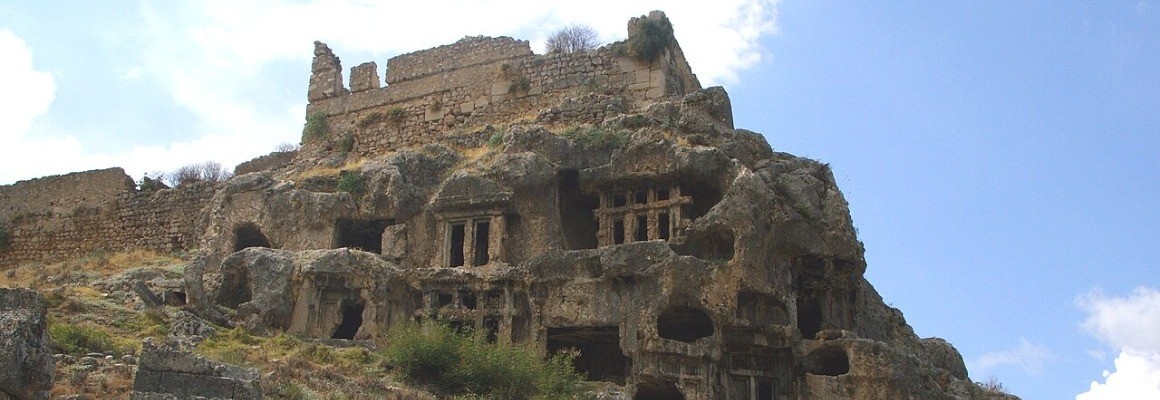
The best-known landmark of Kaunos is its monumental tombs carved into steep cliffs, visible from the Dalyan River. The most prominent examples date to the 4th century BC. Some façades resemble Ionic temples, with columns, horizontal architectural elements, and pediments. Their elaborate design gave the burial monuments a ceremonial appearance and reflected the status of those buried inside.
The tombs were cut directly into the rock. Their architecture combines local funerary traditions with forms familiar from the Greek world. Some chambers contained stone burial benches, and certain tombs continued to be used in later periods, including Roman times.
The façades are especially striking when viewed from the water, rising above the river and green slopes. They have become one of the symbols of the Dalyan area. Visitors should treat the monuments with care and avoid climbing dangerous slopes or damaging the stone surfaces.
The ancient theatre
Another major monument is the ancient theatre at the foot of the acropolis. Its semicircular seating faces the stage area and offers a glimpse of public entertainment in the ancient city. The theatre hosted performances and other events that brought residents and visitors together.
Parts of the seating and architectural features survive, although the building is not completely intact. Other ruins nearby belong to different phases of the city's history. The theatre is particularly interesting because of its position between the public centre of Kaunos and the acropolis above it.
The acropolis and city walls
The acropolis stands on a hill approximately 152 metres high. From this elevated position, visitors can look across the archaeological site, the valley, and the area around Dalyan. Its height had defensive value and helped the city control approaches to its settlement and harbour.
The city walls were built and modified over several periods. Some sections date to the Archaic period, while others belong to the Hellenistic era or later. The northern fortifications include medieval elements. Differences in masonry reveal how the city's defensive needs changed over time.
The agora, temples, and Roman baths
Kaunos preserves remains of public and religious buildings that offer insight into everyday life. These include sections of the agora, where trade and public interaction took place, the remains of temples, and Roman baths. Archaeologists have also identified a monumental fountain and other elements of the city's infrastructure.
Near the theatre are the remains of a basilica-style Christian building, evidence that the city continued to be occupied into Late Antiquity and later periods. The combination of ancient and later structures reflects cultural changes in the region. The function of some ruins remains uncertain and continues to be studied by archaeologists.
The legend of Kaunos's foundation
An ancient legend tells of Kaunos and Byblis, the children of Miletus. According to the story, Byblis developed feelings for her brother that he rejected. Kaunos then left his homeland and travelled to the region between Caria and Lycia, where he founded a city that took his name. The story is known from ancient literature, including the Roman poet Ovid.
The legend does not establish the historical circumstances of the city's foundation, but it illustrates how ancient writers explained place names through myths about heroes, family lineages, and migration.
Archaeology and heritage protection
Although scholars knew of Kaunos from historical accounts, the exact location of the city remained a mystery for a long time. In 1842, the British archaeologist Hoskyn discovered its ruins. Later research helped define the city's boundaries and investigate its architecture, coins, tombs, and trading connections.
In 2014, Kaunos was added to the UNESCO World Heritage Tentative List. This means that it is being considered as a potential candidate for the main World Heritage List; it does not mean that the site has already received World Heritage status. Protecting the stonework, tombs, and archaeological layers is essential to preserving the site.
Best time to visit Kaunos
The archaeological site can be included in a trip along Turkey's southwestern coast during much of the tourist season. Spring and autumn usually offer more comfortable conditions for walking around the open site. Summer can be hot, so an early-morning or late-afternoon visit is often preferable. Bring drinking water, a hat, and sun protection.
The main ruins can be explored in a few hours, depending on how much time you want to spend on archaeology. Comfortable footwear is important because the terrain includes uneven stone surfaces and sloping paths. Check current opening hours and visitor rules on the official Turkish Museums website before travelling.
How to get to Kaunos
One convenient way to reach the ruins is to take a boat from Dalyan along the river and then walk from the landing point to the archaeological site. Kaunos can also be reached overland from the Ortaca area. The best route depends on your starting point, the season, and available transport.
A visit is often combined with a boat trip on the Dalyan River, viewing the rock tombs from the water, and exploring the natural environment of the delta. This route offers different perspectives on the monuments and helps explain the ancient city's close relationship with river and maritime trade.
Kaunos is more than a collection of ruins: it is a historic landscape where archaeology and nature are closely connected. Its rock-cut tombs, theatre, acropolis, and former harbour tell the story of a city that prospered through trade before gradually losing importance as its environment changed.
Gallery