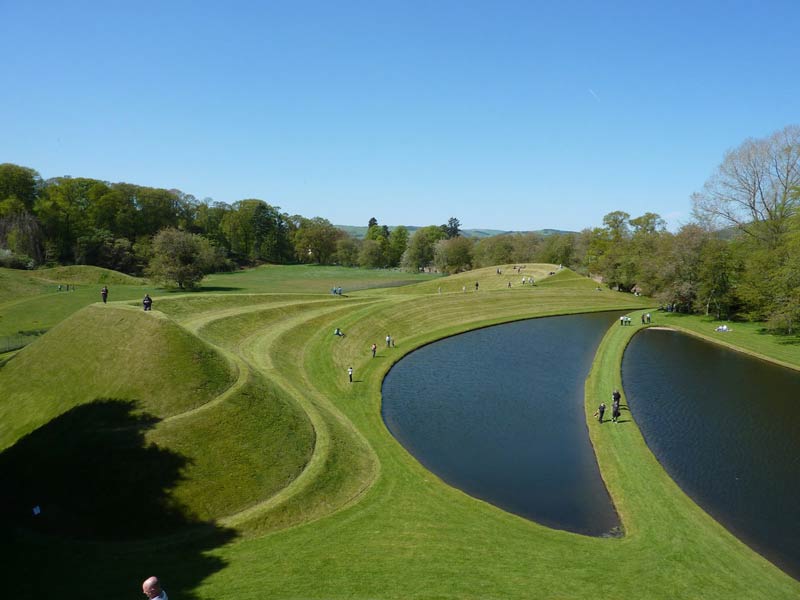
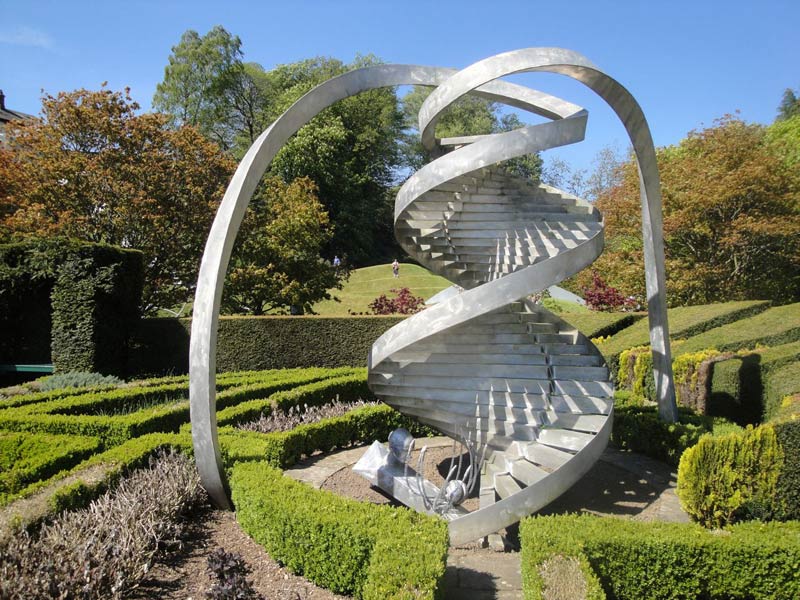
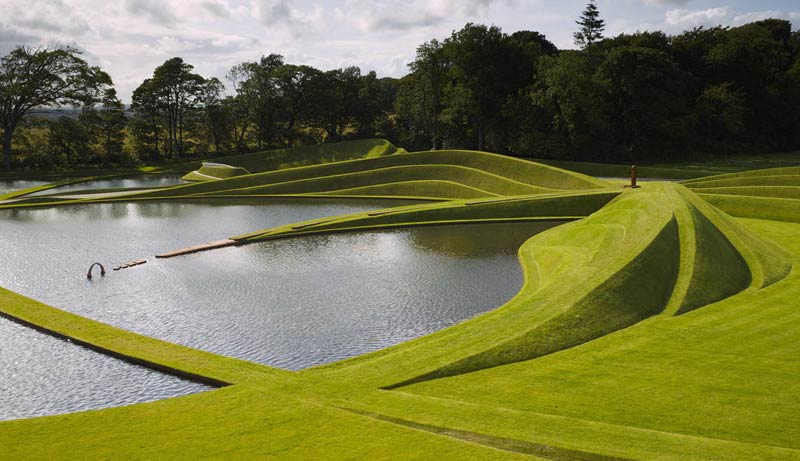
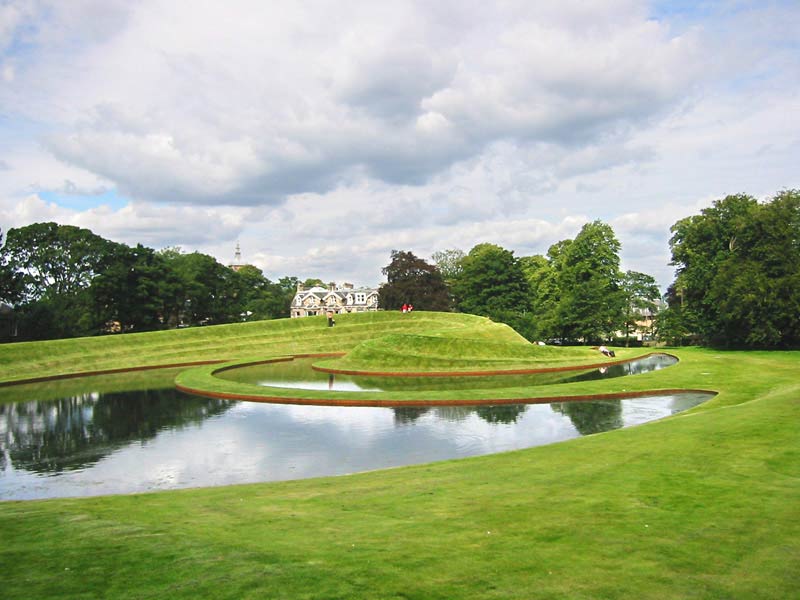
The Garden of Cosmic Speculation is an extraordinary landscape garden and work of contemporary art located at the Portrack estate near Dumfries in southwest Scotland. Its creators transformed the landscape into a large-scale artistic composition inspired by mathematics, physics, cosmology and the structure of the universe. Hills resemble mathematical surfaces, water cascades evoke the evolution of the cosmos, and paths, bridges, sculptures and ponds translate complex scientific ideas into physical space.
Origins of the garden
The project began in 1988 through the work of landscape designer Charles Jencks and his wife, Maggie Keswick. The ordinary grounds of a country estate gradually became an experimental landscape where architecture, sculpture, planting and landforms formed part of a unified artistic vision. Jencks wanted to develop a new language of landscape design capable of expressing scientific and philosophical ideas through natural materials.
The garden evolved over several decades. New elements were added gradually, with contributions from family members and gardeners. The result is a place where individual areas explore different themes while contributing to a wider vision of the relationship between nature and the universe.
The cosmos in landscape art
The garden's central idea is that the world can be understood as a system of interconnected processes. From the smallest particles to galaxies, nature reveals repeating structures, waves and patterns. Jencks expressed these ideas not through museum displays but through a landscape that visitors could walk through and experience from different viewpoints.
Curving landforms resemble mathematical functions, unusual hills suggest complex geometry, and water evokes movement and change. The garden is not a science museum or a substitute for a physics textbook. Its purpose is to spark curiosity and encourage reflection on the scale and structure of the universe.
The water cascade and cosmic history
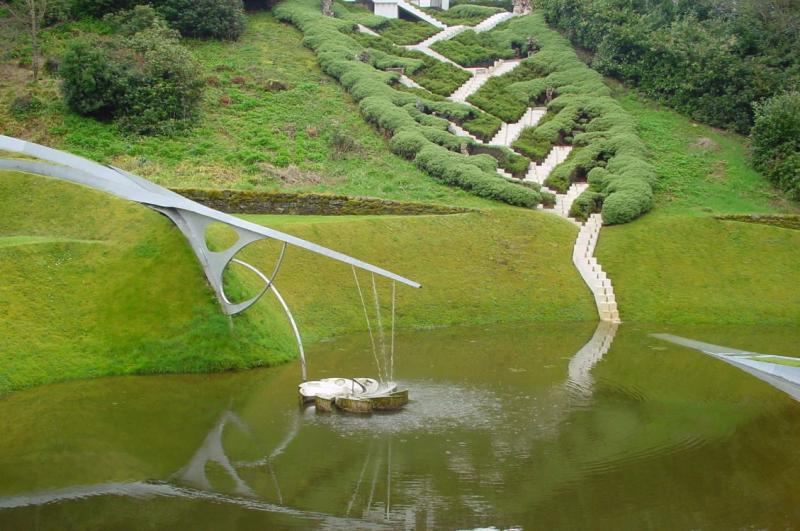
One of the garden's best-known features is a cascade whose sequence of steps and flowing water symbolically recounts the development of the universe. Water moves through a series of levels, creating a visual rhythm of gradual change. It also reflects the surrounding forms and contrasts with the apparently motionless landforms.
Quantum physics and the Quark Walk
Another distinctive feature is the Quark Walk, inspired by the fundamental constituents of matter and the challenge of imagining structures that cannot be seen directly. Its name refers to quarks, particles involved in forming protons and neutrons. The path turns a walk through the garden into an imaginative journey toward the building blocks of matter.
Fractals and mathematical forms
The landscape contains shapes reminiscent of fractals and repeating geometric patterns. Hills, hollows and winding lines create visual analogies with patterns found in nature. These forms cannot be fully appreciated from a single viewpoint; their appearance changes as visitors move through the garden and see them from different angles.
Space, time and architecture
Some features draw inspiration from modern physics, including the relationship between space, time and gravity. A terrace refers to the distortion of spacetime associated with a black hole. It is an artistic interpretation of scientific ideas rather than a literal physical model.
The grounds also contain bridges, sculptures, terraces and architectural structures. One is Octagonia, an octagonal summerhouse dating from the 18th century that was moved to the estate in 1970. Jencks later redesigned its interior around the concept of the number eight.
Plants and the natural setting
Trees, shrubs, flowering plants and lawns frame the sculptural landforms. Planting creates colour contrasts, emphasises the terrain and changes with the seasons. The garden lies near the River Nith, amid the green hills and rural scenery of southwest Scotland.
Charles Jencks and his legacy
Charles Jencks was a prominent theorist of postmodernism, architectural critic and landscape designer. He began developing the garden with Maggie Keswick in 1988. After Maggie's death in 1995, work continued, and Jencks developed the project until his death in 2019. Ideas explored at Portrack influenced several of his later landscape projects.
Visiting the garden
The garden lies at the Portrack estate near Holywood, about six kilometres northwest of Dumfries. It is privately owned and usually opens to the public for just one charity day each year, normally around the May bank holiday. Advance tickets are required.
According to the organisers' latest announcement, the garden will not open in 2026 because extensive building work at the house makes visitor access unsafe. Check the official website for information about any future opening dates.
Why the garden matters
The Garden of Cosmic Speculation brings landscape design, art and scientific ideas together. Water cascades, fractal forms, sculptural hills and symbolic paths offer an unusual way to think about the universe. It is not an ordinary park but a large-scale artwork that unfolds through movement, observation and contemplation.
Gallery