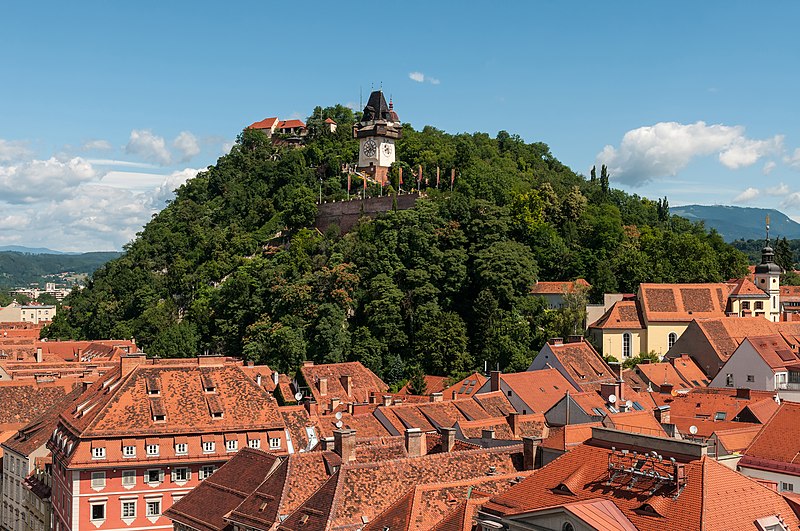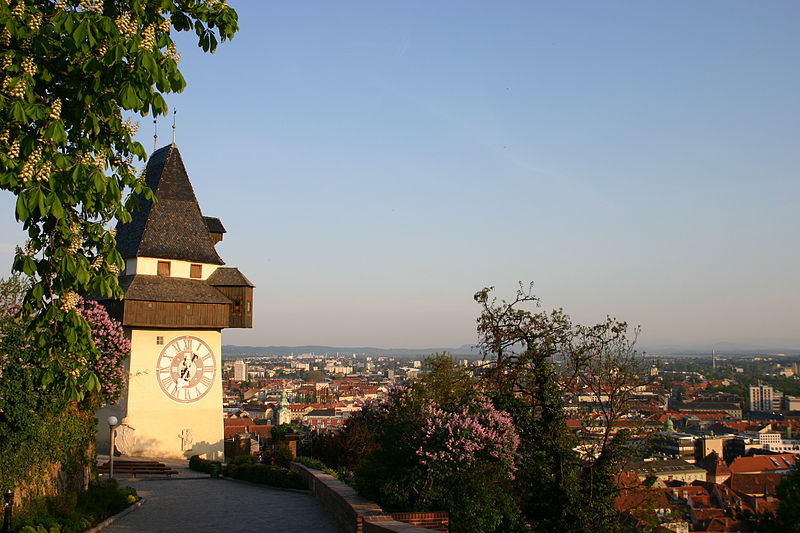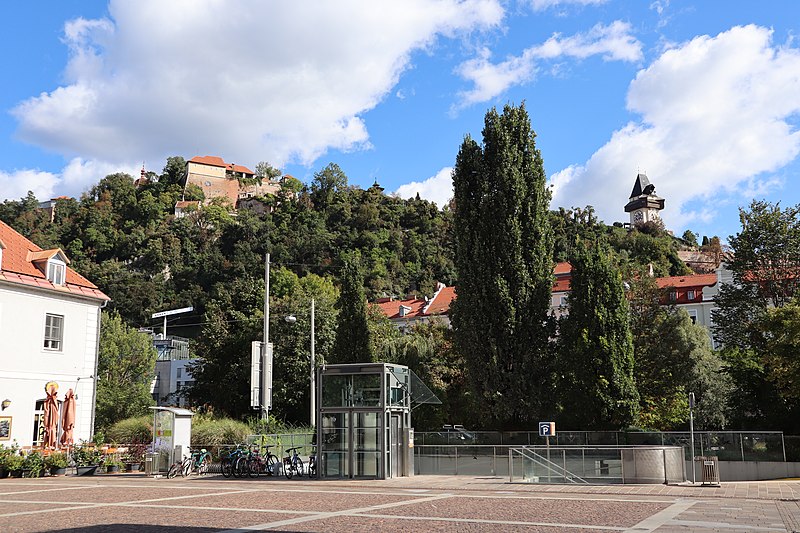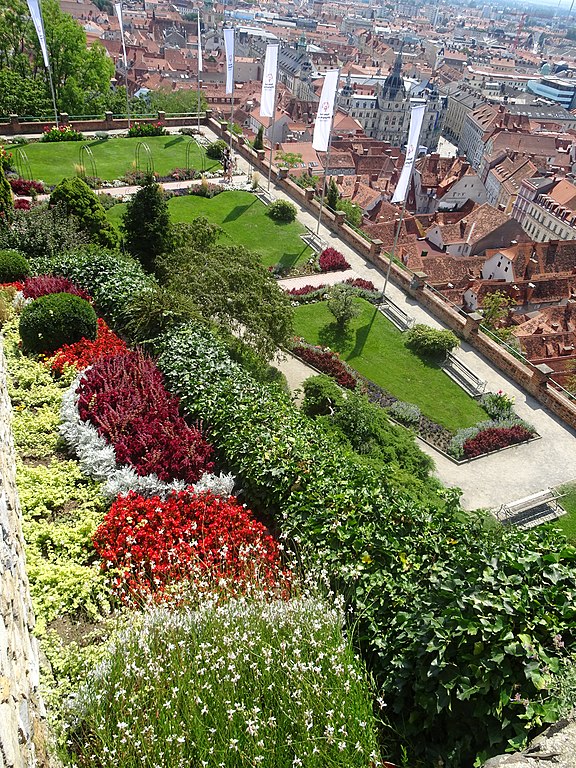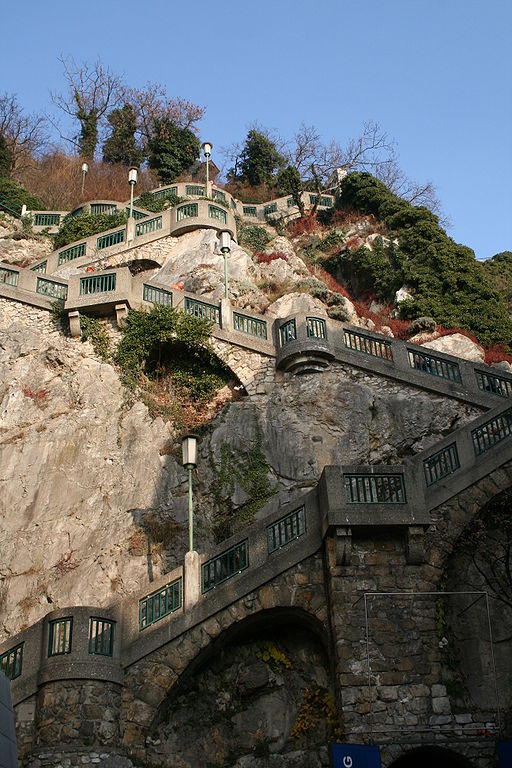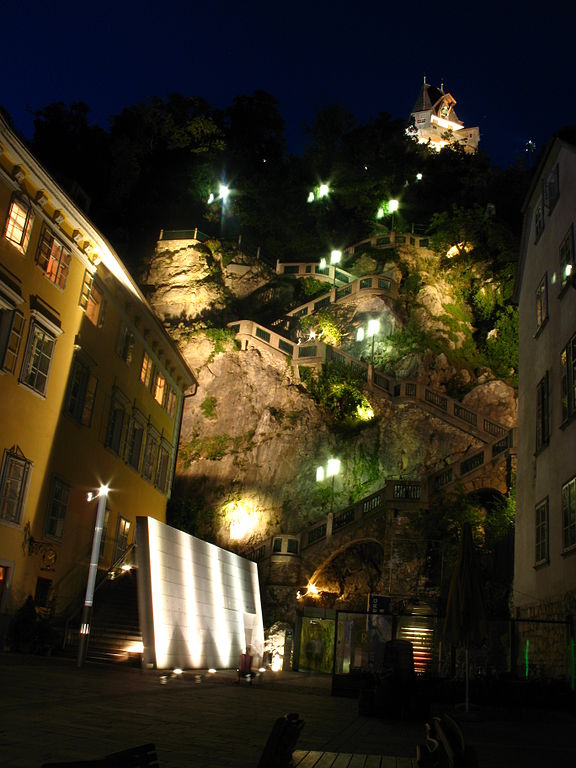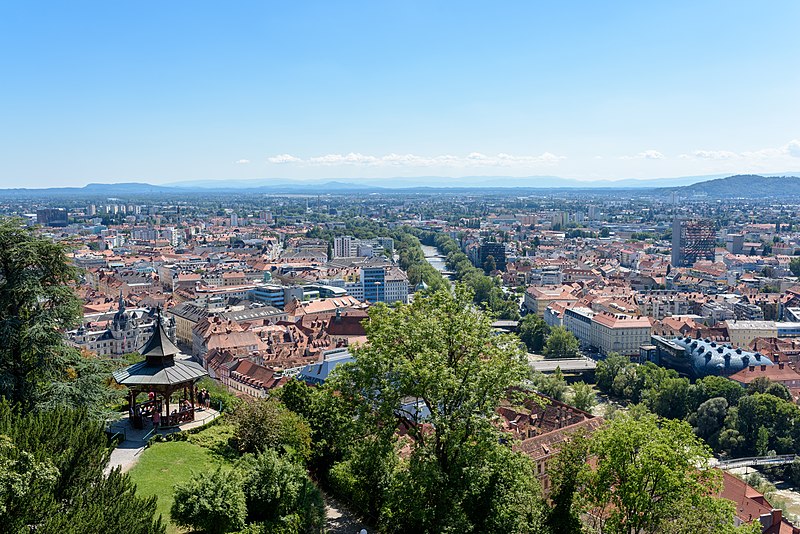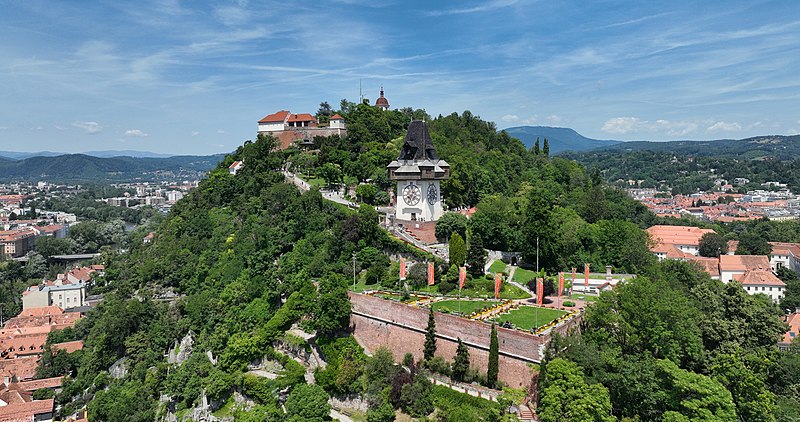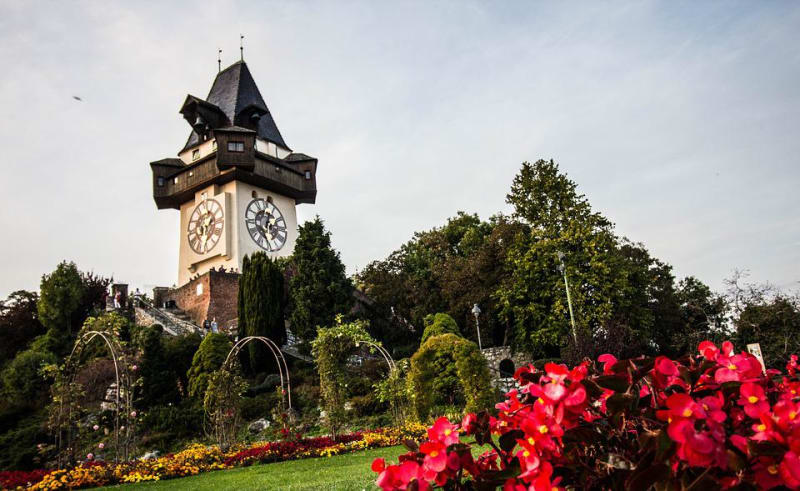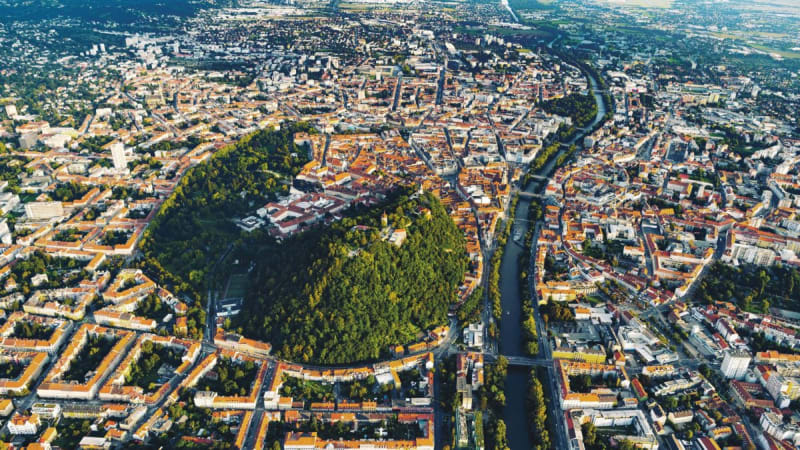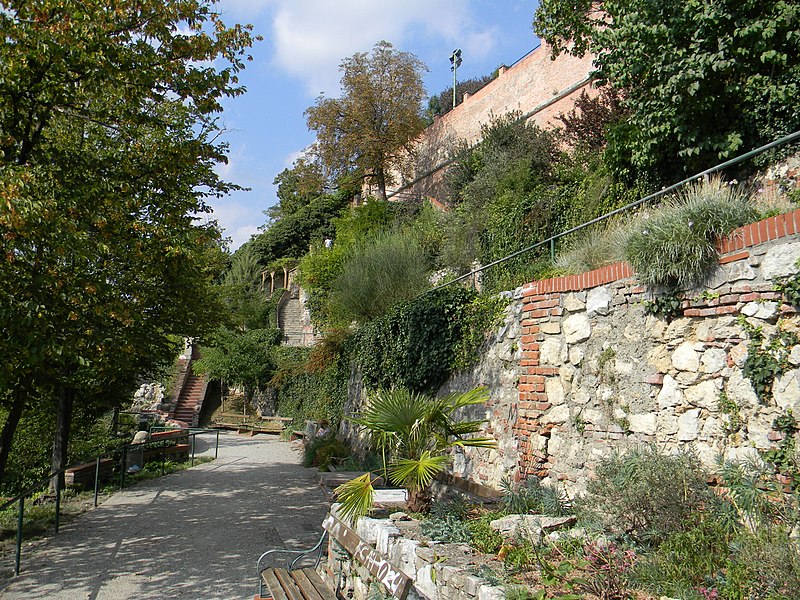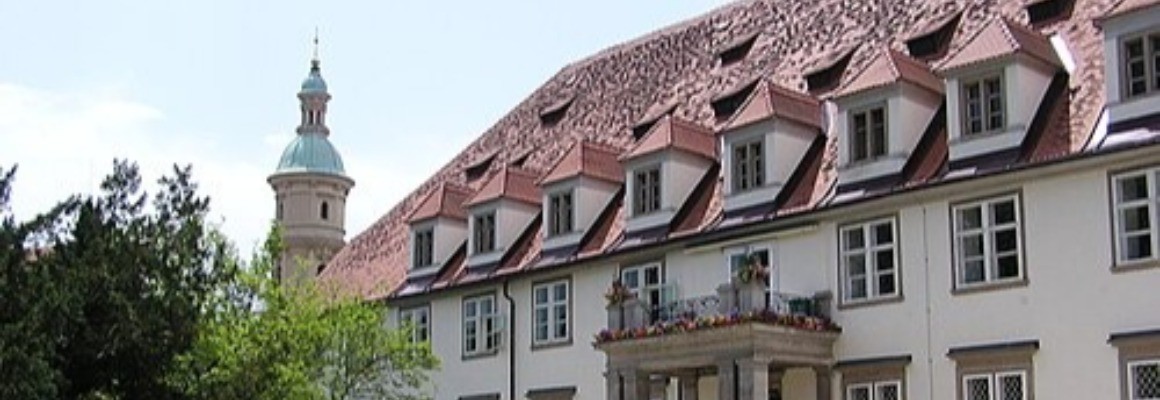

The castle-fortress is located on a hill 473 m high. Schlosberg translates as "castle hill". The castle can be reached on foot, by funicular or elevator. In addition to tourists, locals like to spend time here. There is an excellent park near the castle. The park is intersected by historical trails, and from the observation deck on the hill you can admire the views of ancient Graz. At one time it was the capital.
History of the castle
There is a legend that the name of the city "Graz" is a derivative of "Hradec" – "fortification" in Slavic. Slavs have inhabited these places since ancient times. A substantial defensive structure was built on the hill. The settlement around the fortress became a place of lively trade. 200 years later, the residence of the great Habsburgs was located in Graz. The construction of the castle began with the Bergfried Tower. Then the Urturm clock tower with a height of 28 m was rebuilt, on all 4 facades of which clock faces are installed. The clock mechanism has been in operation since the beginning of the 18th century. The landscapes of Graz are perfectly visible from the height of the tower. 2 bastions and a bell tower are well preserved. The tower itself is remarkably visible from almost all urban areas.
The construction of the castle began in the 12th century in 1125. The sturdy fortress and the surrounding city played an important defensive and defensive role on the borders of the Roman Empire. The castle has survived more than one siege and attack, but has never been captured. The troops of the Ottoman Empire repeatedly attacked Graz and the Schlosberg fortress. In 1531, the Turks again tried to capture the fortress and the city, which prevented them from moving further into Europe. They were defeated in the battle at the River Mur. As a result of the military events, the mountain was pretty much destroyed and the fortress also suffered.
In 1543, it was decided to begin grandiose work to restore and strengthen the defensive capacity of the castle-fortress. The famous Italian architect Domenico Del Alio was assigned to lead the construction. He came up with the idea to install an elevator to deliver heavy materials and people to the top of the hill to the fortress. The old buildings were replaced with more modern and sturdy ones. The works were completed at the end of the 16th century.
In 1809, Napoleon defeated Vienna, but Graz and the castle resisted. French troops partially destroyed the mountain, but they could not take the fortress. Napoleon ordered the burning of houses in Vienna every day until Graz surrendered. The defenders had to give in. Napoleon ordered the Schlossberg to be razed to the ground. But the residents collected the money and gave it to Bonaparte as a payoff so that he would not touch the bell tower and the clock tower.
Schlosberg Castle, an unconquered fortress, is listed in the Guinness Book of Records. From Schlosberg Castle there is a passage to Graz Castle along the inner side of the city wall. In 1999, Schlossberg Castle was included in the UNESCO World Heritage List as a cultural monument. Concerts, theatrical performances, and festivals are often held in the castle. The event hall is organized at the casemates. They pull up the roof, assemble the stage and set up seats for the audience. The improvised hall has excellent acoustics. Both classical and modern pieces sound perfect in it.
Sights of Schlosberg Castle
There is a monument to a dog not far from the clock tower. There is a legend that the girl who lived in Schlosberg Castle rejected the groom. Out of revenge, he decided to kidnap the bride. The dog roused all the guards with his barking and saved them from the attack. Dogs are currently allowed to walk in the park, and even a special drinking bowl has been installed for them. It is interesting to take a look at the ancient well. Its depth is almost 100 m, and the tunnel reaches the river Mur. The well was built in 1544-1547. During the Turkish siege, thanks to the well, the inhabitants and defenders of the fortress were provided with water.
4 signal cannons attract the attention of tourists. They received the nickname "4 evangelists" because they warned of the approach of enemies with their shots. Tourists like to climb the ancient bell tower, it offers a view of the beautiful natural landscape and the city itself. Its height is 34 m. At one time, the bell tower was completely destroyed by the Turks, but in 1588 it was restored. Inside the tower there is a bell "Liesl". Its weight exceeds 4.5 tons. It is said that in 1587 it was cast from cannonballs obtained as a trophy during battles with the Turks. It took 101 balls to make the bell.
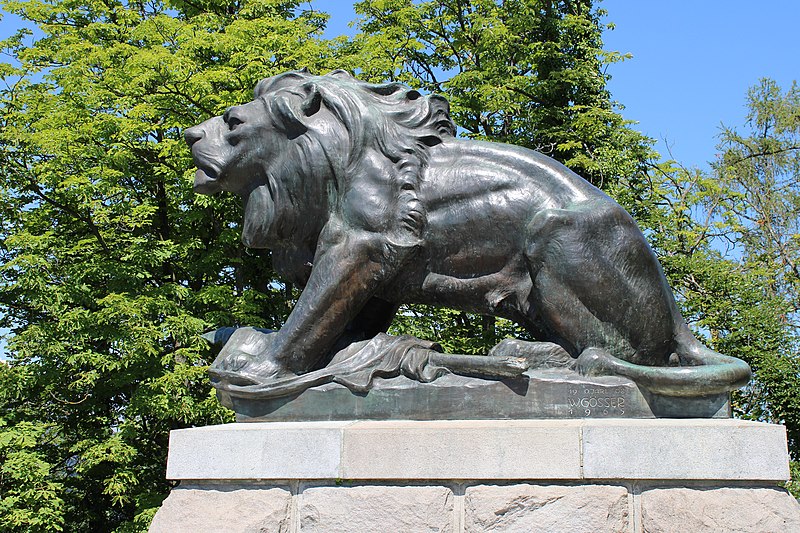
The lion sculpture, installed in 1908, is of interest. She is called "Lev Hackner". Hackner is the name of a brave major who commanded the fortress during the attacks of Napoleon's troops. There were fewer than 1,000 defenders of Schlosberg Castle, but they managed to repel 8 attacks by the French, whose number was 4 times more. Nobody knew Hackner's face at the time of working on the sculpture, so it was decided to depict him in the form of a mighty lion.
The mines in the mountain are surrounded by mystery. Previously, they could be used underground to get from one castle to another and enter the city.
Gallery