The Genoese Fortress in Sudak
The Genoese Fortress is a major medieval architectural landmark in Crimea. It stands on Fortress Hill above Sudak Bay, where stone walls, towers and the remains of historic buildings form an extensive fortified complex. The museum-reserve covers approximately 29.5 hectares and preserves the layout of a medieval trading town.
Early history of Sudak
The settlement near the bay predates the Genoese period. Medieval sources refer to the town by several names, including Sugdeya, Soldaia and Surozh. Its position on the Black Sea connected it with trade routes linking the Black Sea region, Byzantium, the Mediterranean and inland Eurasia.
The Genoese period
During the 14th century, Sudak became an important part of Genoese possessions in Crimea. The Genoese called it Soldaia and strengthened its defences to protect trade and residents. The main construction phase of the surviving fortress is generally dated to 1371-1469. The hill's steep slopes provided natural protection and offered views over the bay and approaches to the town.
Defensive walls and towers
The fortress used an outer line of walls and a higher defensive circuit protecting the citadel. Sections of the masonry preserve loopholes, battlements, passages and other details of medieval military architecture. Several towers are associated with the names of Genoese consuls and officials involved in their construction or repair.
The Consular Castle
The Consular Castle is one of the best-known structures in the upper fortress. It was associated with the administration and defence of the town's leadership. Nearby viewpoints offer broad views of the walls, the Sudak Valley and the Black Sea.
The Watchtower and Port Tower
Notable structures include the Watchtower, also called the Maiden Tower, and the Port Tower, known as Astaguerra. These towers helped monitor the surrounding landscape and protect approaches to the settlement. A local legend about the Maiden Tower tells of a ruler's daughter who rejected an unwanted marriage; it is folklore rather than a verified historical event.
Religious and civic buildings
The site preserves or has partially restored remains of religious and public buildings from different periods. These include the Church of the Twelve Apostles, the ruins of the Catholic Cathedral of the Virgin Mary and a mosque known as Padishah-Jami. Archaeological work has also uncovered traces of houses and workshops, revealing more about everyday life within the walls.
After the Genoese
In 1475, Ottoman forces captured Genoese possessions in Crimea, beginning a new chapter in Sudak's history. The fortress continued to be used and altered over subsequent centuries. After Crimea came under the Russian Empire in the late 18th century, military structures including an artillery redoubt and barracks were added. Its military role later declined, and many buildings fell into ruin.
Archaeology and restoration
The ruins attracted antiquarians and researchers during the 19th century. Major restoration work began in the 1960s, focusing on unstable sections of walls and towers. Today the fortress operates as a museum-reserve, preserving the medieval complex and hosting cultural events.
The fortress in film and culture
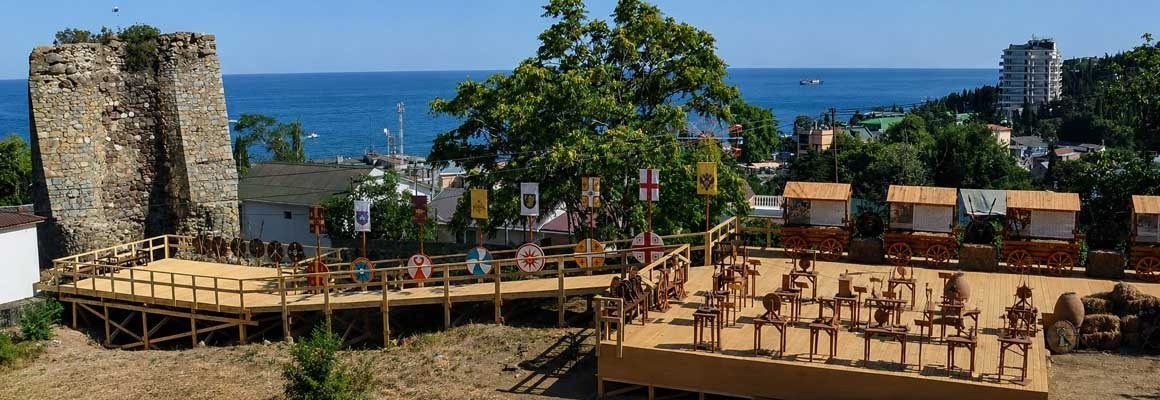
The towers, crenellated walls and sea views have made the fortress a popular setting for historical and adventure films. Cultural events and medieval-themed festivals may also take place here, depending on the season and the museum's programme.
What to see
Visitors can explore both defensive circuits, the towers, the Consular Castle and the remains of religious buildings. Viewpoints reveal Sudak Bay, the town and the surrounding mountains. The terrain is uneven and some paths are steep, so comfortable shoes are recommended. Allow several hours for a relaxed visit.
Planning a visit
The fortress is located near central Sudak at 1 Genoese Fortress Street. Visitors can reach it by local transport or on foot, allowing for the uphill approach. Spring and autumn can be comfortable for exploring, while summer visits require preparation for heat and limited shade. Check the museum's official website for current opening hours and access information.
The heritage of Sudak
The Genoese Fortress brings together the history of maritime trade, medieval military architecture and cultural exchange in Crimea. Its walls and towers show how a medieval town protected its residents and trading connections. Its surviving architecture and dramatic position above the bay make it one of Sudak's most recognizable historic landmarks.
Gallery