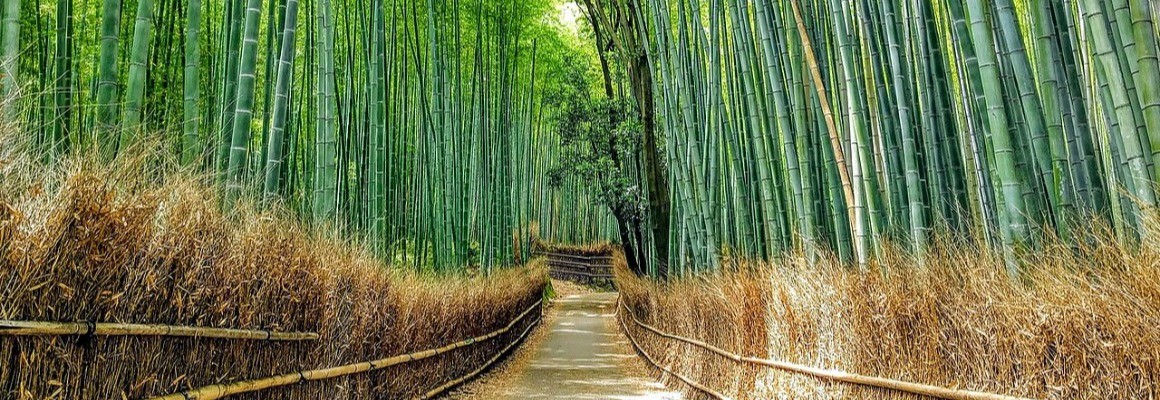
The Sagano Bamboo Forest is one of Kyoto's most famous natural attractions and one of Japan's most recognizable landscapes. Tall bamboo stalks form a dense green wall on both sides of the walkway, and sunlight breaks through the foliage in small patches. When the wind rises, the bamboo begins to sway and make a distinctive rustling sound.
The famous bamboo grove is located in Arashiyama district, in the west of Kyoto. However, the forest itself is only part of the large historical territory of Sagano and Arashiyama. Nearby there are ancient Buddhist temples, traditional gardens, the Oi River, the Togetsu-kyo Bridge and other interesting places.
That is why it is better to take a trip to the bamboo forest not as a visit to one small attraction, but as a walk through one of the most beautiful historical districts of Kyoto.
Where is the Sagano Bamboo Forest?
Bamboo forest is located in the western part of Kyoto, in the area of Saga Arashiyama. The grove is located near the Tenryu-ji Temple and the Saga-Arashiyama Railway Station.
The name Sagano refers to the historical area that occupies the northern part of Arashiyama district. For many centuries, this area has been associated with the nature and culture of Kyoto. Representatives of the aristocracy came here to admire the mountains, the river, autumn leaves and other natural landscapes.
Today, Sagano and Arashiyama are one of the most popular tourist areas in Kyoto. A large number of temples, gardens and traditional landscapes have been preserved here, and the bamboo grove has become the main symbol of this part of the city.
Why is the Sagano Bamboo Forest so famous
The main impression of the forest is created by tall bamboo stalks that grow very close to each other. They form a kind of green corridor, inside of which there is a pedestrian path. The height of the bamboo and the density of the thickets create an unusual sense of space. Even on a sunny day, it can be much darker inside the grove than in the open area. Light passes between the stems and leaves, and the wind makes the bamboo move and touch each other.
The sound of the wind in the bamboo grove is considered one of the features of this place. In Japan, the sounds of nature are traditionally perceived as an important part of the surrounding landscape, so a walk through Sagano is associated not only with visual impressions.
It is the combination of green bamboo walls, light, silence and characteristic rustle that has made the grove one of the most photographed places in Kyoto.
Are Sagano and Arashiyama the same place?
The names Sagano and Arashiyama are often used together, but historically they are different parts of the same large area.
Arashiyama is located south of the Oi River and is known for its temples, mountains and the Togetsu-kyo Bridge. Sagano is located north of the river. It is in this part that the famous bamboo forest is located.
In tourist guidebooks, the grove is often referred to as Arashiyama Bamboo Forest, although geographically it belongs to the Sagano region. Therefore, both names can be found when searching for information about the attraction.
Tenryu-ji Temple
One of the main attractions next to the bamboo grove is the Tenryu-ji Temple. It is one of the most important Zen temples in Kyoto and was founded in the 14th century. The temple garden is particularly famous for combining the traditional Japanese landscape with views of the surrounding mountains. After visiting Tenryu-ji, it is convenient to continue walking towards the bamboo grove.
This route allows you to see two different sides of Kyoto in one trip: the architecture and garden culture of the ancient city, and then the natural landscape with tall bamboo thickets.
Nonomiya Temple
There is a small Nonomiya temple not far from the bamboo grove. He is associated with the ancient traditions of the Japanese imperial court. In the past, Nonomiya was a place where representatives of the imperial family were trained before going to Ise Temple. Today, the temple attracts visitors with its calm atmosphere and traditional architecture.
It is convenient to include Nonomiya in the route along with the bamboo forest, since these attractions are located next to each other.
Togetsu-kyo Bridge and Oi River
Another symbol of Arashiyama is the Togetsu-kyo Bridge over the Oi River. It is located close to the main tourist routes and is considered one of the most recognizable attractions of the area.
The name of the bridge translates as "bridge crossing the moon". It is believed that this name is associated with the impression of the moon moving across the night sky over the bridge.
Togetsu-kyo offers views of the river and mountains. It is especially picturesque here in spring and autumn, when the surrounding vegetation changes color.
Villa Okoti Sanso
After a walk through the bamboo grove, you can continue to Villa Okoti Sanso. This is the former private residence of Japanese actor Okoti Denjiro, located on a mountainside.
The main feature of the villa is its traditional garden. The property offers panoramic views of Kyoto and the surrounding mountains. The gardens are especially beautiful during the autumn season, when the foliage turns red and golden.
The villa is located directly in the bamboo grove area, so it is convenient to add it to the itinerary if you want to spend a few hours in Arashiyama.
Iwatayama Monkey Park
Iwatayama Monkey Park is located on the other side of the Oi River. It is located on a mountainside and is home to Japanese macaques.
To get to the park, you need to climb the footpath. The reward is not only the opportunity to see monkeys, but also a panoramic view of Kyoto from above.
You can visit the park after a walk through the bamboo grove, if you want to add another natural attraction to the route.
How to get to Sagano Bamboo Forest
It is quite easy to get to Sagano from the center of Kyoto. One of the most convenient options is the JR Sagano train from Kyoto Station to Saga Arashiyama Station.
The trip takes about 10-15 minutes, depending on the type of train. It takes about 10-15 minutes to walk from the station to the bamboo grove.
Another option is the Randen railway line, which connects the central part of Kyoto with Arashiyama. Her station is located closer to the main attractions of the area.
Buses also run to Arashiyama, but the roads can be congested during the high tourist season. Therefore, the train often turns out to be a more predictable way to get to the area.
When is the best time to visit bamboo forest
The bamboo grove is open for walks throughout the year, so you can choose the right time depending on the purpose of the trip.
The most important thing is the time of day. Sagano can be very crowded during the day, especially during cherry blossom and autumn leaf color changes. If you want to see the grove in a more relaxed atmosphere and take photos with fewer people, it's better to come early in the morning. In spring, Arashiyama attracts blooming trees, in summer there is a lot of greenery around, and in autumn the mountains and gardens turn red and golden. In winter, there are usually fewer visitors, and the green bamboo stands in particular contrast to the cold colors of the surrounding landscape.
How long does it take to visit
The bamboo grove itself can be traversed quickly enough, but it is not worth allocating only a few tens of minutes for the trip. The main value of Arashiyama lies in the large number of interesting places located nearby.
A quiet walk through the area with a visit to the bamboo forest, Tenryu-ji Temple, Nonomiya Temple and Togetsu-kyo Bridge is worth a few hours.
If you add Okoti Sanso Villa, Iwatayama Monkey Park, or other Sagano temples, you can set aside half a day for the area.
What is important to know before visiting
A walk through the bamboo grove itself is free. However, some nearby temples, gardens and other attractions have a separate entrance fee.
Do not expect that the famous track will always be empty. Sagano is one of the most popular attractions in Kyoto, so there are a lot of tourists here during the day.
During the walk, it is important not to break the bamboo stalks or leave inscriptions on them. You should also follow the designated paths and respect the surrounding nature.
Why it's worth visiting the Sagano Bamboo Forest
The Sagano Bamboo Forest is not just a short path among tall plants. It is located in one of the most interesting historical districts of Kyoto, where nature is closely connected with the culture and architecture of Japan.
In one trip, you can walk among tall bamboo thickets, visit an ancient Zen temple, see a traditional Japanese garden, walk along the Oi River and climb to a panoramic platform overlooking Kyoto.
If you are visiting Kyoto for the first time, Sagano and Arashiyama should be included in the itinerary for at least a few hours. And to get more impressions from the bamboo grove, it is better to arrive early in the morning and not limit yourself to the most famous path.
Gallery