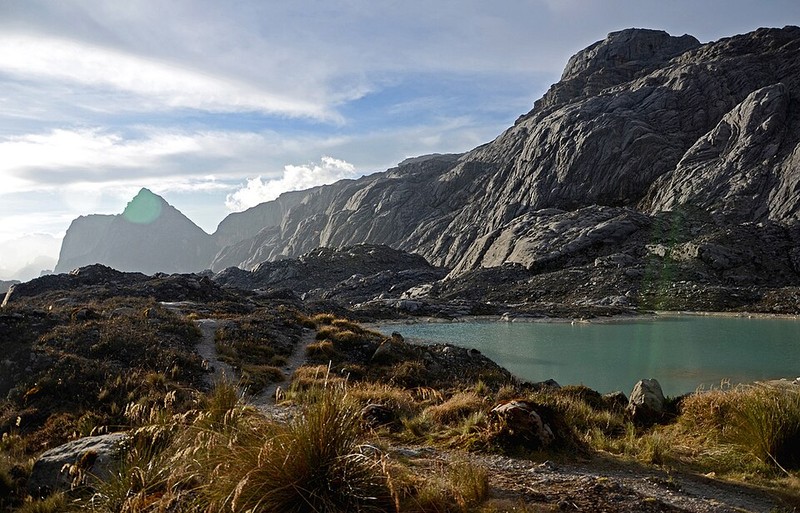
Lorentz National Park is one of the largest protected natural areas in Southeast Asia. It lies on the island of New Guinea in Indonesia’s Papua region and covers approximately 2.35 million hectares. Its vast landscape includes high mountains with glaciers, humid tropical forests, wetlands, rivers, mangroves and the coast of the Arafura Sea.
Lorentz is renowned for its extraordinary range of landscapes and wildlife. It is one of the rare places on Earth where a largely continuous ecological transition survives within a single protected area, extending from high mountain glaciers to a tropical marine environment. In 1999, the park was inscribed on the UNESCO World Heritage List in recognition of its geological significance, ecological integrity and exceptional biodiversity.
Geography and mountain peaks
The park occupies parts of southern and central Indonesian New Guinea, stretching for more than 150 kilometres from the Central Cordillera mountains to lowlands and the Arafura Sea coast. Its terrain ranges from coastal areas close to sea level to peaks reaching approximately 4,884 metres.
The region’s best-known summit is Puncak Jaya, also called Carstensz Pyramid. Located in the Sudirman Range, it is the highest mountain in Indonesia and on the island of New Guinea. The highlands feature harsh weather, dramatic changes in elevation, steep slopes, deep valleys and landforms shaped by ancient glaciation.
The park’s landscape developed where the Australian and Pacific tectonic plates interact. Their collision continues to influence the region’s geology and drives mountain building. Glacial features, including moraines, lakes and valleys carved by moving ice, remain visible in the mountains.
Glaciers in the tropics
One of Lorentz’s most remarkable features is the presence of glaciers close to the equator. Such conditions occur in only a few places around the world. Snow and ice at the highest elevations exist above tropical forests that thrive much farther down the slopes.
The region’s glaciers are important for scientific research because they help researchers study changes in mountain ice systems in a tropical climate. However, they are shrinking rapidly under current climatic conditions. Protecting these glaciers and their associated alpine ecosystems is important for understanding New Guinea’s natural history.
A wide range of ecosystems
Lorentz National Park encompasses numerous natural zones shaped by altitude, temperature and moisture. Lower elevations contain humid tropical forests, river valleys, freshwater swamps and extensive wetlands. Near the coast, mangrove forests and other coastal habitats are linked to the waters of the Arafura Sea.
At middle elevations, mountain rainforests provide habitats for many birds, mammals, insects and other animals. Higher up, forests gradually give way to shorter vegetation, alpine grasslands and cold mountain landscapes. In some locations, conditions are so severe that plant cover becomes sparse.
This combination makes the park especially valuable for science and conservation. Wet lowlands, mountain forests and alpine habitats can be studied within a single protected landscape, along with the connections between them. UNESCO records 34 vegetation types and 29 land systems within the property.
Wildlife and endemic species
Lorentz protects the rich and distinctive wildlife of New Guinea. According to UNESCO, approximately 123 mammal species have been recorded in the area. They include representatives of ancient evolutionary groups, such as the short-beaked echidna and the western long-beaked echidna. The latter is endemic to New Guinea and is adapted to mountain forests and high-altitude environments.
Bird diversity is particularly important. The park supports species with restricted ranges, many of which occur only on New Guinea or in limited parts of the island. Extensive forests and differences between elevation zones provide habitats for a wide variety of specialised species.
Because some areas are remote and the terrain is difficult, the park’s wildlife has not been fully studied. Lorentz is therefore important both for protecting known species and for future scientific research. Its vast size and relatively intact natural habitats help sustain large areas of wilderness.
Vegetation and the ancient history of nature
Plant communities change with elevation and climate. Humid tropical forests dominate the lowlands, while higher areas contain forests with a more temperate character. At great heights, shrubs, grasses and other plants adapted to cold and strong winds survive in exposed conditions.
Southern beech trees of the genus Nothofagus are of particular scientific interest. Their closest relatives occur in cooler parts of Australia, New Zealand and South America. Their presence in tropical New Guinea helps researchers investigate ancient connections between regions of the Southern Hemisphere and climatic changes since the last Ice Age.
Fossil sites within the park also provide evidence of the evolution of life on New Guinea. Geological processes, climate changes and the isolation of mountain areas have contributed to unusual ecological communities and a high level of endemism.
Indigenous peoples and cultural heritage
Indigenous communities live within and around the Lorentz region, maintaining traditional livelihoods and cultural practices. UNESCO identifies several peoples associated with the area, including the Amungme, Moni, Nduga, Dani groups, Asmat, Kamoro and Sempan.
Highland and lowland communities differ in language, traditions, housing and ways of using natural resources. Forests, rivers, mountains and coastal areas have practical as well as cultural significance for local residents. Their knowledge of the environment forms an important part of the region’s heritage.
Conservation must take account of Indigenous communities and their traditional land rights. Protecting the park involves not only preserving plants and animals but also managing the landscape responsibly for the people whose lives depend on it.
UNESCO World Heritage status
Lorentz National Park was inscribed on the UNESCO World Heritage List in 1999. Its international importance rests on three principal qualities: exceptional geological processes, a continuous sequence of natural ecosystems and outstanding biodiversity.
The park’s mountains reveal the effects of tectonic plate collisions and glacial activity. At the same time, the protected landscape preserves a transition from high-altitude ice to tropical forests, wetlands and marine habitats. This makes Lorentz a rare example of a vast natural system containing an extraordinary range of environmental conditions.
World Heritage status supports the long-term protection of the area. Management priorities include safeguarding habitats, monitoring forests and glaciers, preventing illegal logging and poaching, and assessing the effects of infrastructure projects on the natural environment.
Threats and conservation
Despite its enormous size, the park faces significant conservation challenges. These include climate change, shrinking glaciers, illegal logging, poaching and illegal fishing. Roads and other infrastructure may also fragment habitats, disrupt ecological processes and make previously inaccessible areas easier to enter.
The condition of mountain forests and Nothofagus trees receives particular attention. Researchers and conservation organisations continue to investigate the causes of decline in some stands and the need for additional protection. Long-term monitoring helps track ecosystem changes and guide conservation measures.
Visiting the national park
Lorentz is not a conventional tourist park with maintained trails and extensive visitor facilities. Many areas are remote, while rugged terrain, dense forests, swamps and rapidly changing weather make travel difficult. Access to some parts may require special permits, local guides and careful expedition planning.
Before planning a visit, travellers should check current access rules, transport options, permit requirements and safety conditions with the relevant local authorities and park administration. Tourism access is limited and varies by area. Independent journeys into remote mountains and forests can be dangerous without suitable experience and preparation.
For most travellers, Lorentz is primarily a place of outstanding global natural significance. Its value lies in the rare combination of ecosystems, glacial landscapes, endemic wildlife, ancient geology and the cultural heritage of New Guinea’s Indigenous peoples.
Why Lorentz National Park matters
Lorentz demonstrates how varied the natural world of a single island can be. Tropical conditions exist alongside glaciers, mountain forests give way to wetlands, and rich plant and animal life reflects the region’s long geological and evolutionary history.
It is one of Indonesia’s and Southeast Asia’s most important conservation areas. Protecting Lorentz matters not only for rare species and extraordinary landscapes but also for future generations, scientific research and Indigenous communities whose lives remain closely connected to New Guinea’s natural environment.
Gallery