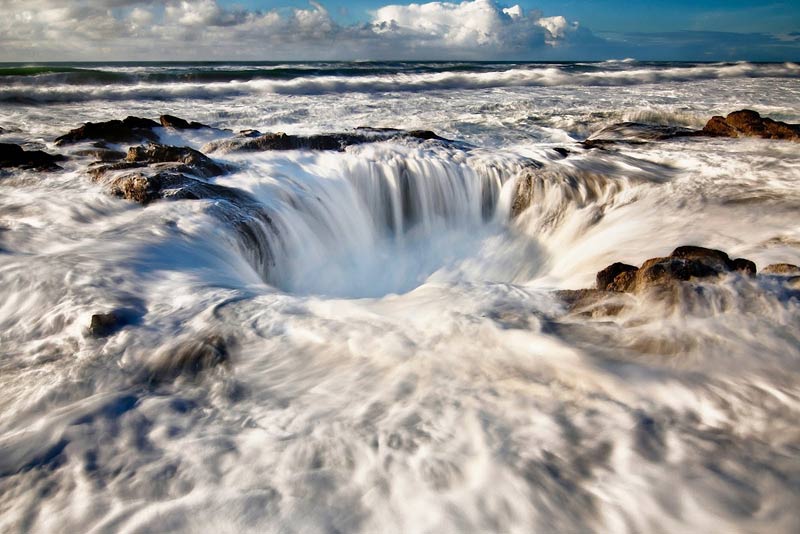
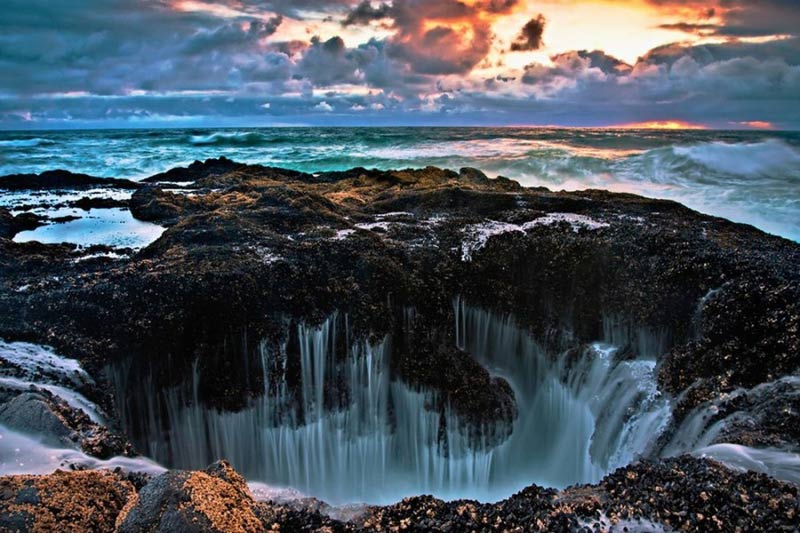
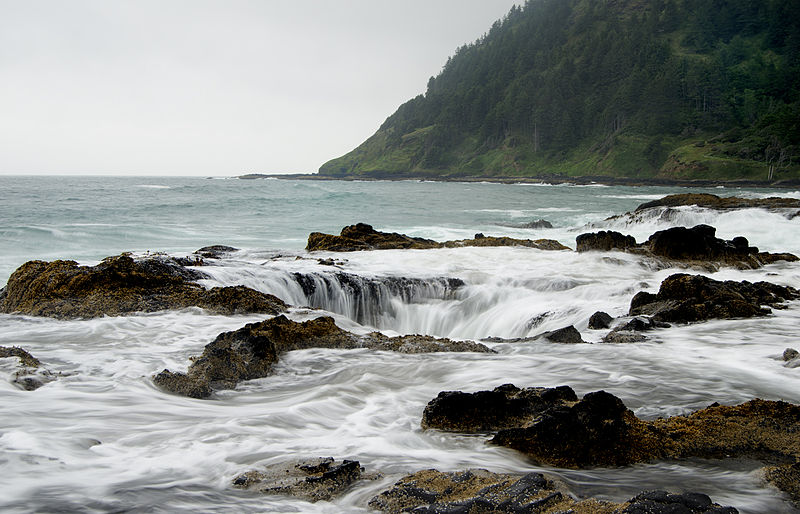
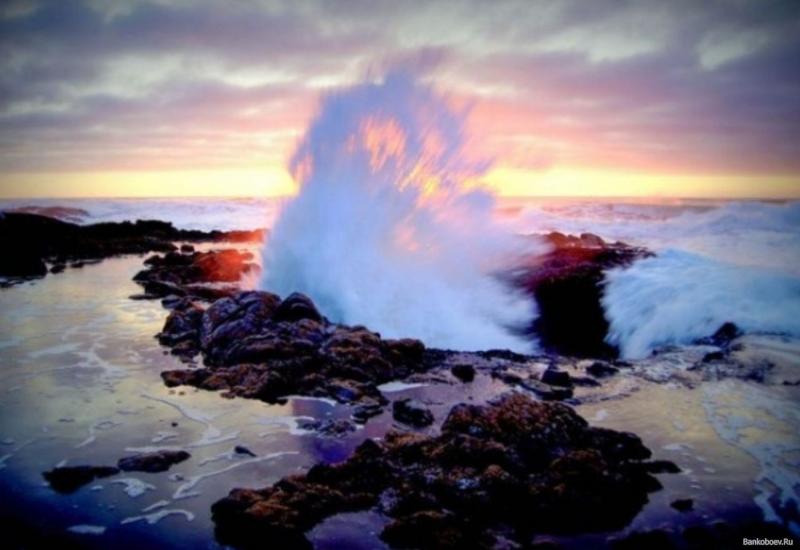
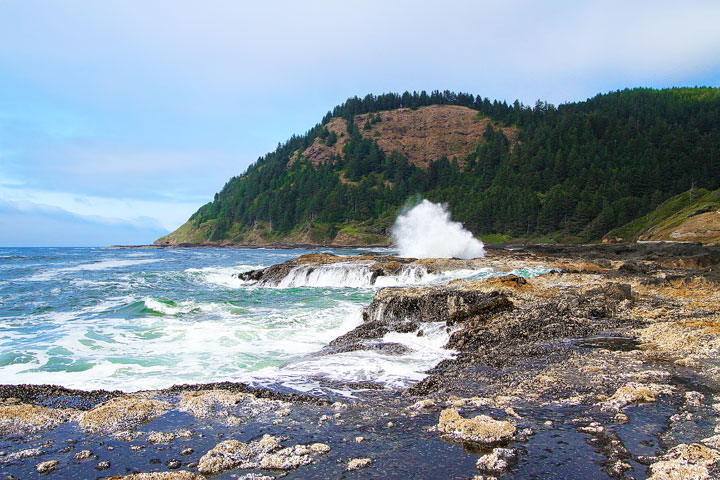
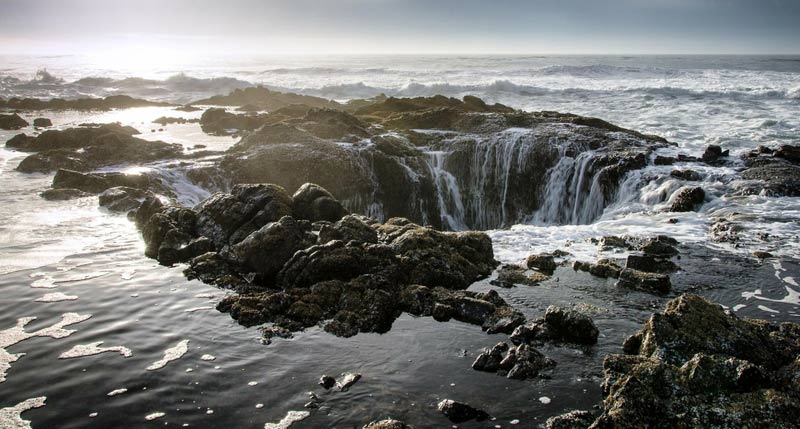
Thor's Well is an unusual natural formation on the Pacific coast of Oregon in the United States. It lies in the scenic Cape Perpetua area near the small coastal town of Yachats. The circular opening in the dark rock appears to swallow seawater, creating the illusion of a bottomless pit. During strong surf, water rushes into the hole, rises through the opening, and bursts into spray.
The site has become one of Oregon's best-known coastal landmarks. Photographs often look almost unreal: a dark hole in black basalt seems to drain the surrounding ocean. In reality, this is a natural feature shaped by waves rather than a mysterious abyss.
Where Thor's Well is located
Thor's Well lies at Cape Perpetua on the central Oregon coast, a few miles south of Yachats. Nearby are Cook's Chasm and Spouting Horn, where waves also enter rocky cavities and force water outward. The area forms part of Cape Perpetua Scenic Area within Siuslaw National Forest.
How Thor's Well formed
The formation is believed to have begun as a sea cave whose roof eventually collapsed. This left an opening in the basalt shore platform that remains connected to the ocean. Waves continue to erode the rock, gradually altering the surface and widening cracks.
At high tide, seawater enters the opening from several directions and through lower passages. As a wave fills the cavity, water surges upward and spills back out before the level drops again. This repeated cycle creates the impression of a giant drain in the ocean floor. Thor's Well is not bottomless; its depth is estimated at roughly 20 feet, or six meters.
When the spectacle is most dramatic
The effect is usually most striking around high tide, when water repeatedly fills the hole and surges out with force. Winter storms can create especially powerful waves, but they also make the coast more dangerous. Check the tide tables for Yachats before visiting. Never step onto wet basalt rocks to get a better photograph.
Cape Perpetua and nearby attractions
A visit to Thor's Well can be combined with stops at Spouting Horn, where water shoots from a rocky cavity, and Cook's Chasm, where waves surge through a narrow fissure. Nearby Devil's Churn is a rocky inlet where surf crashes against the sides of a narrow channel. Viewpoints around Cape Perpetua offer sweeping panoramas of the Pacific, rugged cliffs, and forested hills.
Coastal wildlife and vegetation
The slopes support Sitka spruce, Douglas fir, ferns, mosses, and lichens. Marine mammals inhabit nearby waters, and migrating whales can sometimes be spotted from shore. Tide pools contain sea stars, anemones, mollusks, and other small creatures. Observe them carefully without removing animals from their habitat.
Best time to visit
Thor's Well can be visited throughout the year. Summer weather is often milder, although coastal fog and cool ocean air are common. Autumn and winter usually bring stronger surf, which can make the spectacle more dramatic but also increases the danger. Bring a waterproof jacket, warm layers, and shoes with good traction.
How to get there
The nearest town is Yachats. Cape Perpetua can be reached by US Highway 101. Visitors can use parking areas near Cook's Chasm or follow walking routes from the Cape Perpetua Visitor Center. Short trails lead from the parking areas toward the coast. The drive from Portland generally takes about three hours, while the trip from Eugene takes around two hours, depending on conditions.
Safety precautions
The rocks around Thor's Well can be wet and slippery. Unexpected sneaker waves can surge far beyond the usual waterline and sweep people into the ocean. Watch the formation only from the designated viewpoint and stay on marked trails. Do not walk onto wet rocks, approach the edge of the opening, or turn your back on the sea. Keep children close. Thor's Well is a striking display of the ocean's power, best appreciated from a safe distance.
Gallery