White Desert National Park is one of Egypt’s most unusual natural attractions. It lies in the Western Desert, in the Farafra Depression, roughly 45 km north of Farafra Oasis. White chalk cliffs, stone pillars and formations resembling mushrooms or animals create a landscape very different from the golden dunes commonly associated with the Sahara.
The area is known in Arabic as Sahara el-Beyda, or the White Desert. It was designated a protected area in 2002. Its importance lies in its distinctive geology: chalk deposits formed in an ancient marine environment and were later shaped by wind and other natural processes.
Where is the White Desert?
The protected area lies in western Egypt between the Bahariya and Farafra oases. Many multi-day trips begin in Bahariya, while Farafra is closer to the southern part of the White Desert. Travelling from Cairo takes several hours, so a visit is usually planned as a dedicated trip to the Western Desert.
How the white formations formed
Millions of years ago, this region was covered by an ancient sea. Carbonate sediments, including the remains of microscopic marine organisms, accumulated on the seabed and gradually became chalk and limestone. After the sea receded, wind, sand, temperature changes and erosion sculpted the exposed rock.
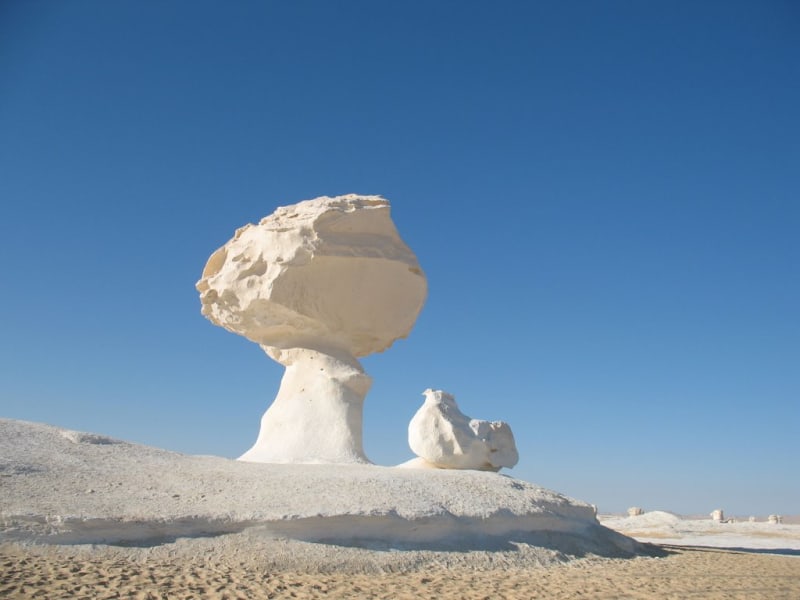
Softer areas wore away more quickly, while harder sections remained as pillars, ridges and shapes resembling mushrooms, towers and animals. The process continues today. These formations are natural sculptures rather than human-made monuments.
Why is the desert white?
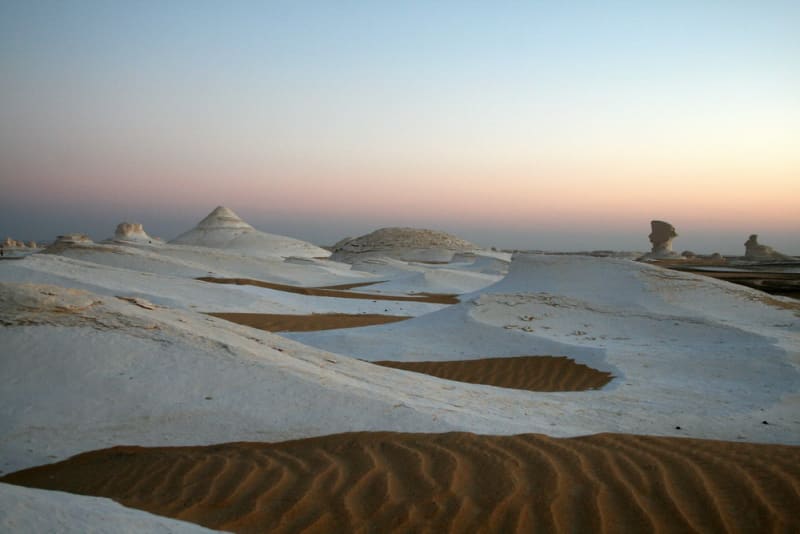
The pale colour comes mainly from chalk and limestone. Against golden sand, the rocks can appear almost snow-white. At sunrise and sunset, they may take on cream, pink or golden tones, while long shadows emphasise their unusual contours.
Unusual rock formations
Some rocks resemble mushrooms with broad caps, birds, animals, sphinxes or abstract sculptures. Names vary between guides because many formations have no official geographical names. The most photogenic features include isolated chalk pillars and groups of rocks rising from the open desert floor.
The White Desert at sunset and at night
At sunset, the rocks gradually shift from cool white to warm cream, pink and gold. An overnight trip offers a chance to experience the desert after dark and see the stars above the open landscape. Many organised tours include dinner at a desert camp, although arrangements depend on the season, weather and reserve rules.
Plants and wildlife
Despite the dry climate, the wider reserve supports desert plants, shrubs and occasional trees, especially where moisture is available. Wildlife adapted to arid conditions includes desert foxes, small mammals, reptiles and birds. Visitors should not disturb animals, leave food or rubbish, or drive away from authorised routes.
The White Desert, Black Desert and Crystal Mountain
Trips often combine the White Desert with the Black Desert, where dark rocks contrast sharply with the pale chalk landscape. Another popular stop is Crystal Mountain, a rocky feature with visible crystalline minerals. Despite its name, it is not a giant mountain made entirely of precious crystals. Some itineraries also include the Agabat Valley and other geological sites.
What a desert safari is like
Most visitors explore the White Desert on an organised four-wheel-drive safari. Depending on the itinerary, the trip may include stops at unusual rock formations, photography breaks, nearby geological attractions and an overnight camp. A day trip covers some highlights, while an overnight excursion allows more time to enjoy changing light and the night sky.
How to get there
From Cairo, travellers usually head to Bahariya or Farafra Oasis and continue by four-wheel-drive vehicle with a local driver or guide. Driving into the desert independently in an ordinary car is not recommended. Before departure, confirm access rules, permit requirements and safety arrangements with the tour operator or local authorities.
When to visit and what to bring
Cooler months are generally more comfortable for desert travel. Early morning and late afternoon offer the best light for photography. Bring sturdy closed shoes, a hat, sunglasses, sunscreen and plenty of drinking water. Warm clothing is important for overnight trips because temperatures can drop considerably after sunset.
Do not leave rubbish, damage the formations, remove rocks or fossils, or leave the agreed route without a guide. White Desert National Park is a remarkable natural landscape where geological history, unusual chalk sculptures and the stillness of the Sahara combine to create one of Egypt’s most memorable outdoor experiences.
Gallery