A symbol of freedom in New York Harbor
The Statue of Liberty is one of the world's most recognizable landmarks and a symbol of freedom, hope and opportunity. It stands on Liberty Island in New York Harbor, near Manhattan. The female figure holding a torch in her right hand and a tablet in her left has become one of the defining images of the United States and a symbol for generations of people who arrived in America seeking a new life.
The monument's official name is Liberty Enlightening the World. France gave it to the United States as a gesture of friendship. It was dedicated on October 28, 1886, and designated a National Monument in 1924. Today it is part of the Statue of Liberty National Monument, which also includes nearby Ellis Island.
The creation of the monument
The idea emerged in France during the nineteenth century. One of its leading advocates was Édouard René de Laboulaye, a political thinker who supported republican ideals and the American struggle for independence. French sculptor Frédéric Auguste Bartholdi designed the monument as a classical female figure carrying a torch and a tablet. Engineer Gustave Eiffel contributed to the design of its internal metal framework.
The copper sections were manufactured in France, and the statue was shipped across the Atlantic in pieces. In the United States, workers built the pedestal and assembled the monument. The project required extensive fundraising on both sides of the ocean.
Dedication and meaning
The statue was dedicated on October 28, 1886. Over time, it became one of America's most powerful symbols. Its silhouette greeted ships entering New York Harbor, and for many immigrants it represented the possibility of beginning a new life.
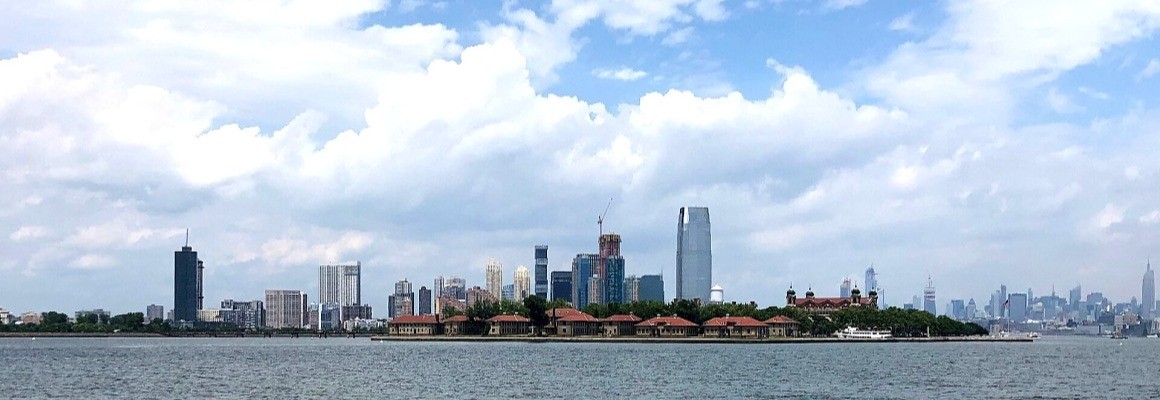
Nearby Ellis Island operated as a major federal immigration station from 1892 to 1954. Millions of people passed through its halls. The Statue of Liberty is on Liberty Island, while the immigration museum is on Ellis Island, but their histories are closely connected through migration and the search for opportunity.
Architecture and dimensions
The monument stands about 93 metres tall from the ground to the tip of the torch, including its pedestal. The copper figure itself is approximately 34 metres high. Its thin copper sheets are attached to a metal framework. The copper was originally reddish brown, but exposure to air and moisture gradually created a green patina that helps protect the metal from further corrosion.
The torch, crown and tablet
The raised torch represents enlightenment. The current copper flame is covered with 24-karat gold and was installed during the restoration for the statue's centennial in 1986. The original torch is displayed in the Statue of Liberty Museum.
The tablet in the statue's left hand bears the date of American independence, July 4, 1776, in Roman numerals. The seven rays of the crown are traditionally interpreted as representing freedom shining across the seven seas and continents. Broken chains at the figure's feet symbolise liberation from oppression.
The pedestal and Liberty Island
The statue stands on a massive pedestal built on the former Fort Wood. Designed by architect Richard Morris Hunt, the pedestal was funded separately from the statue itself. The island offers views of Manhattan, New York Harbor and neighbouring Ellis Island.
The Statue of Liberty was inscribed on the UNESCO World Heritage List in 1984. Restoration work for the centennial renewed parts of the structure and replaced the torch. The monument is now managed by the U.S. National Park Service.
The Statue of Liberty Museum
The museum on Liberty Island explores Bartholdi's design, engineering decisions, the manufacture of the copper shell and the shipment of the statue from France to the United States. Exhibits include historic documents, photographs, models and objects related to restoration. A major exhibit is the original torch, removed in 1984.
Museum admission is included with the standard ferry ticket, with no separate entrance fee. The museum's upper terrace provides views of the statue and the harbour.
Can visitors go inside the statue?
Visitors may buy tickets for the pedestal or crown when places are available. Reaching the crown requires climbing a long staircase, including a narrow spiral section inside the figure. The torch is not open to the public. Access to the pedestal and crown depends on safety rules and ticket availability, so reservations should be made well in advance.
Ellis Island and immigration history
A visit is often combined with a stop at Ellis Island. Its historic building now houses the National Museum of Immigration, where documents, photographs and personal stories tell the experiences of people who came to the United States. Together, the two islands provide insight into American history and the immigrant experience.
How to get there
Liberty Island can only be reached by the authorised Statue City Cruises ferry. Boats depart from The Battery in southern Manhattan or Liberty State Park in Jersey City, New Jersey. Tickets generally include round-trip transportation and stops at both Liberty Island and Ellis Island. Buying tickets in advance from the official operator is recommended.
Passengers must pass through security screening before boarding. Arrive early, check the ferry schedule and plan to return to the same side of the harbour from which you departed.
When to visit
The monument is open to visitors for most of the year, but conditions on the island can be windier and cooler than in central New York. Spring and autumn are often comfortable for walking, summer can be hot and humid, and winter brings cold winds off the water. Allow several hours to explore both islands.
Visitor tips
Wear comfortable shoes, bring water and dress for the weather. Check availability for crown or pedestal tickets and review security rules before travelling. Avoid unofficial street sellers: only the authorised ferry operator can land passengers on the islands.
Why visit the Statue of Liberty?
The Statue of Liberty is both an engineering achievement and a monument of lasting historical significance. Its design combines artistic symbolism with an innovative structure, while its story connects France and the United States with the history of immigration. Visiting the islands offers a close view of the monument, insight into its construction and memorable views of New York Harbor.
Gallery